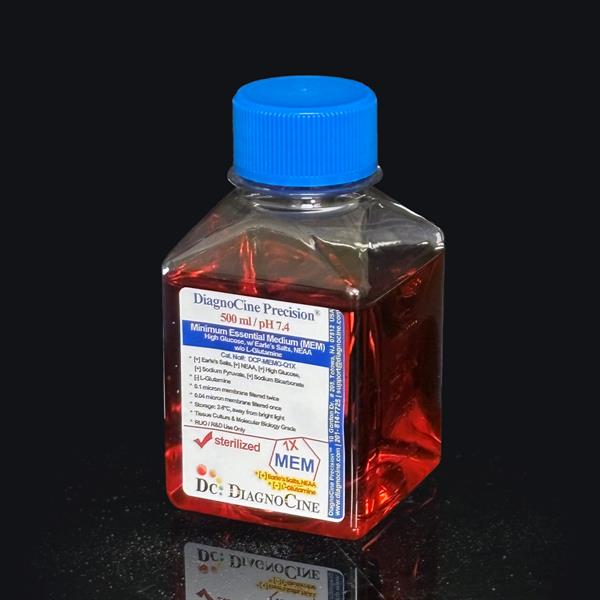
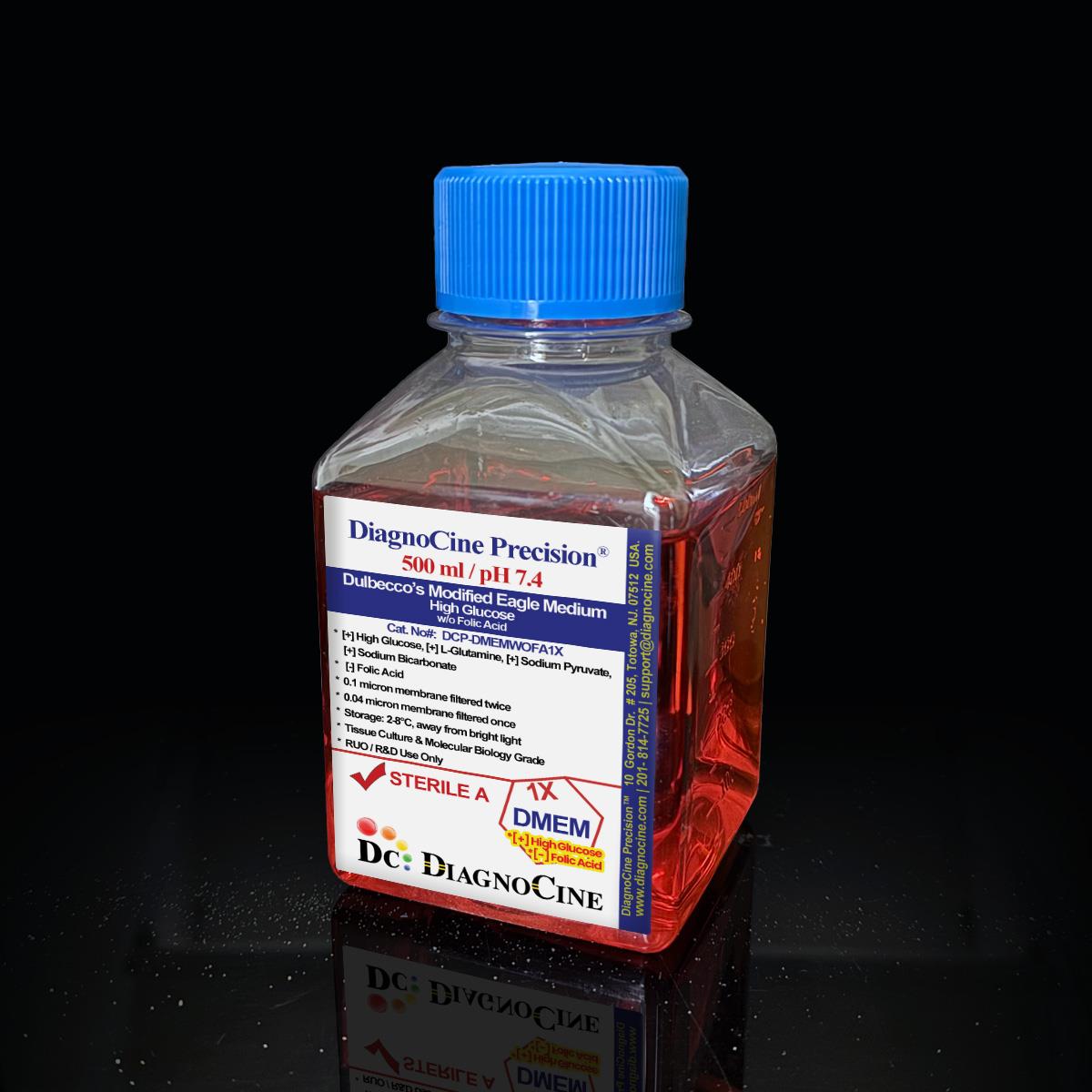
FluxMPS™ Dulbecco’s Modified Eagle Medium (DMEM), High Glucose w/o Folic Acid: 1X Liquid
FluxMPS™ Dulbecco’s Modified Eagle Medium (DMEM), High Glucose w/o Folic Acid: 1X Liquid
FluxMPS™ DCP-DMEMWOFA1X is a Microfluidics Suitable, quadruple-stage ultra-filtered (0.1 µm ×2 + 0.04 µm ×2) DMEM High Glucose — Folic Acid–Free formulation engineered for DHFR-based selection and gene amplification research. It carries the same high-glucose, L-glutamine, sodium pyruvate and sodium bicarbonate formulation as standard DMEM High Glucose, with folic acid intentionally omitted. A quadruple-stage train (0.1 µm ×2 + 0.04 µm ×2) reaches a 0.04 µm final cut-off, five times finer than the 0.22 µm membranes used for conventional sterile filtration.
- Folic acid–free formulation — creates the selective pressure required for DHFR-mediated gene amplification in CHO-DHFR-deficient cell lines
- Compatible with methotrexate (MTX) step-selection protocols for recombinant protein expression amplification
- All other High Glucose DMEM nutrients intact: 4500 mg/L D-glucose, 584 mg/L L-glutamine, 110 mg/L sodium pyruvate, 3700 mg/L sodium bicarbonate
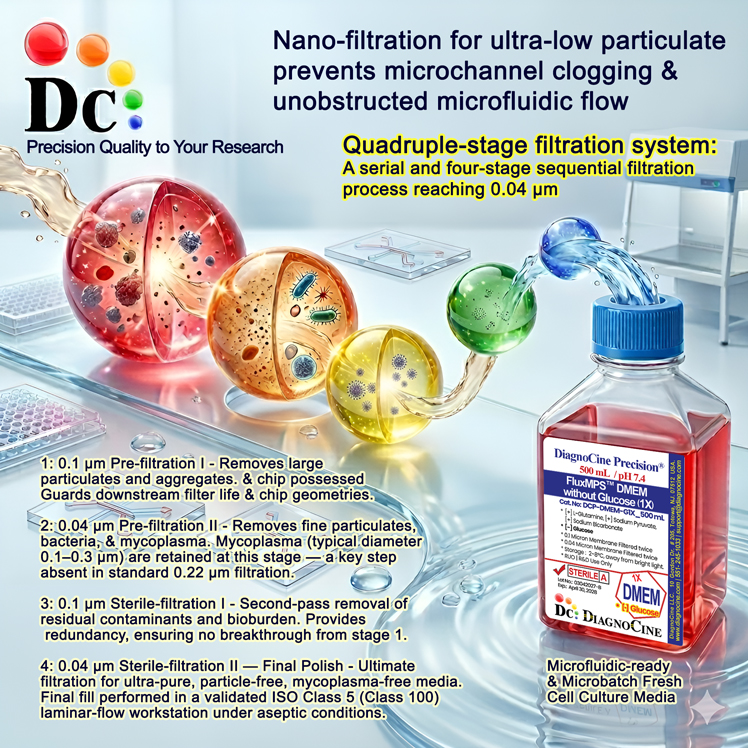
- Quadruple-stage filtration (0.1 µm Prefiltration I → 0.04 µm Final filtration I → 0.1 µm Prefiltration II → 0.04 µm Final filtration II — Polish)
- Endotoxin release specification < 0.05 EU/mL (LAL, USP <85>), tested per manufacturing batch
- Sodium bicarbonate-buffered (3700 mg/L); formulated for a 10% CO₂ incubator atmosphere at pH 7.4
- Manufactured under an ISO 13485:2016 quality management system with per-lot Certificate of Analysis
- Custom formulation modifications available on request — pH, salts, and nutrient adjustments
- Glucose4500 mg/L (4.5 g/L, High Glucose)
- Key featureFolic Acid–Free
- Formulation[+] L-Glutamine, [+] Sodium Bicarbonate, [+] Phenol Red, [+] Calcium, [+] Magnesium, [+] Glucose (High), [+] Sodium Pyruvate, [-] Folic Acid
- AppearanceRed-colored (phenol red indicator), clear solution
- pH (USP <791>)7.4
- Osmolality (USP <785>)310–350 mOsm/kg H2O
- Endotoxin (USP <85>)< 0.05 EU/mL
- Filtration0.1 µm ×2 + 0.04 µm ×2 (4 stages)
- Storage2–8°C, away from light
- Shelf Life12 months from date of manufacture, unopened
Engineered for DHFR selection and folate metabolism research
Standard DMEM High Glucose contains folic acid — a substrate cells can use to bypass dihydrofolate reductase (DHFR) dependency. Removing folic acid creates the selective pressure needed for DHFR-mediated gene amplification, methotrexate step selection, and any study where folate pathway activity must be controlled. FluxMPS™ delivers this folic acid–free formulation through the full quadruple-stage filtration train, with a < 0.05 EU/mL endotoxin release specification, for use in CHO cell lines and microfluidic bioproduction models.
Microchannel-safe purity
0.04 µm final filtration and USP <788> Method 1 particulate compliance support safe perfusion in narrow chip geometries, including sub-100 µm channels.
Precise formulation control
Folic Acid–Free — a defined omission that enables DHFR selection, MTX step-selection, and folate pathway research requiring exact control of this single component.
Ultrapure-grade water
Ultrapure Type 1 water (18.2 MΩ·cm, ASTM D1193 / ISO 3696) minimizes trace-metal and organic-carbon background that could interfere with sensitive assays.
Low endotoxin release specification
< 0.05 EU/mL endotoxin release specification, tested per batch by LAL assay, helps reduce the risk of LPS-driven inflammatory signaling confounding sensitive culture readouts.
High-glucose energy support
4.5 g/L D-glucose sustains the energy demands of CHO bioproduction and other high-metabolic-rate protocols targeted by this formulation.
Customization on demand
pH, glucose, salts, and additional component modifications available. Contact support@diagnocine.com.
Quadruple-stage filtration system
-
1
0.1 µm Prefiltration I
Removes large aggregates, cell debris and protein aggregates; protects the first 0.04 µm cartridge from fouling.
-
2
0.04 µm Final filtration I
First 0.04 µm pass; retains mycoplasma (0.2–0.3 µm) and sub-micron particulates that pass a standard 0.22 µm filter.
-
3
0.1 µm Prefiltration II
A second, dedicated prefilter protecting the second 0.04 µm cartridge — not a polish of Stage 2 effluent, but redundant protection for the final filter.
-
4
0.04 µm Final filtration II — Polish
Ultimate polishing filter prior to aseptic fill & finish.
Performance vs. conventional media
© Diagnocine® — DCP-DMEMWOFA1X
Specialized applications requiring Folic Acid–Free medium
FluxMPS™ DCP-DMEMWOFA1X is designed for research protocols where folic acid–free conditions are essential — combined with Microfluidics Suitable filtration purity for organ-on-a-chip and microfluidic platform compatibility.
Automated Bioreactors & Robotics
An optional 0.01 µm (10 nm) ultra nano-filtered MPS Grade variant of this formulation is available for automated bioreactor perfusion and robotic liquid handlers — a separate six-stage process beyond the Microfluidics Suitable line described on this page.
- Total Particulate Exclusion: 10 nm filtration removes nanoparticulate aggregates invisible to standard QC
- Valve & Sensor Protection: Reduces micro-fouling risk in automated perfusion circuits
- Extended Perfusion Stability: Supports consistent nutrient delivery over long-duration culture
Inquiry Required: Contact support@diagnocine.com for the 0.01 µm MPS Grade variant.
Organ-on-a-Chip & Microphysiological Systems (MPS)
Quadruple-stage 0.04 µm filtration helps prevent microchannel clogging. Folic Acid–Free formulation is Microfluidics Suitable for specialized OoC protocols requiring folate-pathway control.
CHO Bioproduction
FluxMPS™ DCP-DMEMWOFA1X delivers Folic Acid–Free conditions with Microfluidics Suitable filtration purity for demanding CHO bioproduction platforms.
DHFR Gene Amplification
Folic Acid–Free conditions support DHFR-mediated gene amplification workflows in CHO-DHFR-deficient cell lines.
Methotrexate Selection
Compatible with stepwise MTX selection protocols used to drive transgene copy number and expression level.
Recombinant Protein Expression
Supports recombinant protein expression platforms that rely on DHFR/MTX amplification for high-titer production.
Folate Metabolism Research
A defined folic acid–free background for studies of folate pathway activity, one-carbon metabolism and related signaling.
Analytical release specifications
Every lot released against the full specification matrix below. Available pack sizes: 500 mL, 1000 mL. Certificate of Analysis: support@diagnocine.com.
| Parameter | Specification |
|---|---|
| Formulation | [+] L-Glutamine, [+] Sodium Bicarbonate, [+] Phenol Red, [+] Calcium, [+] Magnesium, [+] Glucose (High), [+] Sodium Pyruvate, [-] Folic Acid |
| Appearance | Red-colored (phenol red indicator), clear solution |
| Glucose | 4500 mg/L (4.5 g/L, High Glucose) |
| Key feature | Folic Acid–Free |
| pH USP <791> | 7.4 |
| Osmolality USP <785> | 310–350 mOsm/kg H2O |
| Total ingredients | 32 components across 3 tabbed categories |
| Parameter | Specification |
|---|---|
| Endotoxin USP <85> BET | < 0.05 EU/mL (batch release spec.) |
| Sterility USP <71> | No growth / 14 days |
| Mycoplasma | 0.1 µm mycoplasma-retentive filtration (not tested per lot) |
| Particulate ≥10 µm USP <788> Method 1 | NMT 25/mL |
| Particulate ≥25 µm USP <788> Method 1 | NMT 3/mL |
| Water purity | Type 1, 18.2 MΩ·cm |
| Manufacturing std. | ISO 13485:2016 |
| Fill environment | ISO Class 5 (Class 100) aseptic fill |
| Parameter | Specification |
|---|---|
| Storage temperature | 2–8°C, away from light |
| Freeze-thaw | Do not freeze |
| Shelf life | 12 months from date of manufacture, unopened |
| Shipping condition | Cold pack |
| CO₂ requirement | 10% CO₂ incubator atmosphere (derived from 3700 mg/L sodium bicarbonate buffering at pH 7.4) |
| Parameter | Specification |
|---|---|
| Raw material grade | Reagent / cell culture grade |
| Traceability | Full lot traceability per ISO 13485 |
| Manufacturing QMS ISO | ISO 13485:2016 certified |
| UNSPSC | 41116155 — Molecular biology and cell culture growth media (UNv260801) |
| Regulatory alignment | 21 CFR Part 820 (QMSR) aligned |
| Production method | Micro-batch, per-lot QC release |
| Intended use | Research Use Only (RUO) |
Full composition (mg/L)
DMEM High Glucose — Folic Acid–Free: 32 ingredients verified per lot with CAS numbers for full raw-material traceability. Folic acid is intentionally absent from this formulation; do not add folic acid unless ending the selection period. All other vitamins, amino acids and inorganic salts are present at standard DMEM High Glucose concentrations.
| Component | CAS Number | mg/L |
|---|---|---|
| INORGANIC SALTS | ||
| Calcium chloride dihydrate | 10035-04-8 | 265.000 |
| Ferric nitrate nonahydrate | 7782-61-8 | 0.100 |
| Magnesium sulfate anhydrous | 7487-88-9 | 97.720 |
| Potassium chloride | 7447-40-7 | 400.000 |
| Sodium bicarbonate | 144-55-8 | 3700.000 |
| Sodium chloride | 7647-14-5 | 6400.000 |
| Sodium dihydrogen phosphate anhydrous | 7558-80-7 | 109.000 |
| Component | CAS Number | mg/L |
|---|---|---|
| AMINO ACIDS | ||
| Glycine | 56-40-6 | 30.000 |
| L-Arginine hydrochloride | 1119-34-2 | 84.000 |
| L-Cystine dihydrochloride | 30925-07-6 | 62.570 |
| L-Glutamine | 56-85-9 | 584.000 |
| L-Histidine hydrochloride monohydrate | 5934-29-2 | 42.000 |
| L-Isoleucine | 73-32-5 | 105.000 |
| L-Leucine | 61-90-5 | 105.000 |
| L-Lysine hydrochloride | 657-27-2 | 146.000 |
| L-Methionine | 63-68-3 | 30.000 |
| L-Phenylalanine | 63-91-2 | 66.000 |
| L-Serine | 56-45-1 | 42.000 |
| L-Threonine | 72-19-5 | 95.000 |
| L-Tryptophan | 73-22-3 | 16.000 |
| L-Tyrosine Disodium Salt dihydrate | 69847-15-0 | 103.790 |
| L-Valine | 72-18-4 | 94.000 |
| Component | CAS Number | mg/L |
|---|---|---|
| VITAMINS | ||
| Choline chloride | 67-48-1 | 4.000 |
| D-Ca-Pantothenate | 137-08-6 | 4.000 |
| Nicotinamide | 98-92-0 | 4.000 |
| Pyridoxal hydrochloride | 65-22-5 | 4.000 |
| Riboflavin | 83-88-5 | 0.400 |
| Thiamine hydrochloride | 67-03-8 | 4.000 |
| i-Inositol | 87-89-8 | 7.200 |
| OTHERS | ||
| D-Glucose | 50-99-7 | 4500.000 |
| Phenol red sodium salt | 34487-61-1 | 15.900 |
| Sodium pyruvate | 113-24-6 | 110.000 |
Manufacturing & compliance
Every FluxMPS™ product is manufactured and released under a rigorous multi-layer quality system.
ISO 13485:2016 Quality Management
Manufactured under ISO 13485:2016–certified facilities. Final QA at Diagnocine R&D Center, Totowa, NJ, USA.
Ultrapure Type 1 Water
18.2 MΩ·cm feed water, minimizing trace-metal and organic-carbon background.
ISO Class 5 Fill & Finish
Aseptic fill in validated ISO Class 5 (Class 100) laminar-flow workstations.
Micro-Batch Precision
Small-batch, per-lot tested — no blending; a Certificate of Analysis is issued for every lot.
Endotoxin — USP <85> BET
LAL assay; release specification < 0.05 EU/mL per manufacturing batch.
Particulate — USP <788> Method 1
Light obscuration: NMT 25/mL (≥10 µm), NMT 3/mL (≥25 µm).
Osmolality — USP <785>
Target: 310–350 mOsm/kg H2O.
Documentation & CoA
Full CoA with raw-material traceability available for every lot on request.
- Endotoxin — LAL assay, USP <85> Bacterial Endotoxins Test; assay sensitivity 0.005 EU/mL; release specification < 0.05 EU/mL
- pH, osmolality, conductivity, appearance and clarity
- Sterility
How DCP-DMEMWOFA1X compares
FluxMPS™ DCP-DMEMWOFA1X vs. conventional 0.22 µm–filtered DMEM High Glucose formulations.
| Parameter | DCP-DMEMWOFA1X (FluxMPS™) | Conventional DMEM HG (0.22 µm filtered) |
Standard DMEM HG (0.22 µm filtered) |
|---|---|---|---|
| Grade | Microfluidics Suitable | Not applicable | Not applicable |
| High Glucose DMEM without Folic Acid — DHFR selection, gene amplification, folate metabolism studies | check_circle Yes | cancel No | cancel No |
| Final filtration pore size | 0.04 µm | 0.22 µm | 0.22 µm |
| Number of filtration stages | 4 (Quadruple) | 1 | 1 |
| Mycoplasma-retentive filtration | check_circle Yes (0.1 µm) | cancel No | cancel No |
| Endotoxin (release specification) | FluxMPS™ — < 0.05 EU/mL | Corning classical liquid media — < 0.25 EU/mL Sigma-Aldrich DMEM complete medium — ≤ 2 EU/mL Gibco classical DMEM — Not specified (recorded per lot) |
|
| USP <788> particulate tested | check_circle Yes | cancel No | cancel No |
| Water quality | Type 1, 18.2 MΩ·cm | Purified water | Purified water |
| Manufacturing QMS | ISO 13485:2016 | ISO 9001 or none | ISO 9001 or none |
| Microfluidic channel compatibility | check_circle Microfluidics Suitable | cancel Risk of clogging | cancel Risk of clogging |
| Custom formulation | check_circle Available | cancel Fixed | cancel Fixed |
Comparison figures from published supplier specifications, accessed 2026-09-02. Suppliers that publish no numeric endotoxin specification are shown as "Not specified".
Frequently asked questions
Common questions about FluxMPS™ DCP-DMEMWOFA1X — DMEM High Glucose Folic Acid–Free.
Supporting literature
Key publications supporting the research applications of FluxMPS™ DCP-DMEMWOFA1X.
- Urlaub G, Chasin LA. Isolation of Chinese hamster cell mutants deficient in dihydrofolate reductase activity. Proc Natl Acad Sci USA. 1980;77:4216–4220. doi:10.1073/pnas.77.7.4216
- Kaufman RJ, Sharp PA. Amplification and expression of sequences cotransfected with a modular dihydrofolate reductase complementary DNA gene. J Mol Biol. 1982;159:601–621. doi:10.1016/0022-2836(82)90103-6
- Wurm FM. Production of recombinant protein therapeutics in cultivated mammalian cells. Nat Biotechnol. 2004;22:1393–1398. doi:10.1038/nbt1026
- Huh D, et al. Reconstituting organ-level lung functions on a chip. Science. 2010;328:1662–1668. doi:10.1126/science.1188302
- Bhatia SN, Ingber DE. Microfluidic organs-on-chips. Nat Biotechnol. 2014;32:760–772. doi:10.1038/nbt.2989
- Novak R, et al. Robotic fluidic coupling and interrogation of multiple vascularized organ chips. Nat Biomed Eng. 2020;4:407–420. doi:10.1038/s41551-019-0497-x
- Locasale JW. Serine, glycine and the one-carbon cycle: cancer metabolism in full circle. Nat Rev Cancer. 2013;13:572–583. doi:10.1038/nrc3557
- Ducker GS, Rabinowitz JD. One-carbon metabolism in health and disease. Cell Metab. 2017;25:27–42. doi:10.1016/j.cmet.2016.08.009
- Sung JH, et al. Microfabricated mammalian organ systems and their integration into models of whole animals and humans. Lab Chip. 2013;13:1201–1212. doi:10.1039/c3lc41017j