

- Home
- Dulbecco's Modified Eagle Medium (DMEM), 25mM HEPES w/o Glucose, Sodium Pyruvate Sodium Bicarbonate, Phenol Red: 1X Liquid
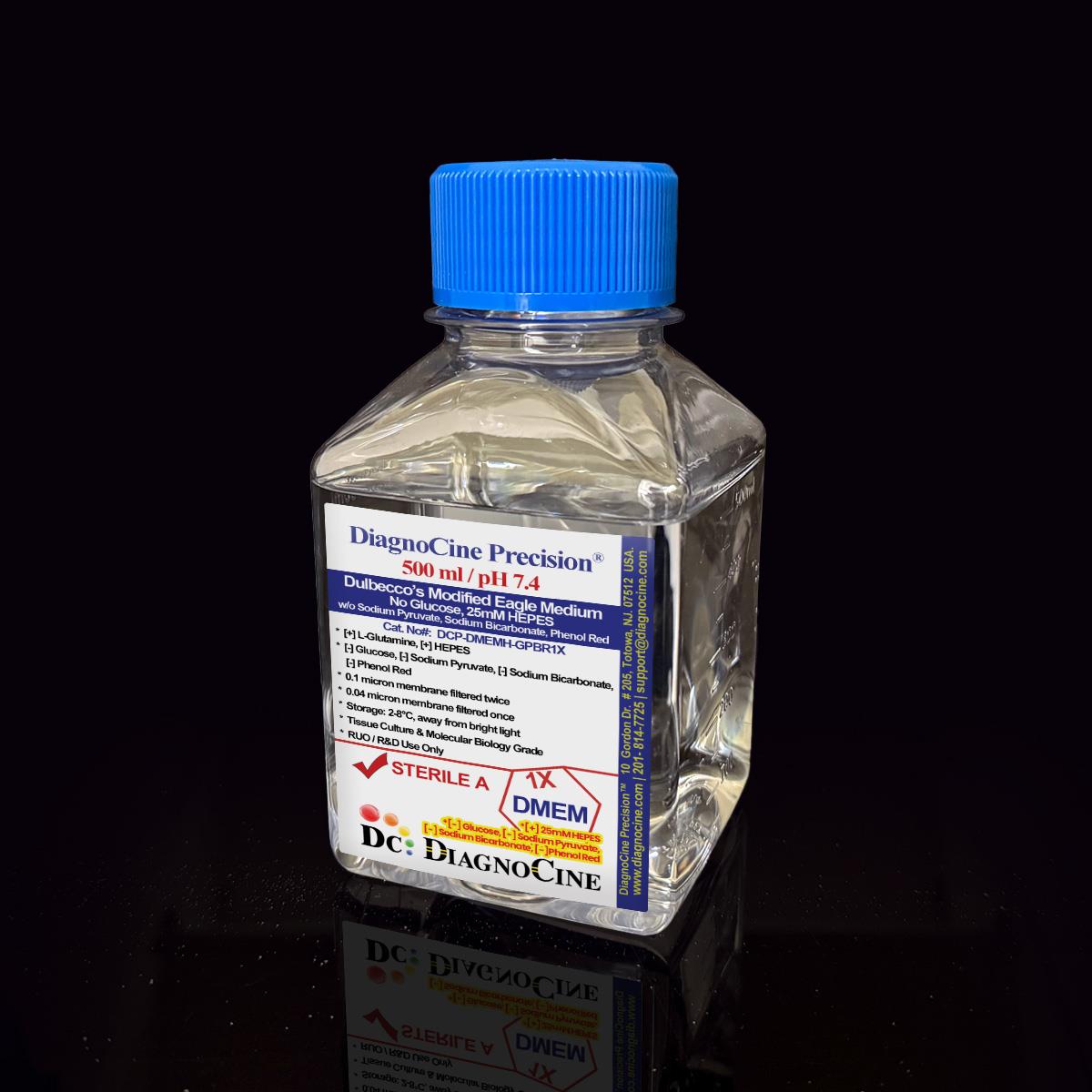
Dulbecco's Modified Eagle Medium (DMEM), 25mM HEPES w/o Glucose, Sodium Pyruvate Sodium Bicarbonate, Phenol Red: 1X Liquid
FluxMPS™ Dulbecco's Modified Eagle Medium (DMEM), 25mM HEPES w/o Glucose, Sodium Pyruvate, Sodium Bicarbonate, Phenol Red: 1X Liquid
This FluxMPS™ DMEM formulation is Microfluidics Suitable, ultra-filtered through Diagnocine's quadruple-stage filtration train (0.1 µm ×2 + 0.04 µm ×2) to a 0.04 µm final cut-off — engineered for microfluidic channels, organ-on-a-chip (OoC) and microphysiological system (MPS) platforms. Buffered with 25 mM HEPES and formulated without glucose, sodium pyruvate, sodium bicarbonate, or phenol red, it is a defined basal platform that gives investigators full control over carbon source for metabolic and nutrient-restriction research.
- Glucose-free, sodium pyruvate-free, and sodium bicarbonate-free basal formulation for studying cellular metabolism under nutrient-restricted or carbon-source-defined conditions
- 25 mM HEPES buffering (5958 mg/L) helps stabilize pH outside strict CO₂-controlled incubator environments
- L-Glutamine retained at 584 mg/L (≈4 mM) for direct use without additional glutamine supplementation
- Quadruple-stage filtration — 0.1 µm membrane twice and 0.04 µm membrane twice — exceeding a standard single-pass 0.22 µm filtration process
- Phenol red-free formulation removes a source of background absorbance/fluorescence for optical, biosensor, and imaging-based assays
- Manufactured under an ISO 13485:2016-aligned quality management system; final packaging, QC and customization performed at Diagnocine Precision, Totowa, NJ
- Batch-release endotoxin specification: less than 0.05 EU/mL (LAL, USP <85>)
- Custom pH, reintroduction of glucose/pyruvate/bicarbonate, and other supplement formulations available on request
- GlucoseNone / Not added
- L-Glutamine584 mg/L (≈4 mM)
- Sodium PyruvateNone / Not added
- Sodium BicarbonateNone / Not added
- HEPES5958 mg/L (25 mM)
- pH (USP <791>)7.4
- Osmolality (USP <785>)310 - 350 mOsm/kg
- Endotoxin (USP <85>)< 0.05 EU/mL
- FiltrationQuadruple-stage: 0.1 µm ×2 + 0.04 µm ×2
- Shelf Life12 months from date of manufacture, unopened
Engineered where standard media fails
Conventional 0.22 µm filtered media leave mycoplasma-scale organisms, sub-micron particulates, and protein aggregates behind — a tolerable margin in a flask, but a direct threat to narrow microfluidic channels, sensor surfaces, and optical assays. FluxMPS™ media are processed further to remove what a standard filter cannot.
Microchannel-safe purity
Quadruple-stage filtration to a 0.04 µm final cut-off removes sub-micron particulates and aggregates that a standard 0.22 µm filter cannot, protecting narrow microfluidic channels and sensor surfaces from clogging and drift.
Total metabolic control
Formulated without glucose, sodium pyruvate, or sodium bicarbonate, this basal medium places carbon source entirely under investigator control — suited to Warburg-effect, nutrient-restriction, and stem cell metabolic studies. L-Glutamine (584 mg/L) is retained for direct use.
High-purity process water
Formulated using process water controlled for trace metals and organic carbon content, supporting reproducible, low-background cell culture performance batch to batch.
Low background for imaging
Quadruple-stage filtration reduces particulate load below that of conventional 0.22 µm media, supporting cleaner fields of view for confocal microscopy and optical biosensor work. Riboflavin, a native DMEM component, contributes its own fluorescence independent of filtration.
Rich, stable nutrient profile
Built on Basal Medium Eagle (BME) with four-fold concentrations of amino acids and vitamins, plus glycine, serine, and ferric nitrate, and released on a per-lot, micro-batch basis.
Customization on demand
Need glucose, sodium pyruvate, sodium bicarbonate, or phenol red reintroduced, a different pH, or another concentration? Contact support@diagnocine.com.
Quadruple-stage filtration system
Every FluxMPS™ Sterile-processed medium passes through a validated, four-pass filtration train — two dedicated prefilter/final-filter pairs in series — reaching a 0.04 µm final pore size well below the mycoplasma-retentive 0.1 µm grade and the industry-conventional 0.22 µm grade.
- 1
0.1 µm Prefiltration I
Removes large particulate, cell debris, and protein aggregates, protecting the first 0.04 µm cartridge downstream.
- 2
0.04 µm Final filtration I
First 0.04 µm pass; retains sub-micron particulates and microaggregates that a 0.22 µm filter would pass through.
- 3
0.1 µm Prefiltration II
A second, dedicated prefilter protecting the second 0.04 µm cartridge — not a polish of the first pass, but redundant protection for the second.
- 4
0.04 µm Final filtration II — Polish
Ultimate polishing filter prior to aseptic fill and finish.
Performance vs. conventional media
Each 0.04 µm final filter is protected by its own dedicated 0.1 µm prefilter — two full prefilter/final-filter pairs run in series, rather than a single descending cascade.

© Diagnocine® — DCP-DMEMH-GPBR1X
Where this formulation is used
A glucose-free, pyruvate-free, bicarbonate-free, HEPES-buffered basal medium supports research where carbon source, buffering system, and optical background must be defined by the investigator rather than fixed by the formulation.
Automated Bioreactors & Robotics
For automated perfusion systems, closed-loop bioreactors, and robotic liquid handling where valve and sensor fouling drive downtime, Diagnocine also offers an optional 0.01 µm (10 nm) ultra nano-filtered MPS Grade variant of this formulation — a distinct, six-stage cascade beyond the Microfluidics Suitable 0.04 µm line described on this page.
- Total Particulate Exclusion — six-stage cascade down to 0.01 µm for the most sensitive automated flow paths
- Valve & Sensor Protection — minimizes fouling of microvalves, flow sensors, and optical windows in closed-loop systems
- Extended Perfusion Stability — supports longer unattended run times between service intervals
Inquiry Required: The 0.01 µm MPS Grade variant is produced to order. Contact support@diagnocine.com to request this grade for your platform.
Micro Physiological System (MPS) & Chip
Basal platform for perfused microfluidic channel networks requiring investigator-defined carbon source and low particulate load.
Warburg Effect & Metabolic Research
Glucose-free basal medium for studying glycolytic dependence and metabolic reprogramming with a defined, investigator-added carbon source.
iPSC-Derived Models
Basal platform for metabolic-maturation protocols; requires supplementation with a defined carbon source and cell-type-specific factors before use (see FAQ).
Endothelial & Primary Cells
Basal medium platform for endothelial and primary hepatocyte culture models requiring formulation customization.
Metabolic Flux Analysis
Glucose-free, bicarbonate-free, phenol red-free formulation compatible with tracer-based flux studies and with Agilent Seahorse XF assay requirements for bicarbonate-free, phenol red-free medium.
Microscopy & Optical Sensing
Phenol red-free formulation removes a common source of optical interference for confocal microscopy, biosensors, and TEER-based assays.
Full parameter reference
Available pack sizes: 500 mL, 1000 mL. All parameters below reflect the 1X liquid, ready-to-filter-supplement formulation as released by Diagnocine.
| Parameter | Specification |
|---|---|
| Formulation | L-Glutamine (584 mg/L), HEPES (5958 mg/L / 25 mM), Calcium, Magnesium present; Sodium Bicarbonate, Phenol Red, Glucose, Sodium Pyruvate not added |
| Appearance | Pale yellow-colored, clear solution |
| pH (USP <791>) | 7.4 USP <791> |
| Osmolality (USP <785>) | 310 - 350 mOsm/kg H2O USP <785> |
| Glucose | None / Not added |
| L-Glutamine | 584 mg/L (≈4 mM) |
| Sodium Pyruvate | None / Not added |
| Phenol Red | None / Not added |
| Parameter | Specification |
|---|---|
| Endotoxin (USP <85>) | < 0.05 EU/mL USP <85> |
| Sterility (USP <71>) | No growth after 14-day incubation USP <71> |
| Mycoplasma | 0.1 µm mycoplasma-retentive filtration (not tested per lot) |
| Manufacturing standard | ISO 13485:2016 ISO 13485 |
| Parameter | Specification |
|---|---|
| Storage temperature | 2-8°C, away from bright light |
| Shelf life | 12 months from date of manufacture, unopened |
| Handling note | Use before the expiry date given on the product label |
| Parameter | Specification |
|---|---|
| Traceability | Final packaging, QC, and customization performed at Diagnocine Precision, Totowa, NJ, USA |
| Manufacturing QMS | ISO 13485:2016-aligned quality management system ISO 13485 |
| UNSPSC | 41116155 — Molecular biology and cell culture growth media (UNv260801) |
| Regulatory alignment | ISO 13485:2016 quality management system |
| Intended use | For Research Use Only (RUO) |
Full composition (mg/L)
Formulated at four-fold BME amino acid and vitamin concentrations, plus glycine, serine, and ferric nitrate, released per lot. Total: 30 components across 4 categories.
| Component | CAS Number | mg/L |
|---|---|---|
| Calcium chloride dihydrate | 10035-04-8 | 265.000 |
| Ferric nitrate nonahydrate | 7782-61-8 | 0.100 |
| Magnesium sulfate anhydrous | 7487-88-9 | 97.720 |
| Potassium chloride | 7447-40-7 | 400.000 |
| Sodium chloride | 7647-14-5 | 6400.000 |
| Sodium dihydrogen phosphate anhydrous | 7558-80-7 | 109.000 |
| Component | CAS Number | mg/L |
|---|---|---|
| Glycine | 56-40-6 | 30.000 |
| L-Arginine hydrochloride | 1119-34-2 | 84.000 |
| L-Cystine dihydrochloride | 30925-07-6 | 62.570 |
| L-Glutamine | 56-85-9 | 584.000 |
| L-Histidine hydrochloride monohydrate | 5934-29-2 | 42.000 |
| L-Isoleucine | 73-32-5 | 105.000 |
| L-Leucine | 61-90-5 | 105.000 |
| L-Lysine hydrochloride | 657-27-2 | 146.000 |
| L-Methionine | 63-68-3 | 30.000 |
| L-Phenylalanine | 63-91-2 | 66.000 |
| L-Serine | 56-45-1 | 42.000 |
| L-Threonine | 72-19-5 | 95.000 |
| L-Tryptophan | 73-22-3 | 16.000 |
| L-Tyrosine Disodium Salt dihydrate | 103.790 | |
| L-Valine | 72-18-4 | 94.000 |
| Component | CAS Number | mg/L |
|---|---|---|
| VITAMINS | ||
| Choline chloride | 67-48-1 | 4.000 |
| D-Ca-Pantothenate | 137-08-6 | 4.000 |
| Folic acid | 59-30-3 | 4.000 |
| Nicotinamide | 98-92-0 | 4.000 |
| Pyridoxal hydrochloride | 65-22-5 | 4.000 |
| Riboflavin | 83-88-5 | 0.400 |
| Thiamine hydrochloride | 4.000 | |
| OTHERS | ||
| HEPES | 7365-45-9 | 5958.000 |
| i-Inositol | 87-89-8 | 7.200 |
Manufacturing & compliance
Every lot is manufactured, filtered, and released against a fixed set of physical, chemical, and microbiological specifications.
- Endotoxin — LAL assay, USP <85> Bacterial Endotoxins Test; assay sensitivity 0.005 EU/mL; release specification < 0.05 EU/mL
- pH, osmolality, conductivity, appearance and clarity
- Sterility
Endotoxin (USP <85>)
LAL, Bacterial Endotoxins Test; release specification < 0.05 EU/mL.
Sterility (USP <71>)
No bacterial or fungal growth observed after 14 days of incubation.
Osmolality (USP <785>)
Measured at 1X concentration: 310 - 350 mOsm/kg H2O.
Documentation / CoA
Certificate of Analysis with lot number, expiry, and full release specification results.
How DCP-DMEMH-GPBR1X compares
A side-by-side view of FluxMPS™ against conventional 0.22 µm filtered DMEM alternatives.
| Parameter | DCP-DMEMH-GPBR1X (FluxMPS™) | Conventional DMEM (0.22 µm filtered) | Standard alternative (0.22 µm filtered) |
|---|---|---|---|
| Grade | Microfluidics Suitable | Standard grade | Standard grade |
| Formulation trait | 25 mM HEPES; glucose-, pyruvate-, bicarbonate-, phenol red-free | Typically bicarbonate-buffered with glucose and phenol red | Varies by supplier |
| Final filtration pore size | 0.04 µm | 0.22 µm | 0.22 µm |
| Number of filtration stages | 4 (0.1 µm ×2 + 0.04 µm ×2) | 1 | 1 |
| Mycoplasma barrier filtration | check_circle | cancel | cancel |
| Endotoxin (release specification) | FluxMPS™ — < 0.05 EU/mL | Corning classical liquid media — < 0.25 EU/mL Sigma-Aldrich DMEM complete medium — ≤ 2 EU/mL Gibco classical DMEM — Not specified (recorded per lot) |
Not specified |
| Manufacturing QMS | ISO 13485:2016 | Varies by supplier | Varies by supplier |
| Microfluidic channel compatibility | check_circle | cancel | cancel |
| Custom formulation available | check_circle | cancel | cancel |
Comparison figures from published supplier specifications, accessed 2 September 2026. Suppliers that publish no numeric endotoxin specification are shown as "Not specified".
Frequently asked questions
Common questions about DCP-DMEMH-GPBR1X.
Supporting literature
Selected literature relevant to this formulation's applications in metabolic research, microfluidics, and organ-on-a-chip systems.
- Bhatia SN, Ingber DE. Microfluidic organs-on-chips. Nat Biotechnol. 2014;32(8):760-772. doi:10.1038/nbt.2989
- Vander Heiden MG, Cantley LC, Thompson CB. Understanding the Warburg effect: the metabolic requirements of cell proliferation. Science. 2009;324(5930):1029-1033. doi:10.1126/science.1160809
- Huh D, Hamilton GA, Ingber DE. From 3D cell culture to organs-on-chips. Trends Cell Biol. 2011;21(12):745-754. doi:10.1016/j.tcb.2011.09.005
- Good IJ. HEPES and related buffers in biological research. Biochemistry. 1966;5(2):467-477. doi:10.1021/bi00866a011
- Zheng F, et al. Organ-on-a-chip systems: microengineering to biomimic living systems. Small. 2016;12(17):2253-2282. doi:10.1002/smll.201503208
- Buchanan CF, et al. Flow shear stress regulates endothelial barrier function and expression of angiogenic factors in a 3D microfluidic tumor vascular model. Cell Adh Migr. 2014;8(5):517-524. doi:10.4161/19336918.2014.970001
- Buescher JM, et al. A roadmap for interpreting 13C metabolite labeling patterns from cells. Curr Opin Biotechnol. 2015;34:189-201. doi:10.1016/j.copbio.2015.02.003
- Wenger RH, et al. Frequently asked questions in hypoxia research. Hypoxia (Auckl). 2015;3:35-43. doi:10.2147/HP.S92198
- Srinivasan B, et al. TEER measurement techniques for in vitro barrier model systems. J Lab Autom. 2015;20(2):107-126. doi:10.1177/2211068214561025
- Freshney RI. Culture of Animal Cells: A Manual of Basic Technique and Specialized Applications. 7th ed. Wiley-Blackwell; 2016. doi:10.1002/9781118873651