- Home
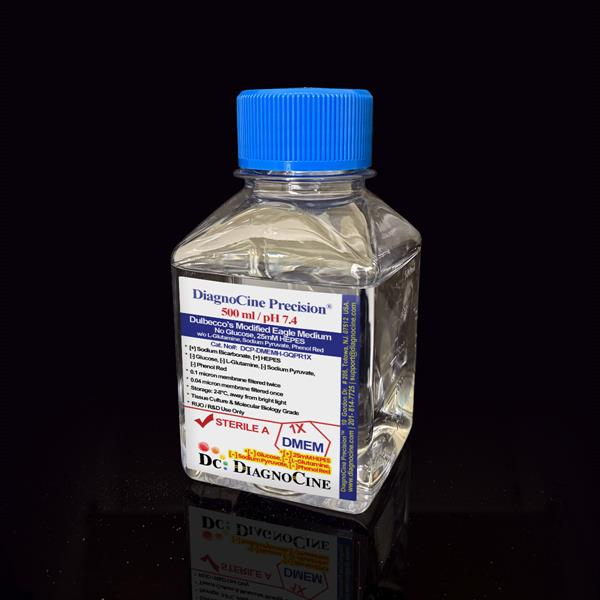
- FluxMPS™ Dulbecco's Modified Eagle Medium (DMEM), 25mM HEPES w/o Glucose, L-Glutamine, Sodium Pyruvate, Sodium Bicarbonate, Phenol Red: 1X Liquid
FluxMPS™ Dulbecco's Modified Eagle Medium (DMEM), 25mM HEPES w/o Glucose, L-Glutamine, Sodium Pyruvate, Sodium Bicarbonate, Phenol Red: 1X Liquid
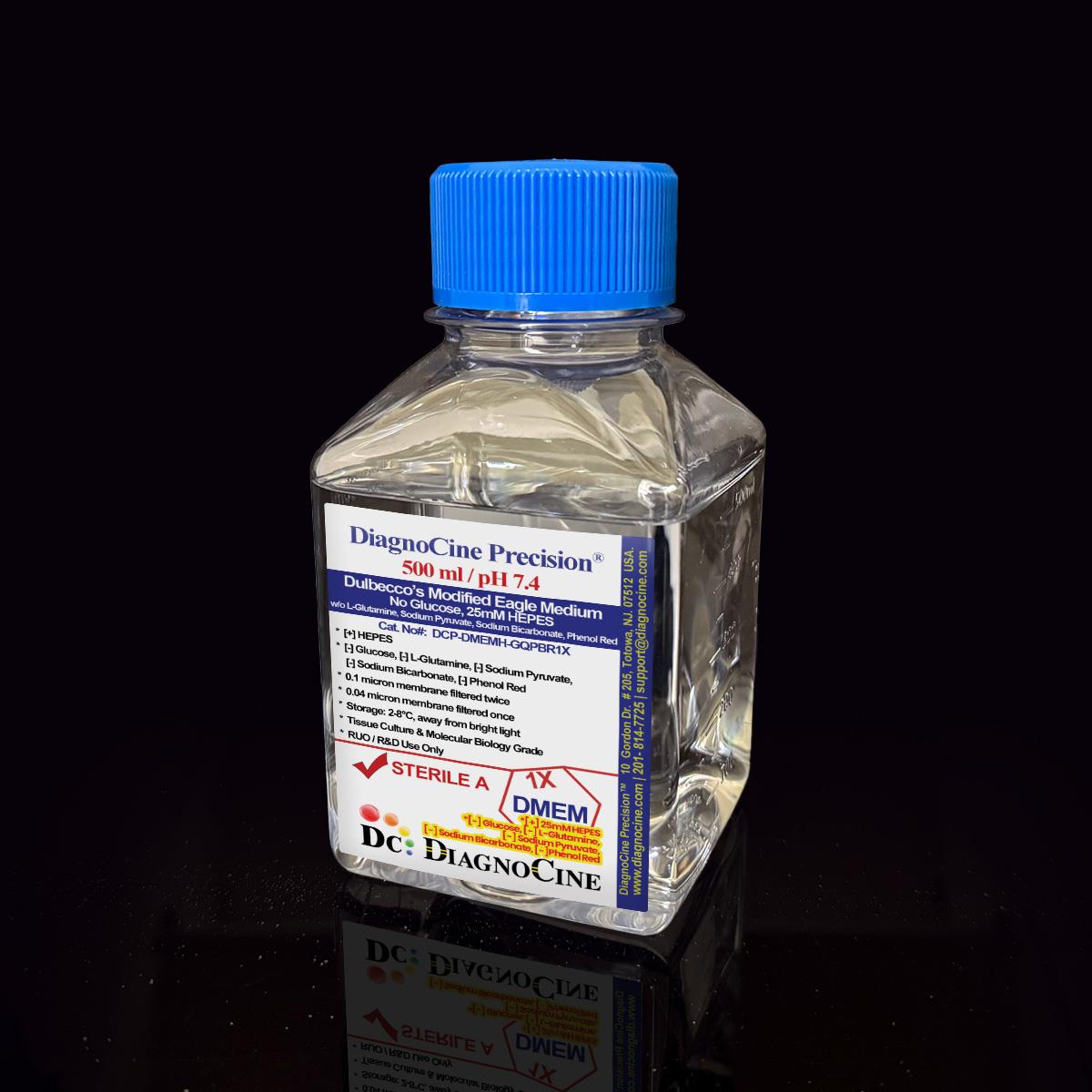
FluxMPS™ Dulbecco's Modified Eagle Medium (DMEM), 25mM HEPES w/o Glucose, L-Glutamine, Sodium Pyruvate, Sodium Bicarbonate, Phenol Red: 1X Liquid
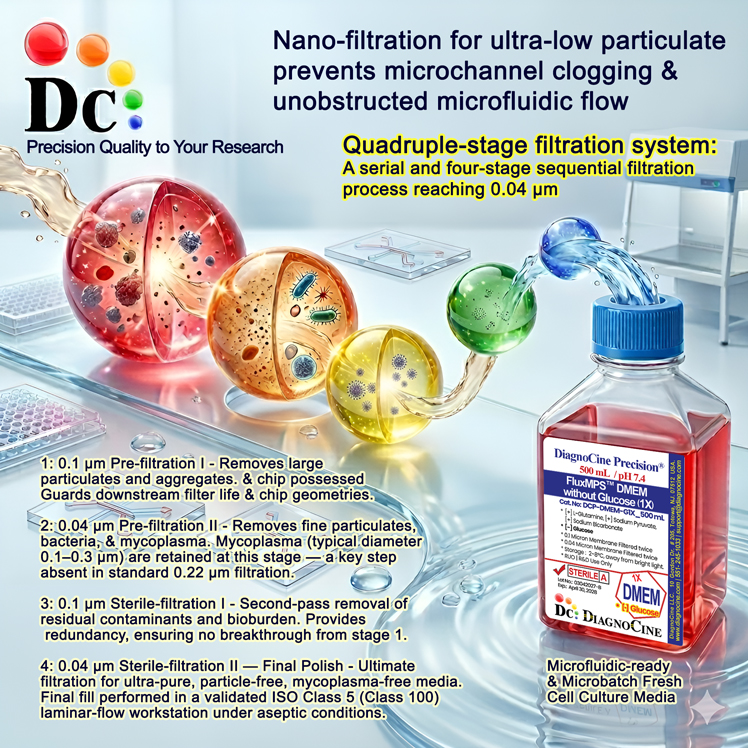
FluxMPS™ DCP-DMEMH-GQPBR1X is a Microfluidics Suitable, quadruple-stage ultra-filtered (0.1 µm ×2 + 0.04 µm ×2) glucose-free DMEM + 25 mM HEPES formulation engineered for metabolic flux analysis, 13C isotope tracing, Warburg-effect research, and organ-on-a-chip (OoC) applications where carbon source identity must be precisely controlled. A quadruple-stage train (0.1 µm ×2 + 0.04 µm ×2) reaches a 0.04 µm final cut-off, five times finer than the 0.22 µm membranes used for conventional sterile filtration.
- Glucose-free — add D-glucose, 13C-glucose, galactose, fructose, or any carbon source at your defined concentration
- 25 mM HEPES (pKa 7.3 at 37°C) — CO2-independent pH stability; suited to Seahorse XF, open-top chips, and metabolic sampling outside incubators
- Quadruple-stage filtration system (0.1 µm ×2 + 0.04 µm ×2) reaching a 0.04 µm final pore size for microchannel-safe particulate control
- Endotoxin release specification < 0.05 EU/mL (LAL, USP <85>) for clean metabolic baselines
- Formulation: [+] HEPES, Calcium, Magnesium | [-] Glucose, L-Glutamine, Sodium Pyruvate, Sodium Bicarbonate, Phenol Red
- Manufactured under an ISO 13485:2016 quality management system; final QC at Diagnocine, Totowa, NJ
- Custom glucose concentrations, carbon sources, and nutrient modifications available on request
- GlucoseNot included — researcher-defined
- HEPES25 mM (5958 mg/L), pKa 7.3 at 37°C
- Formulation[+] HEPES, Calcium, Magnesium | [-] Glucose, L-Glutamine, Sodium Pyruvate, Sodium Bicarbonate, Phenol Red
- AppearancePale yellow colored, clear solution
- pH (USP <791>)7.4
- Osmolality (USP <785>)310–350 mOsm/kg H2O
- Endotoxin (USP <85>)< 0.05 EU/mL
- Filtration0.1 µm ×2 + 0.04 µm ×2 (Quadruple-stage)
- Storage2–8°C, away from light
- Shelf Life12 months from date of manufacture, unopened
When carbon source control is the experiment
Standard DMEM contains a fixed glucose concentration that cannot be changed without switching media entirely. FluxMPS™ glucose-free DMEM + HEPES gives you a clean base formulation where every carbon source is added fresh at the concentration and identity you choose, while a 0.04 µm final filter and a < 0.05 EU/mL endotoxin release specification reduce the risk of inflammatory artefacts confounding metabolic readouts.
Complete carbon source control
Add D-glucose, 13C-glucose, U-13C6-galactose, fructose, or no sugar. Combine with palmitate or other fatty acids. Define carbon source identity and concentration precisely for every experiment.
Seahorse XF & metabolomics ready
A glucose-free, bicarbonate-free, phenol red–free base is the standard starting point for Seahorse XF Glycolysis Stress Tests. HEPES maintains pH during real-time injection protocols without CO2 dependency.
HEPES: CO2-stable pH
25 mM HEPES (pKa 7.3 at 37°C) maintains pH 7.2–7.4 outside CO2 incubators — useful for metabolic sampling, Seahorse injection events, and open-top chip platforms.
Microchannel-safe purity
0.04 µm final filtration and a < 0.05 EU/mL endotoxin release specification support clean metabolic baselines in microfluidic channels.
Low background for imaging
This formulation removes phenol red, eliminating pH-indicator dye background and associated estrogen-receptor agonist activity. Combined with 0.04 µm particulate control, it supports a clean particulate baseline for live-cell imaging, TEER, and biosensor OoC platforms. Note: this medium retains riboflavin, which contributes inherent flavin autofluorescence common to DMEM-based media.
Customization on demand
Custom glucose concentrations, carbon source additions, pH, and nutrient modifications available. Contact support@diagnocine.com.
Quadruple-stage filtration system
Four serial filtration stages, run as two prefilter-plus-final-filter pairs, reach a final 0.04 µm polish. This is particularly relevant for glucose-free metabolic assays, where particulate contamination and endotoxin can independently confound innate immune and metabolic signalling.
-
1
0.1 µm Prefiltration I
Removes large particulate, cell debris and protein aggregates; protects the first 0.04 µm cartridge.
-
2
0.04 µm Final filtration I
First 0.04 µm pass; retains sub-micron particulates and mycoplasma-range organisms (0.2–0.3 µm) that pass a standard 0.22 µm filter.
-
3
0.1 µm Prefiltration II
Second dedicated prefilter, protecting the second 0.04 µm cartridge in the train.
-
4
0.04 µm Final filtration II — Polish
Ultimate polishing filter; aseptic fill and finish under ISO Class 5 (Class 100) conditions.
Why filtration purity matters for metabolic assays
Subvisible particulates and elevated endotoxin can independently upregulate glycolysis via TLR4/NF-κB signalling, which would confound glucose uptake, lactate production, and oxygen consumption rate (OCR) measurements. FluxMPS™ DCP-DMEMH-GQPBR1X keeps both variables within specification: < 0.05 EU/mL endotoxin and NMT 25 particles/mL (≥10 µm).
© Diagnocine® — DCP-DMEMH-GQPBR1X
Metabolic research and OoC applications
FluxMPS™ DCP-DMEMH-GQPBR1X is built for experiments where carbon source identity must be controlled — from Seahorse XF assays to 13C metabolic flux analysis and glucose dose-response studies on organ-on-a-chip platforms.
Automated Bioreactors & Robotics
For closed-loop, automated microfluidic bioreactors and robotic liquid-handling platforms, Diagnocine also offers an optional 0.01 µm (10 nm) ultra nano-filtered MPS Grade variant of this formulation, engineered to further reduce valve fouling and sensor drift over extended perfusion runs.
- Total Particulate Exclusion: 0.01 µm final cut-off for the most demanding closed microfluidic loops
- Valve & Sensor Protection: minimizes particulate accumulation on inline sensors and microvalves
- Extended Perfusion Stability: supports longer unattended run times in automated bioreactor systems
Inquiry Required: The 0.01 µm MPS Grade variant is available on request. Contact support@diagnocine.com.
13C Metabolic Flux Analysis
Add U-13C6-glucose at any specific activity without background dilution. HEPES maintains pH during NMR sample preparation outside incubators.
Warburg Effect & OXPHOS Switching
Add glucose (Warburg), galactose (force OXPHOS), or no sugar (starvation) to study metabolic flexibility in cancer lines without media changes.
Glucose Dose-Response on Chip
Perfuse defined glucose gradients through OoC channels to study dose-dependent metabolic responses in endothelial, beta-cell, or hepatocyte chips.
iPSC Metabolic Maturation
Glucose-free base enables galactose-forced OXPHOS maturation of iPSC-derived cardiomyocytes and hepatocytes, supporting more mature metabolic phenotypes.
Nutrient Deprivation Studies
Starvation experiments, glucose withdrawal, and nutrient re-feeding protocols with defined timing and concentration control.
Metabolic Imaging & Biosensors
Phenol red–free formulation removes pH-indicator background fluorescence. Combined with 0.04 µm particulate filtration, it supports FLIM, NAD(P)H imaging, glucose FRET sensors, and TEER measurements on metabolic chips.
Analytical release specifications
Every lot released against the full specification matrix. Available pack sizes: 500 mL, 1000 mL. CoA available at support@diagnocine.com.
| Parameter | Specification |
|---|---|
| Formulation | [+] HEPES, Calcium, Magnesium | [-] Glucose, L-Glutamine, Sodium Pyruvate, Sodium Bicarbonate, Phenol Red |
| Appearance | Pale yellow colored, clear solution |
| Glucose | Not included — add at desired concentration |
| HEPES | 25 mM (5958 mg/L), pKa 7.3 at 37°C |
| pH USP <791> | 7.4 |
| Osmolality USP <785> | 310–350 mOsm/kg H2O |
| Total ingredients | 29 |
| Parameter | Specification |
|---|---|
| Endotoxin USP <85> BET | < 0.05 EU/mL |
| Sterility USP <71> | No growth / 14 days |
| Mycoplasma | 0.04 µm mycoplasma-retentive filtration (not tested per lot) |
| Particulate ≥10 µm USP <788> | NMT 25/mL |
| Particulate ≥25 µm USP <788> | NMT 3/mL |
| Water purity | Type 1, 18.2 MΩ·cm |
| Manufacturing std. | ISO 13485:2016 |
| Fill environment | ISO Class 5 (Class 100) |
| Parameter | Specification |
|---|---|
| Storage temperature | 2–8°C, away from light |
| Freeze-thaw | Do not freeze |
| Shelf life | 12 months from date of manufacture, unopened |
| Shipping condition | Cold pack |
| CO2 requirement | CO2-independent — HEPES (25 mM) maintains pH 7.2–7.4 at 37°C without gas supplementation |
| Parameter | Specification |
|---|---|
| Raw material grade | Reagent / cell culture grade |
| Traceability | Full lot traceability per ISO 13485 |
| Manufacturing QMS ISO | ISO 13485:2016 certified |
| UNSPSC | 41116155 — Molecular biology and cell culture growth media (UNv260801) |
| Regulatory alignment | 21 CFR Part 820 (QMSR) aligned |
| Production method | Micro-batch, per-lot QC release |
| Intended use | Research Use Only (RUO) |
Full composition (mg/L)
Glucose-free DMEM + HEPES scaffold: 29 ingredients verified per lot with CAS numbers, across 4 composition categories (Inorganic Salts, Amino Acids, Vitamins, Others). Glucose is intentionally absent — add your carbon source of choice. HEPES (25 mM = 5958 mg/L, CAS 7365-45-9) is listed under OTHERS.
| Component | CAS Number | mg/L |
|---|---|---|
| INORGANIC SALTS | ||
| Calcium chloride dihydrate | 10035-04-8 | 265.000 |
| Ferric nitrate nonahydrate | 7782-61-8 | 0.100 |
| Magnesium sulfate anhydrous | 7487-88-9 | 97.720 |
| Potassium chloride | 7447-40-7 | 400.000 |
| Sodium chloride | 7647-14-5 | 6400.000 |
| Sodium dihydrogen phosphate anhydrous | 7558-80-7 | 109.000 |
| Component | CAS Number | mg/L |
|---|---|---|
| AMINO ACIDS | ||
| Glycine | 56-40-6 | 30.000 |
| L-Arginine hydrochloride | 1119-34-2 | 84.000 |
| L-Cystine dihydrochloride | 30925-07-6 | 62.570 |
| L-Histidine hydrochloride monohydrate | 5934-29-2 | 42.000 |
| L-Isoleucine | 73-32-5 | 105.000 |
| L-Leucine | 61-90-5 | 105.000 |
| L-Lysine hydrochloride | 657-27-2 | 146.000 |
| L-Methionine | 63-68-3 | 30.000 |
| L-Phenylalanine | 63-91-2 | 66.000 |
| L-Serine | 56-45-1 | 42.000 |
| L-Threonine | 72-19-5 | 95.000 |
| L-Tryptophan | 73-22-3 | 16.000 |
| L-Tyrosine Disodium Salt dihydrate | 69847-15-0 | 103.790 |
| L-Valine | 72-18-4 | 94.000 |
| Component | CAS Number | mg/L |
|---|---|---|
| VITAMINS | ||
| Choline chloride | 67-48-1 | 4.000 |
| D-Ca-Pantothenate | 137-08-6 | 4.000 |
| Folic acid | 59-30-3 | 4.000 |
| Nicotinamide | 98-92-0 | 4.000 |
| Pyridoxal hydrochloride | 65-22-5 | 4.000 |
| Riboflavin | 83-88-5 | 0.400 |
| Thiamine hydrochloride | 67-03-8 | 4.000 |
| OTHERS | ||
| HEPES | 7365-45-9 | 5958.000 |
| i-Inositol | 87-89-8 | 7.200 |
Manufacturing & compliance
Every FluxMPS™ product is manufactured and released under a multi-layer quality system.
ISO 13485:2016 Quality Management
Manufactured under an ISO 13485:2016-certified quality management system. Final QC at Diagnocine, Totowa, NJ, USA.
Ultrapure Type 1 Water
18.2 MΩ·cm feed water, controlled for trace metals and organic carbon.
ISO Class 5 Fill & Finish
Aseptic fill in validated ISO Class 5 (Class 100) laminar-flow workstations.
Micro-Batch Precision
Small-batch, per-lot tested — no blending between batches; a Certificate of Analysis is available for every lot.
Endotoxin — USP <85> BET
LAL assay; assay sensitivity 0.005 EU/mL; release specification < 0.05 EU/mL.
Particulate — USP <788> Method 1
Light obscuration: NMT 25/mL (≥10 µm), NMT 3/mL (≥25 µm).
Osmolality — USP <785>
Target: 310–350 mOsm/kg H2O.
Documentation & CoA
Full CoA with raw-material traceability available for every lot on request.
- Endotoxin — LAL assay, USP <85> Bacterial Endotoxins Test; assay sensitivity 0.005 EU/mL; release specification < 0.05 EU/mL
- pH, osmolality, conductivity, appearance and clarity
- Sterility
How DCP-DMEMH-GQPBR1X compares
FluxMPS™ DCP-DMEMH-GQPBR1X vs. conventional glucose-free DMEM and standard DMEM for metabolic assays.
| Parameter | DCP-DMEMH-GQPBR1X (FluxMPS™) | Conventional GF-DMEM (0.22 µm filtered) |
Standard DMEM (fixed glucose, 0.22 µm) |
|---|---|---|---|
| Grade | Microfluidics Suitable | Standard grade | Standard grade |
| Glucose-free DMEM + HEPES base — CO2-independent, all carbon/nitrogen sources and phenol red removed; researcher defines everything | check_circle Yes | cancel No | cancel No |
| Glucose content | None — researcher-defined | None | Fixed (1–4.5 g/L) |
| HEPES (25 mM) | check_circle Yes | cancel Usually no | cancel No |
| Final filtration pore size | 0.04 µm | 0.22 µm | 0.22 µm |
| Number of filtration stages | 4 (0.1 µm ×2 + 0.04 µm ×2) | 1 | 1 |
| Endotoxin specification (release specification) | < 0.05 EU/mL | Corning classical liquid media — < 0.25 EU/mL Sigma-Aldrich DMEM complete medium — ≤ 2 EU/mL Gibco classical DMEM — Not specified (recorded per lot) |
|
| USP <788> particulate tested | check_circle Yes (Method 1) | cancel No | cancel No |
| Mycoplasma-retentive filtration | check_circle Yes (0.04 µm) | cancel No | cancel No |
| Seahorse XF compatible | check_circle Yes (GF base + HEPES) | check_circle Yes (no HEPES) | cancel Carbon source fixed |
| Manufacturing QMS | ISO 13485:2016 | ISO 9001 or none | ISO 9001 or none |
| Custom formulation | check_circle Available | cancel Fixed | cancel Fixed |
Comparison figures from published supplier specifications, accessed 2026-09-02. Suppliers that publish no numeric endotoxin specification are shown as "Not specified".
Frequently asked questions
Common questions about FluxMPS™ DCP-DMEMH-GQPBR1X glucose-free DMEM + 25 mM HEPES.
Supporting literature
Key publications supporting glucose-free DMEM in metabolic flux analysis, Seahorse XF assays, isotope tracing, and organ-on-a-chip metabolic studies.
- Warburg O. On the origin of cancer cells. Science. 1956;123:309–314. doi:10.1126/science.123.3191.309
- Jain M, et al. Metabolite profiling identifies a key role for glycine in rapid cancer cell proliferation. Science. 2012;336:1040–1044. doi:10.1126/science.1218595
- Birsoy K, et al. An essential role of the mitochondrial electron transport chain in cell proliferation is to enable aspartate synthesis. Cell. 2015;162:540–551. doi:10.1016/j.cell.2015.07.016
- Sullivan LB, et al. Supporting aspartate biosynthesis is an essential function of respiration in proliferating cells. Cell. 2015;162:552–563. doi:10.1016/j.cell.2015.07.017
- Huh D, et al. Reconstituting organ-level lung functions on a chip. Science. 2010;328:1662–1668. doi:10.1126/science.1188302
- Bhatia SN, Ingber DE. Microfluidic organs-on-chips. Nat Biotechnol. 2014;32:760–772. doi:10.1038/nbt.2989
- Schell JC, et al. A role for the mitochondrial pyruvate carrier as a repressor of the Warburg effect and colon cancer cell growth. Mol Cell. 2014;56:400–413. doi:10.1016/j.molcel.2014.09.026
- Faubert B, et al. Lactate metabolism in human lung tumors. Cell. 2017;171:358–371. doi:10.1016/j.cell.2017.09.019
- Novak R, et al. Robotic fluidic coupling and interrogation of multiple vascularized organ chips. Nat Biomed Eng. 2020;4:407–420. doi:10.1038/s41551-019-0497-x