Denaturing Gel-Loading Buffer with Dye
FluxMPS™ Denaturing Gel-Loading Buffer with Dye
DCP-DGLBWD is an MPS-grade, formamide-based denaturing gel-loading buffer built for resolving ssDNA, DNA, and RNA by size rather than secondary structure. Manufactured with DEPC-treated Ultrapure Type 1 Water and carried through quadruple-stage 0.1 µm/0.04 µm filtration, it delivers a pH 8.0, EDTA-chelated, dye-loaded formulation with none-detected DNase and RNase activity so your denaturing agarose or PAGE runs stay clean and reproducible.
- Quadruple-stage filtration — 0.1 µm membrane twice and 0.04 µm membrane twice
- Formamide (80%) denatures secondary structure for size-based migration on denaturing gels
- EDTA (pH 8.0, 10mM) chelates divalent metal ions to inhibit nucleases and protect samples
- Pre-loaded with Bromophenol Blue and Xylene Cyanol FF for direct migration tracking
- DEPC-treated Ultrapure Type 1 Water — none-detected DNase and RNase activity (18 hr, room temperature)
- Supplied 5 × 1 mL; store at -20°C for a 3-year shelf life
- pH, additive content, and formulation customizable on request
- FormatDenaturing gel-loading buffer with dye
- Size5 × 1 mL
- pH8.0
- Formamide80%
- EDTA10mM
- Tracking DyesBromophenol Blue 0.025%, Xylene Cyanol FF 0.025%
- Filtration0.1 µm ×2 + 0.04 µm ×2
- Water QualityDEPC-treated Ultrapure Type 1
- Nuclease ActivityNone detected (DNase & RNase, 18 hr RT)
- Storage / Shelf Life-20°C / 3 years
Engineered where standard loading buffers fail
Conventional 0.22 µm-filtered gel-loading buffers can carry subvisible particulate, residual nuclease activity, and undefined water quality into a run that is supposed to be clean by design. DCP-DGLBWD is built to keep formamide denaturation, EDTA chelation, and dye tracking consistent from lot to lot.
Microchannel-safe purity
Quadruple-stage 0.1 µm/0.04 µm filtration reduces particulate carried into low-volume wells and channels.
Precise, stable denaturation
80% formamide with 10mM EDTA at pH 8.0 gives consistent secondary-structure denaturation run to run.
Ultrapure-grade water
DEPC-treated Ultrapure Type 1 Water supports nuclease-free handling of DNA and RNA samples.
Built-in migration tracking
Bromophenol Blue and Xylene Cyanol FF let you track sample migration directly on the gel.
Defined, traceable composition
Every component — formamide, EDTA, and both dyes — is lot-released at a stated concentration.
Customization on demand
Alternate concentrations, additional chemicals/compounds/proteins/supplements, pH, and modifications available on inquiry.
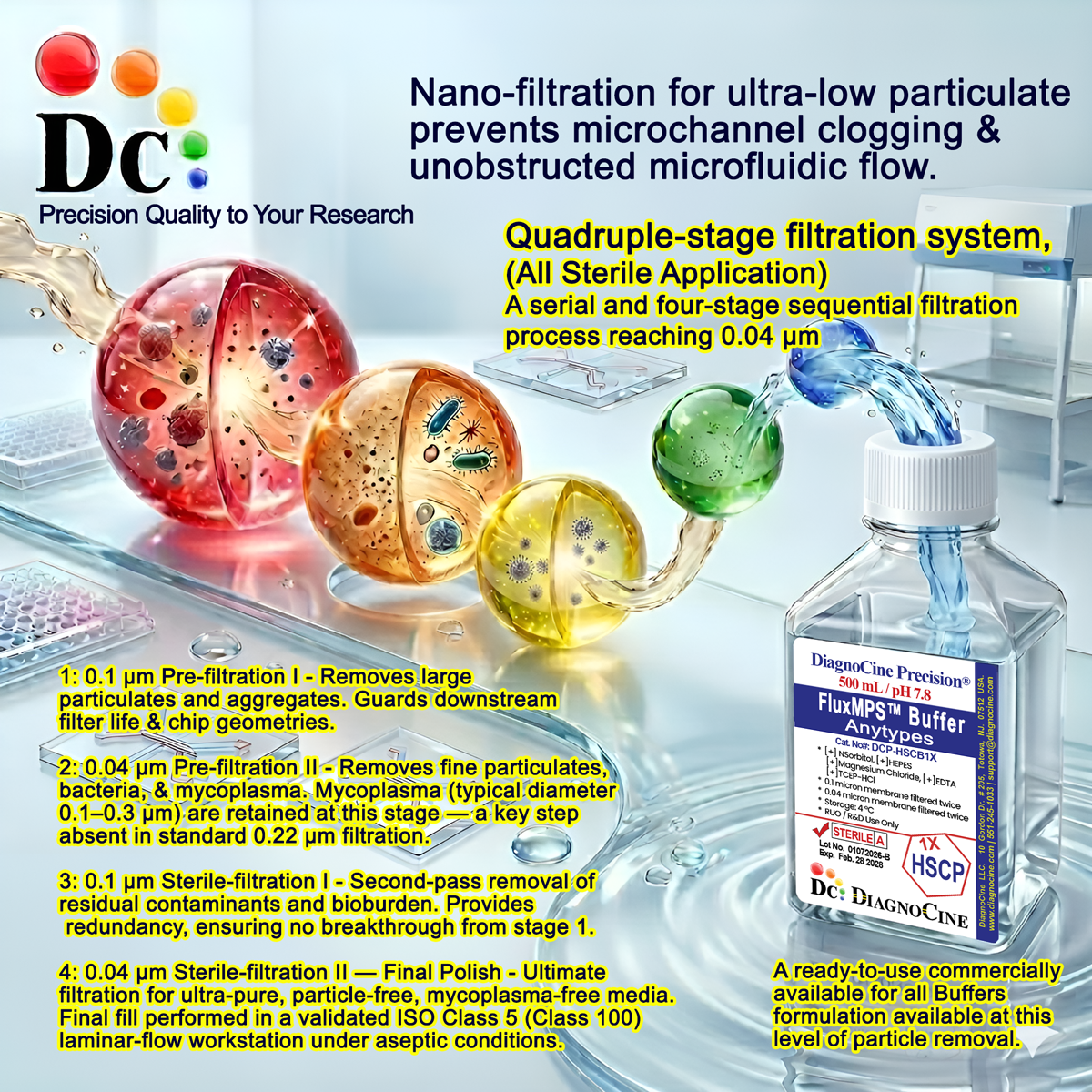
Quadruple-stage filtration system
DCP-DGLBWD is carried through four sequential membrane passes — 0.1 µm membrane filtration applied twice followed by 0.04 µm membrane filtration applied twice — before DEPC-treated Ultrapure Type 1 Water is used to formulate the buffer.
-
1
0.1 µm Pre-filtration I
Large particulate and aggregate removal, extending the life of downstream filtration stages.
-
2
0.04 µm Pre-filtration II
Fine particulate and bioburden retention below the range of most contaminating organisms — the smallest known mycoplasma type is about 0.2 micron, well above this filtration threshold.
-
3
0.1 µm Sterile-filtration I
Second-pass redundancy through a 0.1 µm membrane confirms particulate control ahead of final polish.
-
4
0.04 µm Sterile-filtration II — Final Polish
Ultimate polish pass before aseptic fill, preventing mycoplasma contamination of the finished buffer.
Performance vs. conventional buffer
Sequential 0.1 µm and 0.04 µm filtration, each applied twice, removes finer particulates than a single 0.22 µm pass typical of conventional gel-loading buffer.
© Diagnocine® — DCP-DGLBWD
Where DCP-DGLBWD is used
Formulated for denaturing agarose or polyacrylamide gel electrophoresis (PAGE) of DNA and RNA, DCP-DGLBWD denatures secondary structure so samples migrate by size, while its dyes and increased density keep loading straightforward across sample types and workflows.
Automated Bioreactors & Robotics
An optional 0.01 µm (10 nm) ultra-filtered variant of DCP-DGLBWD is available on inquiry for automated liquid-handling and robotic loading systems where valve and sensor protection is critical.
- Total Particulate Exclusion — further reduces particulate below the standard quadruple-stage architecture
- Valve & Sensor Protection — minimizes fouling risk in automated dispensing hardware
- Extended Perfusion Stability — supports longer unattended run times in robotic workflows
Inquiry Required: contact support@diagnocine.com to request the 0.01 µm ultra-filtered grade of DCP-DGLBWD.
Micro Physiological System (MPS) & Chip
Supports denaturing gel-electrophoresis quality control of nucleic acid eluates recovered from on-chip sample preparation.
Wash, Dilution & Reconstitution
Formamide-based loading increases sample density and denatures ssDNA, DNA, and RNA ahead of the gel well.
iPSC-Derived Model Handling
Used to resolve RNA integrity from iPSC-derived cultures via denaturing gel electrophoresis before downstream analysis.
Endothelial & Primary Cell Perfusion
Loads and denatures RNA or DNA recovered from perfused endothelial and primary cell cultures for denaturing PAGE analysis.
ELISA, Blotting & Blocking
Denatured RNA resolved with this buffer supports Northern blot workflows that complement ELISA and blotting panels.
Microscopy & Optical Sensing
Nuclease-free preparation supports downstream RNA/DNA QC for samples paired with confocal and biosensor-based studies.
Specifications at a glance
Values below are drawn directly from DCP-DGLBWD's release documentation.
| Parameter | Specification |
|---|---|
| Formulation / Composition | Formamide-based denaturing gel-loading buffer with EDTA and tracking dyes |
| pH USP <791> | 8.0 |
| Formamide concentration | 80% |
| EDTA concentration (pH 8.0) | 10mM |
| Parameter | Specification |
|---|---|
| Sterility / Filtration | Filtered 0.1 µm membrane twice and 0.04 µm membrane twice |
| DNase activity | None detected after incubation with plasmid DNA for 18 hr at room temperature |
| RNase activity | None detected after incubation with ribosomal RNA for 18 hr at room temperature |
| Water purity | DEPC-treated Ultrapure Type 1 Water |
| Manufacturing standard ISO 13485 | ISO 13485:2016 |
| Fill environment | ISO Class 5 (Class 100) |
| Parameter | Specification |
|---|---|
| Storage temperature | -20°C |
| Shelf life | 3 years |
| Size | 5 × 1 mL |
| Parameter | Specification |
|---|---|
| Raw material grade | DEPC-treated Ultrapure Type 1 Water; molecular-biology-grade formamide, dyes, and EDTA |
| Manufacturing QMS ISO 13485 | ISO 13485:2016 |
| Production method | Filtered 0.1 µm membrane twice and 0.04 µm membrane twice; DEPC-treated Ultrapure Type 1 Water used |
| Intended use | For Research Use Only (RUO) |
Full composition
Every component of DCP-DGLBWD, at the exact concentration stated on its release documentation.
| Component | CAS Number | Concentration |
|---|---|---|
| Formamide | 75-12-7 | 80% |
| Bromophenol Blue | 115-39-9 | 0.025% |
| Xylene Cyanol FF | 2650-17-1 | 0.025% |
| EDTA (pH 8.0) | 6381-92-6 | 10mM |
Manufacturing & compliance
DCP-DGLBWD is produced under a documented quality system with lot-specific nuclease testing.
ISO 13485:2016 QMS
Manufactured under an ISO 13485:2016-aligned quality management system.
Ultrapure, DEPC-Treated Water
DEPC-treated Ultrapure Type 1 Water is used to formulate the buffer, supporting nuclease-free performance.
ISO Class 5 Fill & Finish
Final fill is conducted in an ISO Class 5 (Class 100) environment.
Micro-Batch Precision
Each lot is filtered, filled, and tested individually at the 5 × 1 mL scale.
DNase Activity Lot QC
None detected after incubation with plasmid DNA for 18 hr at room temperature.
RNase Activity Lot QC
None detected after incubation with ribosomal RNA for 18 hr at room temperature.
Filtration ISO 13485
Filtered 0.1 µm membrane twice and 0.04 µm membrane twice prior to fill.
Documentation / CoA
Lot-specific documentation is available on request.
How DCP-DGLBWD compares
A side-by-side look at filtration architecture and formulation traits against conventional gel-loading buffer.
| Parameter | DCP-DGLBWD (FluxMPS™) | Conventional (0.22 µm filtered) | Standard Alternative (0.22 µm filtered) |
|---|---|---|---|
| Filtration stages | 4 (0.1 µm ×2 + 0.04 µm ×2) | 1 (0.22 µm) | 1 (0.22 µm) |
| Nuclease-free (DNase/RNase tested) | check_circle | cancel | cancel |
| DEPC-treated Ultrapure Type 1 Water | check_circle | cancel | cancel |
| EDTA chelation included | check_circle | check_circle | cancel |
| Pre-loaded tracking dyes (Bromophenol Blue + Xylene Cyanol FF) | check_circle | check_circle | cancel |
| ISO 13485:2016 manufacturing | check_circle | cancel | cancel |
| Microfluidic / low-volume channel compatible | check_circle | cancel | cancel |
| Custom formulation available | check_circle | cancel | cancel |
Frequently asked questions
Common questions about DCP-DGLBWD, the FluxMPS™ Denaturing Gel-Loading Buffer with Dye.
Supporting literature
Curated peer-reviewed literature relevant to denaturing gel electrophoresis, formamide-based denaturation, and microfluidic sample handling.
- Rio DC. Denaturing agarose gel electrophoresis of RNA. Cold Spring Harb Protoc. 2015. doi:10.1101/pdb.prot080994
- Masek T, Vopalensky V, Suchomelova P, Pospisek M. Denaturing RNA electrophoresis in TAE agarose gels. Anal Biochem. 2005;336(1):46-50. doi:10.1016/j.ab.2005.07.021
- Green MR, Sambrook J. Agarose gel electrophoresis for the separation of DNA fragments. Cold Spring Harb Protoc. 2019. doi:10.1101/pdb.prot100479
- Green MR, Sambrook J. Estimation of RNA quality by agarose gel electrophoresis. Cold Spring Harb Protoc. 2018. doi:10.1101/pdb.top090613
- Bhatia SN, Ingber DE. Microfluidic organs-on-chips. Nat Biotechnol. 2014;32(8):760-772. doi:10.1038/nbt.2989
- Huh D, Torisawa YS, Hamilton GA, Kim HJ, Ingber DE. Microengineered physiological biomimicry: organs-on-chips. Lab Chip. 2012;12(12):2156-2164. doi:10.1039/c2lc40089h
- Zhang B, Radisic M. Organ-on-a-chip devices advance to market. Lab Chip. 2017;17(14):2395-2420. doi:10.1039/C6LC01554A
- Wilkinson M. Preparation of RNA for Northern blot hybridization. Cold Spring Harb Protoc. 2006. doi:10.1101/pdb.prot4622
- Reyes DR, Iossifidis D, Auroux PA, Manz A. Micro total analysis systems. 1. Introduction, theory, and technology. Anal Chem. 2002;74(12):2623-2636. doi:10.1021/ac0202435
- Sambrook J, Russell DW. Molecular Cloning: A Laboratory Manual. 3rd ed. Cold Spring Harbor Laboratory Press; 2001. ISBN:978-0879695774