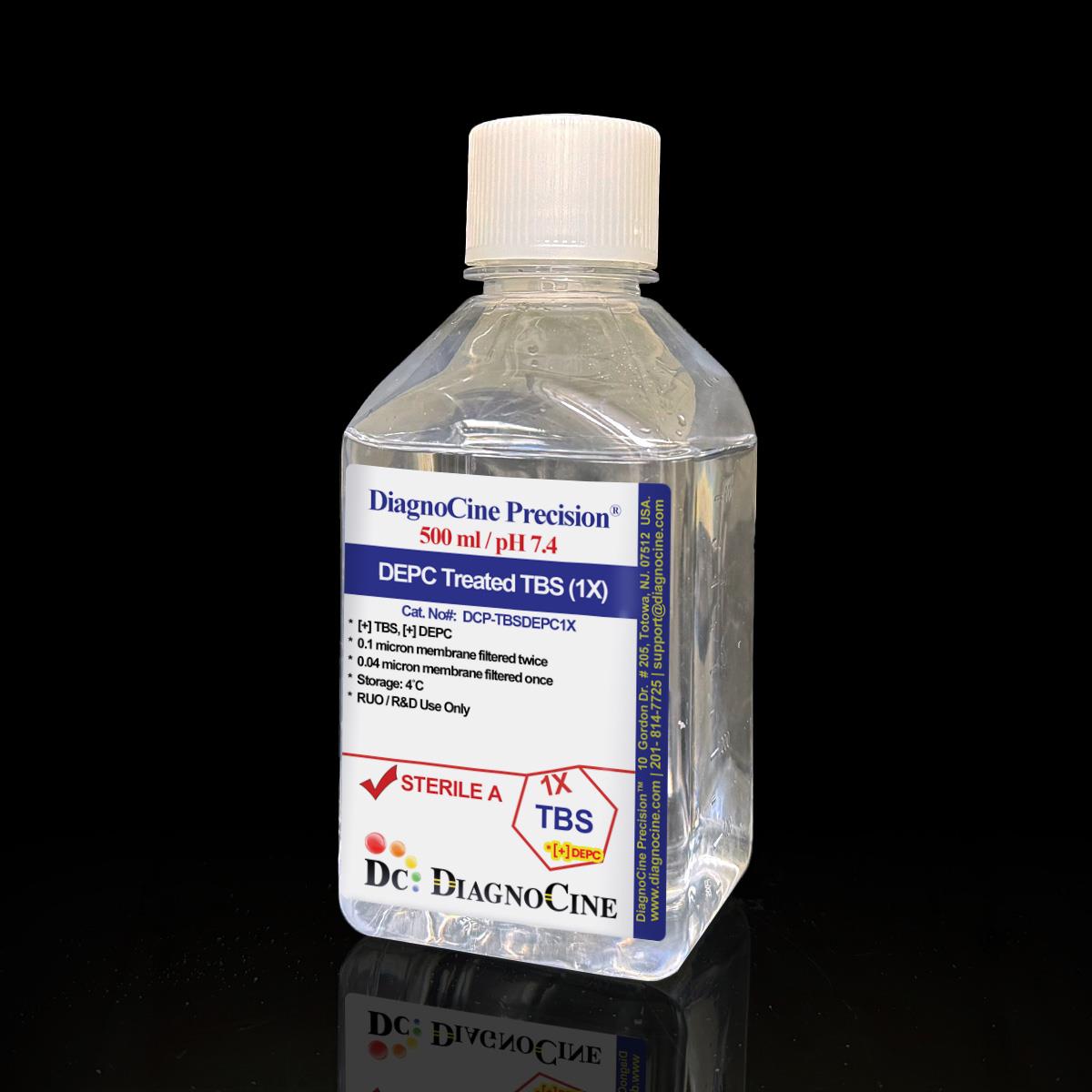
UltraClean DEPC Treated TBS, 1X
FluxMPS™ UltraClean DEPC Treated TBS, 1X
FluxMPS™ UltraClean DEPC Treated TBS, 1X is a sterile, ultra-filtered Tris-Buffered Saline formulated for RNA-sensitive molecular biology workflows. DEPC treatment inactivates RNase, DNase, and other nucleases, while quadruple-stage 0.1 µm and 0.04 µm membrane filtration delivers microchannel-safe purity for organ-on-a-chip (OoC) and microfluidic protocols. A physiological pH of 7.4 and a defined 20 mM Tris / 150 mM NaCl formulation support reproducible results across RNA extraction, in situ hybridization, and immunoassay applications.
- Quadruple-stage filtration: 0.1 µm membrane (twice) and 0.04 µm membrane (twice) for ultra-low particulate purity
- DEPC-treated to inactivate RNase, DNase, and other nuclease activity
- Physiological pH 7.4 with a defined 20 mM Tris base / 150 mM NaCl formulation
- Sterile and autoclaved after DEPC treatment for ready-to-use reliability
- Manufactured with DEPC-treated, nuclease-free water
- Produced under ISO 13485-certified, CE-approved manufacturing
- Microchannel-safe purity supports OoC, ToC, and microfluidic workflows
- Custom pH, concentration, and additive formulations available on request
- Formulation1X Tris-Buffered Saline (TBS), DEPC-treated
- pH7.4
- Molarity / Concentration20 mM Tris base / 150 mM NaCl
- Nuclease ControlDEPC-treated; RNase- and DNase-free
- Filtration0.1 µm x2 + 0.04 µm x2
- SterilitySterile (autoclaved)
- Water QualityDEPC-treated, nuclease-free water
- Storage4 °C
- Shelf Life24 months
- AppearanceColorless, clear solution
Engineered where standard buffers fail
Conventional 0.22 µm-filtered buffers can retain subvisible particulates, accumulate in microfluidic channels, drift in pH and ionic composition, and carry residual nuclease activity that compromises RNA-sensitive assays. FluxMPS™ buffers are engineered to remove these failure modes at the source.
Microchannel-safe purity
Quadruple-stage 0.1 µm and 0.04 µm membrane filtration removes fine particulate matter before packaging, supporting reliable performance in narrow microfluidic channels.
Precise, stable pH
Formulated to pH 7.4 with a defined 20 mM Tris base / 150 mM NaCl composition for consistent, physiological-range performance across protocols.
Ultrapure-grade water
Manufactured with DEPC-treated, nuclease-free water to inactivate RNase and DNase contamination that would otherwise compromise RNA workflows.
Low background for imaging & assays
Sterile, ultra-filtered formulation supports low-background performance in western blot, ELISA, and in situ hybridization workflows.
Defined, traceable composition
Every lot is formulated to the same 20 mM Tris base / 150 mM NaCl composition with documented sterility and filtration processing.
Customization on demand
Alternate concentrations, pH values, and added chemicals, compounds, proteins, or supplements are available — contact support@diagnocine.com.
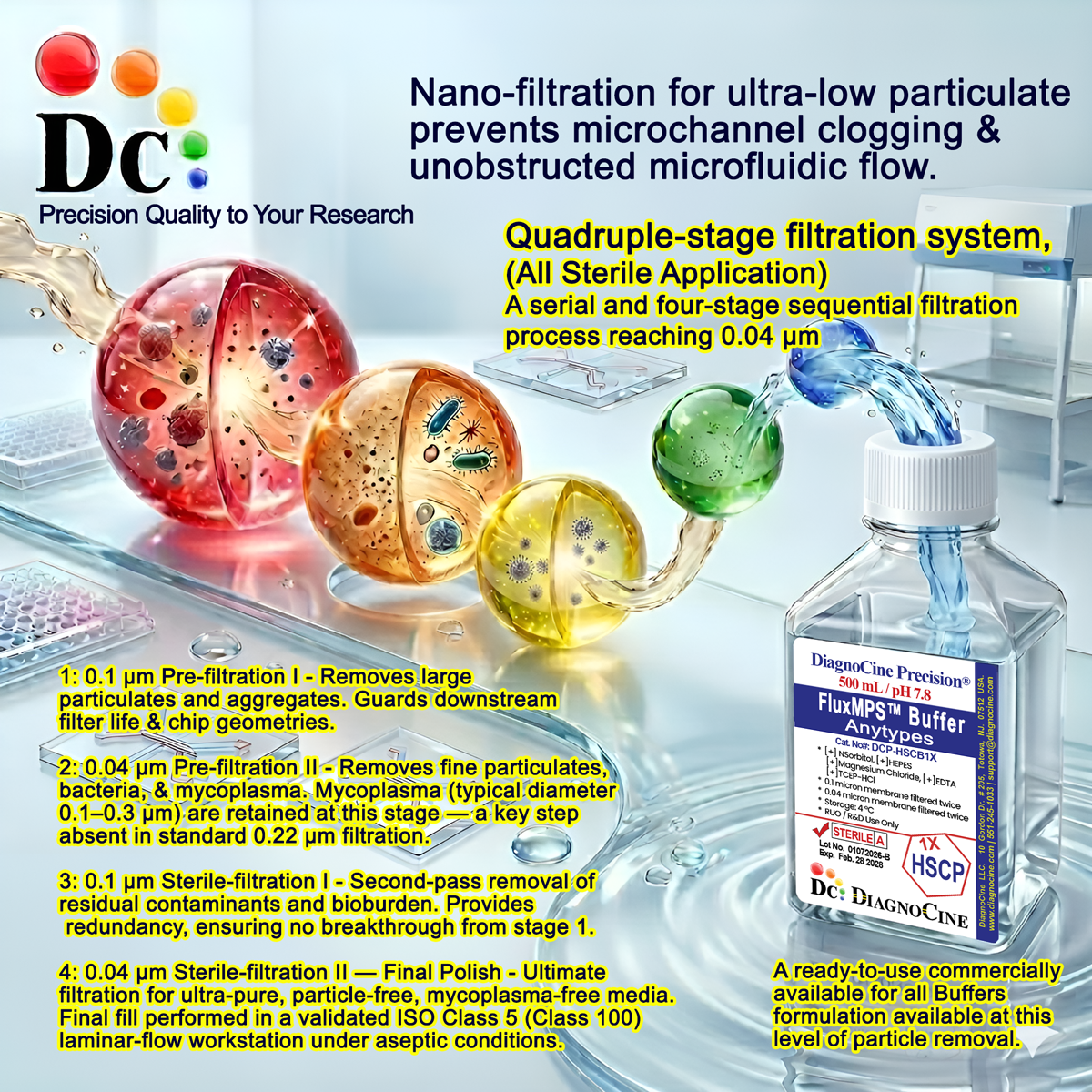
Quadruple-stage filtration system
This buffer is filter-sterilized in four sequential passes — 0.1 µm membrane filtration twice followed by 0.04 µm membrane filtration twice — then autoclaved after DEPC treatment to help prevent mycoplasma and nuclease contamination in RNA-sensitive workflows.
-
1
0.1 µm Pre-filtration I
Removes large particulates and aggregates, extending the service life of downstream filtration stages.
-
2
0.04 µm Pre-filtration II
Retains fine particulates and reduces bioburden. Because the smallest mycoplasma type is about 0.2 microns, sub-0.1 micron filtration stages such as this help prevent mycoplasma carry-over.
-
3
0.1 µm Sterile-filtration I
A second 0.1 micron pass provides filtration redundancy ahead of the final polishing stage.
-
4
0.04 µm Sterile-filtration II — Final Polish
A second 0.04 micron pass provides the final purity polish before the buffer is autoclaved and packaged sterile.
Performance vs. conventional buffer
Sequential 0.1 µm (x2) and 0.04 µm (x2) filtration removes finer particulate matter than a single 0.22 µm pass used in conventional buffers, supporting nuclease-free, mycoplasma-controlled conditions for RNA workflows.
© Diagnocine® — DCP-TBSDEPC1X
Built for RNA-sensitive and general molecular biology workflows
DEPC Treated TBS, 1X is a ready-to-use, nuclease-free buffer for RNA extraction and purification, in situ hybridization, immunoassays such as western blot and ELISA, and any protocol where nuclease-free conditions are critical. It also serves as a general wash buffer, storage buffer, sample dilution medium, and resuspension medium for cells or nucleic acids.
Automated Bioreactors & Robotics
An optional 0.01 µm (10 nm) ultra-filtered variant is available for automated bioreactor and robotic liquid-handling systems where valve and sensor protection is critical.
- Total Particulate Exclusion — supports sub-10 nm particulate control for sensitive automated systems
- Valve & Sensor Protection — helps guard fine-tolerance robotic and microfluidic hardware from particulate fouling
- Extended Perfusion Stability — supports longer-duration perfusion runs without filter or channel obstruction
Inquiry Required: the 0.01 µm ultra-filtered grade is produced on request — contact support@diagnocine.com.
Micro Physiological System (MPS) & Chip
Sterile, ultra-filtered TBS supports microfluidic channel integrity across MPS platforms.
Wash, Dilution & Reconstitution
Serves as a wash buffer, sample dilution medium, and resuspension medium for RNA extraction and purification workflows.
iPSC-Derived Model Handling
Nuclease-free, physiological-pH buffer suitable for handling RNA-sensitive iPSC-derived model workflows.
Endothelial & Primary Cell Perfusion
Physiological pH 7.4 and defined ionic composition support endothelial and primary cell perfusion protocols.
ELISA, Blotting & Blocking
Suitable as a wash and dilution buffer for western blot and ELISA workflows referenced in the source protocol.
Microscopy & Optical Sensing
Low-particulate, sterile formulation supports low-background use in imaging and biosensor-based assays.
Specification summary
Specifications reflect only values stated for this product. Where a parameter is not reported, it is omitted rather than estimated.
| Parameter | Specification |
|---|---|
| Formulation / Composition | 1X Tris-Buffered Saline (TBS), DEPC-treated |
| Appearance | Colorless, clear solution |
| pH | 7.4 |
| Molarity / Concentration | 20 mM Tris base; 150 mM NaCl |
| Parameter | Specification |
|---|---|
| Sterility USP <71> | Sterile (autoclaved after DEPC treatment) |
| Filtration System | 0.1 µm membrane (twice) and 0.04 µm membrane (twice) |
| Nuclease Contamination Control | DEPC-treated; RNase- and DNase-free |
| Water Quality | DEPC-treated, nuclease-free water |
| Parameter | Specification |
|---|---|
| Storage Temperature | 4 °C |
| Shelf Life | 24 months |
| Usage Note | Use before expiry date on product label |
| Parameter | Specification |
|---|---|
| Manufacturing QMS ISO 13485 | ISO 13485-certified facility |
| Regulatory Alignment | CE-approved facility (Suppliers of DiagnoCine Precision) |
| Production & QA Location | Final packaging, quality assurance, and testing at DiagnoCine R&D and Quality Testing Center |
| Customization & Assembly Location | DiagnoCine Precision, Totowa, New Jersey, USA |
| Intended Use | Research Use Only (RUO) |
Full composition
Composition is formulated to a defined 20 mM Tris base / 150 mM NaCl buffering system, brought to volume with DEPC-treated, nuclease-free water.
| Component | CAS Number | Concentration |
|---|---|---|
| Tris base | 77-86-1 | 20 mM |
| Sodium Chloride | 7647-14-5 | 150 mM |
| Water (DEPC-treated, nuclease-free) | 7732-18-5 | To volume |
Manufacturing & compliance
DCP-TBSDEPC1X is manufactured under ISO 13485-certified and CE-approved facilities, with final packaging, quality assurance, and testing performed at the DiagnoCine R&D and Quality Testing Center.
ISO 13485:2016 QMS
Manufactured under an ISO 13485-certified quality management system.
DEPC-Treated, Nuclease-Free Water
Formulated to volume with DEPC-treated water to inactivate RNase and DNase activity.
Sterile Fill & Finish
Filter-sterilized and autoclaved after DEPC treatment for complete inactivation of residual DEPC.
Micro-Batch Precision
Customization and assembly requests are completed at DiagnoCine Precision, Totowa, New Jersey, USA.
Sterility USP <71>
Sterile, autoclaved after DEPC treatment and filtration.
Filtration Validation
0.1 µm membrane filtration twice and 0.04 µm membrane filtration twice.
pH Control
Formulated and verified to pH 7.4.
Documentation / CoA
Certificate of Analysis available on request.
How DCP-TBSDEPC1X compares
A qualitative comparison of DCP-TBSDEPC1X against conventional single-pass filtered buffers.
| Parameter | DCP-TBSDEPC1X (FluxMPS™) | Conventional TBS (0.22 µm filtered) | Standard Alternative TBS (0.22 µm filtered) |
|---|---|---|---|
| Filtration System | 0.1 µm x2 + 0.04 µm x2 | 0.22 µm single pass | 0.22 µm single pass |
| Number of Filtration Stages | 4 | 1 | 1 |
| DEPC Treatment (Nuclease Inactivation) | check_circle | cancel | cancel |
| Sterile & Autoclaved | check_circle | Varies by supplier | Varies by supplier |
| pH | 7.4 | Varies by supplier | Varies by supplier |
| Manufacturing QMS | ISO 13485-certified | Varies by supplier | Varies by supplier |
| Custom Formulation | check_circle | Limited | cancel |
Frequently asked questions
Answers to common questions about DCP-TBSDEPC1X.
Supporting literature
Curated literature relevant to DEPC treatment, nuclease-free buffer handling, and RNA-sensitive workflows.
- Blumberg, D.D. Creating a ribonuclease-free environment. Methods Enzymol. 1987;152:20-24. doi:10.1016/0076-6879(87)52005-8
- Sambrook, J., Russell, D.W. Molecular Cloning: A Laboratory Manual, 3rd ed. Cold Spring Harbor Laboratory Press; 2001.
- Farrell, R.E. RNA Methodologies: A Laboratory Guide for Isolation and Characterization, 4th ed. Academic Press; 2010.
- Ingham, C.J. et al. Growth and multicellular expansion of magnetically confined bacterial aggregates. Analyst. 2012;137:4457-4463. doi:10.1039/c2an35782h
- Bhatia, S.N., Ingber, D.E. Microfluidic organs-on-chips. Nat Biotechnol. 2014;32:760-772. doi:10.1038/nbt.2989
- Zeisel, A. et al. In situ hybridization methods for RNA detection in tissue. Curr Protoc Mol Biol. 2016.
- Good, N.E. et al. Hydrogen ion buffers for biological research. Biochemistry. 1966;5:467-477. doi:10.1021/bi00866a011
- Huh, D. et al. Reconstituting organ-level lung functions on a chip. Science. 2010;328:1662-1668. doi:10.1126/science.1188302
- Mannhalter, C. et al. Evaluation of RNA isolation methods and reference genes for RT-PCR analyses. Clin Chem Lab Med. 2000;38:171-177. doi:10.1515/CCLM.2000.026