UltraClean DEPC Treated PBS, 1X (Phosphate Buffered Saline)
FluxMPS™ UltraClean DEPC Treated PBS, 1X (Phosphate Buffered Saline)
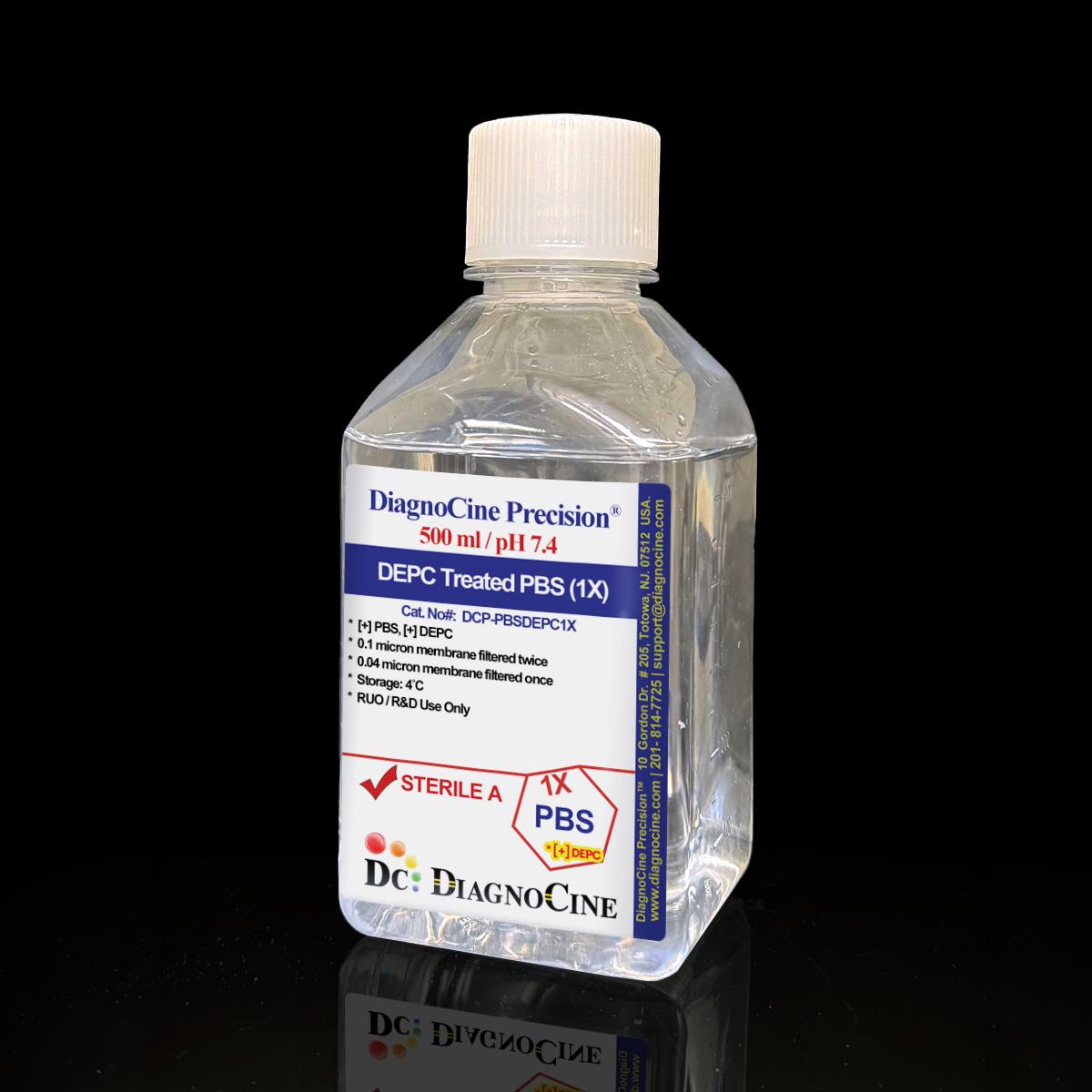
DCP-PBSDEPC1X is an MPS-grade, DEPC-treated 1X phosphate buffered saline engineered for RNase- and DNase-free molecular biology workflows.[1] Formulated to a physiological pH and purified through a quadruple-stage 0.1 µm and 0.04 µm filtration process, it delivers ultra-clean, nuclease-free performance for microfluidic, organ-on-a-chip, and nucleic acid research applications.
- Quadruple-stage filtration: 0.1 µm membrane filtered twice and 0.04 µm membrane filtered twice for ultra-low particulate purity
- DEPC-treated to inactivate RNase and DNase, then autoclaved to ensure sterility and complete removal of residual DEPC
- Physiological pH of 7.0–7.4, formulated with NaCl, KCl, Na2HPO4, and KH2PO4
- Prepared to volume with DEPC-treated, nuclease-free, Ultrapure Type 1 water (18.2 MΩ·cm)
- Sterile, colorless, clear solution ready for use in sensitive molecular biology applications
- Compatible with RNA/DNA isolation, RT-PCR, qPCR, and in vitro transcription workflows
- Manufactured under ISO 13485-certified, CE-approved facilities
- pH, concentration, additives, and formulation customization available on request
- pH
- 7.4
- Formulation
- 1X PBS (NaCl, KCl, Na2HPO4, KH2PO4)
- Nuclease Status
- RNase- and DNase-free (DEPC-treated)
- Water Quality
- Ultrapure Type 1 (18.2 MΩ·cm), DEPC-treated
- Sterility
- Sterile
- Filtration
- 0.1 µm x2 + 0.04 µm x2 (Quadruple-stage)
- Appearance
- Colorless, clear solution
- Storage
- 4°C
- Shelf Life
- 24 months
- Manufacturing
- ISO 13485-certified, CE-approved
Engineered where standard buffers fail
Conventional 0.22 µm-filtered buffers can carry subvisible particulates, residual nucleases, and pH or ionic drift that compromise sensitive nucleic acid workflows. DCP-PBSDEPC1X is built to remove those failure points at the source.
Microchannel-Safe, Nuclease-Free Purity
Quadruple-stage 0.1 µm and 0.04 µm filtration combined with DEPC treatment removes fine particulates and inactivates RNase/DNase for microfluidic-safe use.
Precise, Physiological pH
Formulated to pH 7.0–7.4 with defined NaCl, KCl, Na2HPO4, and KH2PO4 concentrations mimicking physiological ion balance.
Ultrapure DEPC-Treated Water
Prepared with Ultrapure Type 1 water (18.2 MΩ·cm) treated with diethyl pyrocarbonate to inactivate residual nucleases.
Low-Background for Sensitive Assays
Nuclease-free, low-particulate formulation supports clean signal in RT-PCR, qPCR, and in vitro transcription reactions.
Defined, Traceable Composition
Lot-released NaCl, KCl, Na2HPO4, and KH2PO4 in DEPC-treated, nuclease-free water.
Customization on Demand
Alternate concentrations, additives, pH, and modifications available — contact support@diagnocine.com.
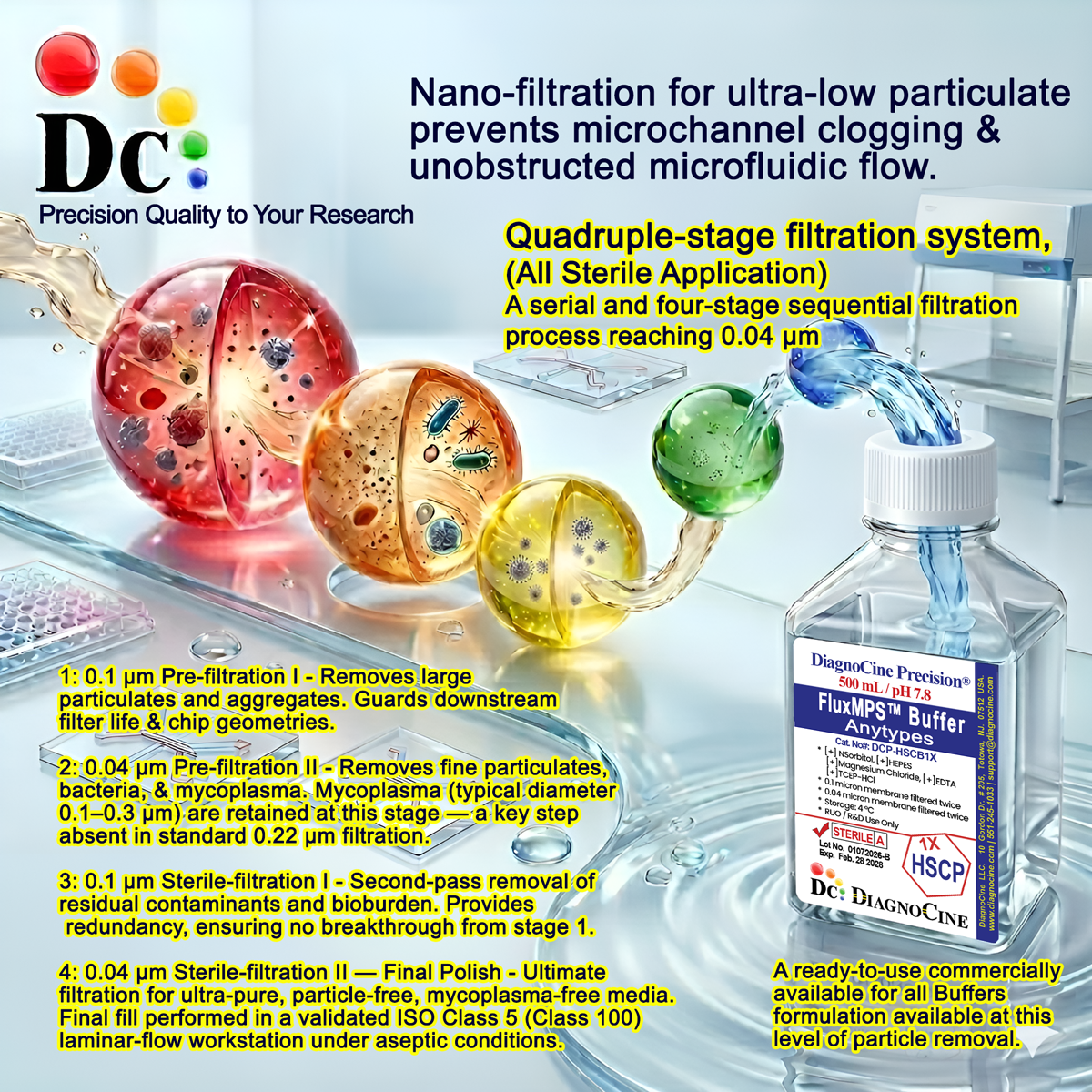
Quadruple-stage filtration system
DCP-PBSDEPC1X is sterile-filtered through a 0.1 µm membrane twice and a 0.04 µm membrane twice, then DEPC-treated and autoclaved — supporting the ultra-low particulate, nuclease-free background required for RNA and DNA workflows.
-
1
0.1 µm Pre-filtration I
Removes large particulates and aggregates, extending downstream filter life.
-
2
0.04 µm Pre-filtration II
Retains fine particulates and bioburden, including organisms as small as mycoplasma, which can measure approximately 0.2 micron.
-
3
0.1 µm Sterile-filtration I
Second-pass redundancy through a 0.1 µm membrane ahead of final polishing.
-
4
0.04 µm Sterile-filtration II — Final Polish
Final 0.04 µm polish performed under ISO Class 5 (Class 100) aseptic fill conditions.
Performance vs. conventional buffer
Sequential 0.1 µm and 0.04 µm filtration, each applied twice, removes finer particulates than a single 0.22 µm pass, supporting the low-particulate, nuclease-free background this buffer is designed to deliver for nucleic acid workflows.
© Diagnocine® — DCP-PBSDEPC1X
Built for nuclease-sensitive research workflows
DCP-PBSDEPC1X supports RNA and DNA isolation and purification, sample preparation for RT-PCR, qPCR, and in vitro transcription, and protein research and immunoassays where nuclease-free conditions are required.[2]
Automated Bioreactors & Robotics
For automated perfusion and robotic liquid-handling platforms, an optional 0.01 µm (10 nm) ultra-filtered variant of this buffer is available to further protect valves, sensors, and microchannels from particulate accumulation.
- Total Particulate Exclusion: 0.01 µm ultra-filtration for the finest downstream particulate protection
- Valve & Sensor Protection: minimizes microparticulate load on automated flow components
- Extended Perfusion Stability: supports longer unattended run times in closed perfusion loops
Inquiry Required: the 0.01 µm ultra-filtered grade is available upon request — contact support@diagnocine.com.
Micro Physiological System (MPS) & Chip
Nuclease-free, ultra-filtered buffer for perfusion and reagent handling in microfluidic chip formats.
RNA & DNA Isolation and Purification
Wash and dilution buffer for nucleic acid isolation workflows requiring RNase- and DNase-free conditions.
iPSC-Derived Model Handling
Nuclease-free wash and resuspension buffer for handling iPSC-derived cell models.
Endothelial & Primary Cell Perfusion
Physiological pH and ionic composition suitable for perfusion of primary and endothelial cell models.
Protein Research & Nuclease-Free Immunoassays
Sterile, nuclease-free buffer for protein research and immunoassays where nuclease contamination must be avoided.
RT-PCR, qPCR & In Vitro Transcription
Nuclease-free sample preparation buffer supporting enzymatic reactions sensitive to RNase/DNase activity.
Full specification sheet
Measured and declared parameters for DCP-PBSDEPC1X.
| Parameter | Specification |
|---|---|
| Formulation / Composition | 1X PBS (NaCl, KCl, Na2HPO4, KH2PO4) in DEPC-treated, nuclease-free water |
| Appearance | Colorless, clear solution |
| pH (USP <791>) | 7.4 |
| Parameter | Specification |
|---|---|
| Sterility (USP <71>) USP | Sterile |
| Water Quality | Ultrapure Type 1 water (18.2 MΩ·cm), DEPC-treated |
| Manufacturing Standard ISO | ISO 13485-certified, CE-approved facilities |
| Fill Environment | ISO Class 5 (Class 100) |
| Parameter | Specification |
|---|---|
| Storage Temperature | 4°C |
| Shelf Life | 24 months |
| Parameter | Specification |
|---|---|
| Raw Material Grade | Ultrapure, DEPC-treated |
| Traceability | Final packaging, quality assurance, and testing performed at the DiagnoCine R&D and Quality Testing Center; customization and assembly performed at DiagnoCine Precision, Totowa, New Jersey, USA |
| Manufacturing QMS ISO | ISO 13485-certified, CE-approved facilities (Suppliers of DiagnoCine Precision) |
| Regulatory Alignment | For Research Use Only (RUO) |
| Production Method | DEPC treatment to inactivate RNase and DNase, followed by 0.04 µm filtration and autoclaving |
| Intended Use | RNA and DNA isolation, RT-PCR, qPCR, in vitro transcription, and nuclease-free molecular biology applications |
Full composition
Component concentrations as formulated in DCP-PBSDEPC1X, prepared to volume in DEPC-treated, nuclease-free water.
| Component | CAS Number | Concentration |
|---|---|---|
| Sodium Chloride (NaCl) | 7647-14-5 | 137 mM |
| Potassium Chloride (KCl) | 7447-40-7 | 2.7 mM |
| Sodium Phosphate Dibasic (Na2HPO4) | 7558-79-4 | 10.1 mM |
| Potassium Phosphate Monobasic (KH2PO4) | 7778-77-0 | 1.76 mM |
| Water (DEPC-treated, nuclease-free) | 7732-18-5 | To volume |
Manufactured under certified quality systems
DCP-PBSDEPC1X is manufactured under ISO 13485-certified and CE-approved facilities, with final packaging, quality assurance, and testing performed at the DiagnoCine R&D and Quality Testing Center.
ISO 13485:2016 QMS
Manufactured under an ISO 13485-certified, CE-approved quality management system.
Ultrapure Type 1 Water
Prepared with DEPC-treated, nuclease-free Ultrapure Type 1 water (18.2 MΩ·cm).
ISO Class 5 Fill & Finish
Final 0.04 µm filtration polish performed under ISO Class 5 (Class 100) aseptic conditions.
Micro-Batch Precision
Customization requests and assembly performed at DiagnoCine Precision in Totowa, New Jersey, USA.
Endotoxin (USP <85> BET)
Tested per the USP <85> Bacterial Endotoxins Test protocol as part of routine quality control.
Particulate (USP <788> Method 2)
Quadruple-stage 0.1 µm and 0.04 µm filtration supports low-particulate quality consistent with USP <788> expectations.
Osmolality (USP <785>)
Formulated to a physiological ion balance in accordance with USP <785> testing methodology.
Documentation / CoA
Certificate of Analysis available upon request for lot-specific data.
How DCP-PBSDEPC1X compares
A side-by-side look at DCP-PBSDEPC1X against conventional 0.22 µm-filtered buffers.
| Parameter | DCP-PBSDEPC1X (FluxMPS™) | Conventional Buffer | Standard Alternative |
|---|---|---|---|
| RNase/DNase-Free (DEPC-Treated) | check_circle | cancel | cancel |
| Final Filtration Pore Size | 0.04 µm | 0.22 µm | 0.22 µm |
| Number of Filtration Stages | 4 | 1 | 1 |
| Sterile | check_circle | check_circle | check_circle |
| Physiological pH 7.0–7.4 | check_circle | cancel | cancel |
| Water Quality | Ultrapure Type 1, DEPC-treated | Standard purified | Standard purified |
| Manufacturing QMS | ISO 13485 / CE | Unspecified | Unspecified |
| Microfluidic Channel Compatibility | check_circle | cancel | cancel |
| Custom Formulation | check_circle | cancel | cancel |
Frequently asked questions
Common questions about DCP-PBSDEPC1X.
Supporting literature
Curated literature relevant to DEPC-treated buffers, PBS chemistry, and organ-on-a-chip / microfluidic applications.
- Ingber DE. Human organs-on-chips for disease modeling, drug discovery and personalized medicine. Nat Rev Genet. 2022;23:467-491. doi:10.1038/s41576-022-00466-9
- Bhatia SN, Ingber DE. Microfluidic organs-on-chips. Nat Biotechnol. 2014;32:760-772. doi:10.1038/nbt.2989
- Huh D, Matthews BD, Mammoto A, Montoya-Zavala M, Hsin HY, Ingber DE. Reconstituting organ-level lung functions on a chip. Science. 2010;328:1662-1668. doi:10.1126/science.1188302
- Kim HJ, Huh D, Hamilton G, Ingber DE. Human gut-on-a-chip inhabited by microbial flora that experiences intestinal peristalsis-like motions and flow. Lab Chip. 2012;12:2165-2174. doi:10.1039/c2lc40074j
- Low LA, Mummery C, Berridge BR, Austin CP, Tagle DA. Organs-on-chips: into the next decade. Nat Rev Drug Discov. 2021;20:345-361. doi:10.1038/s41573-020-0079-3
- Chomczynski P, Sacchi N. Single-step method of RNA isolation by acid guanidinium thiocyanate-phenol-chloroform extraction. Anal Biochem. 1987;162:156-159. doi:10.1016/0003-2697(87)90021-2
- Blumberg DD. Creating a ribonuclease-free environment. Methods Enzymol. 1987;152:20-24. doi:10.1016/0076-6879(87)52005-8
- Green MR, Sambrook J. Diethyl pyrocarbonate (DEPC) treatment to inactivate RNases. Cold Spring Harb Protoc. 2019;2019. doi:10.1101/pdb.prot101659
- Dulbecco R, Vogt M. Plaque formation and isolation of pure lines with poliomyelitis viruses. J Exp Med. 1954;99:167-182. doi:10.1084/jem.99.2.167
- Mosmann T. Rapid colorimetric assay for cellular growth and survival: application to proliferation and cytotoxicity assays. J Immunol Methods. 1983;65:55-63. doi:10.1016/0022-1759(83)90303-4