
CloverDirect, Lys(Me), amber(5×300μl translation)
Product#: FNK-CLD2203
$3,236.50
Availability:
Ships in 1-2 Weeks
CloverDirect, Lys(Me), amber(5×300μl translation)
Cat. No.: FNK- CLD2203
Size: 1 kit
Storage: -80℃. Always store this product in the dark.
This product is stable at - 70°C until the expiration date which is indicated on the outside of the package.
If once unnatural aminoacyl-tRNA is dissolved in tRNA buffer, the unnatural aminoacyl-tRNA solution can be stored at -70°C for 2 months.
Description:
CloverDirectTM tRNA Reagents for Site-Directed Protein Functionalization allow the incorporation of unnatural amino acids at defined positions of proteins using in vitro translation. Incorporation position of unnatural amino acids is defined by a UAG amber codon or CGGG four-base codon. An unnatural aminoacyl-tRNA recognizes the UAG amber codon or the CGGG codon during translation. On the contrary, if the UAG codon is recognized by release factor 1 (RF1) which is one of the termination factors, the protein synthesis is terminated. If the CGG is recognized as a triplet codon by Arg-tRNA, the reading frame shifts to +1 frame and a downstream stop codon will terminate the protein synthesis. Therefore, the translation product obtained as a full-length protein contains the unnatural amino acid at 100% efficiency.
Specifications:
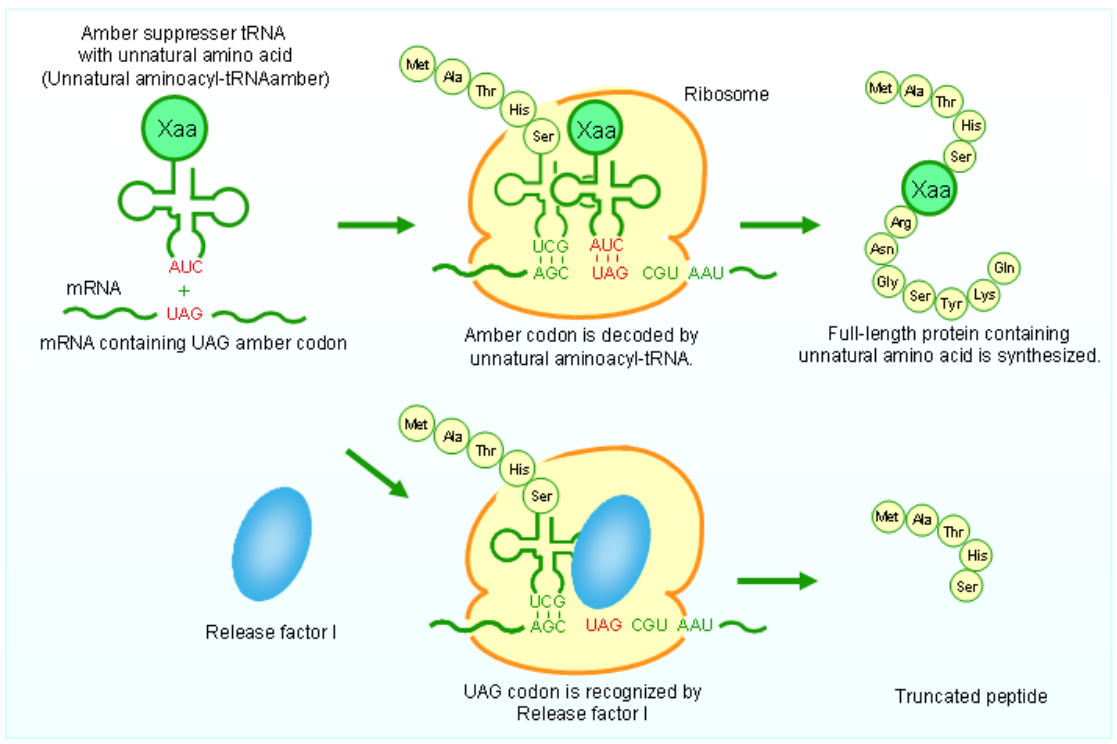
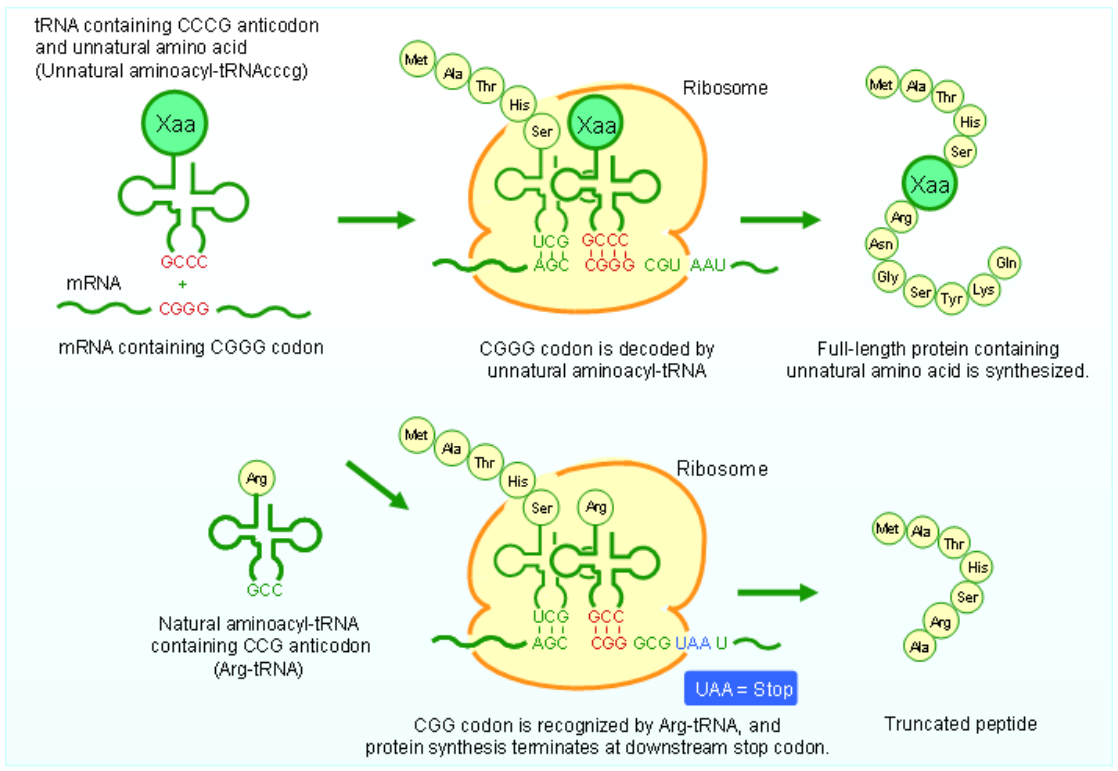
Figure 1 : Principle of incorporation of unnatural amino acids (Top : UAG amber codon. Bottom : CGGG four-base codon)
●Product contents
• Unnatural aminoacyl-tRNA (see note 1) x1
• tRNA buffer x1
Note 1: One tube contains unnatural aminoacyl-tRNA sufficient for 300 µL of in vitro translation reaction.
• tRNA buffer x1
Note 1: One tube contains unnatural aminoacyl-tRNA sufficient for 300 µL of in vitro translation reaction.
●Equipment and reagents to be supplied by others
Protein Expression
• E.coli cell-free translation system (e.g., RYTS kit; ProteinExpress, #CF002)
• Expression gene containing UAG or CGGG codon (plasmid DNA, linear DNA, or messenger RNA).
(Suitable expression vector should be used for the cell-free translation system.)
• Expression gene containing UAG or CGGG codon (plasmid DNA, linear DNA, or messenger RNA).
(Suitable expression vector should be used for the cell-free translation system.)
Purification, buffer exchange, and concentration
• Affinity column and buffer for purification (e.g., His SpinTrapTM kit; GE Healthcare Science, #28-9321-71)
• Ultrafiltration membrane and buffer (e.g., AmiconUltra-0.5; Millipore, #UFC501024)
• Ultrafiltration membrane and buffer (e.g., AmiconUltra-0.5; Millipore, #UFC501024)
●Points to note
Protein expression
Confirm your protein can be expressed in E.coli cell-free translation system. In case of very low expression of a wild-type gene which does not contain UAG codon or CGGG codon, optimization of nucleotide sequence (codon usage, addition of N-terminal tags, etc.) is required to improve the expression.
Incorporation site-dependency
Some unnatural amino acids are allowed to be incorporated only at the N-terminal region (within 20 amino acid residues from the N-terminus). Please check the product list for details.
*Incorporation at N-terminal regions (within 20 amino acid residues from the N-terminus) in response to CGGG codon sometimes results in the production of full-length proteins without unnatural amino acids, possibly because of spontaneous +1 frameshifting. In such case, ProteinExpress recommends the use of ProXTM tag, which is original peptide tag developed for the CGGG codon-mediated incorporation of unnatural amino acids.
| 5' | AUG | UCU | AAA | CAA | AUC | GAA | GUA | AAC | UAG or CGGG |
UCU | AAU | GAG | -3' |
| Met | Ser | Lys | Gln | Ile | Glu | Val | Asn | Xaa | Ser | Asn | Glu |
●Generation of expression gene
The expression gene must contain amber UAG codon or CGGG four-base codon.
Additionally, please check the following points.
• Additional of C-terminal tag for purification Reaction mixture includes several proteins derived from cell-free translation system and unnatural amino acid which is not incorporated into protein. Full-length protein containing unnatural amino acid can be isolated by C-terminal tag such as His tag for purification.
• UAG amber codon for unnatural amino acids In case the termination codon of your gene of interest is UAG amber codon, the stop signal must be substituted by other terminaltion codon (UAA or UAG).
• CGGG four-base codon for unnatural amino acids In case of the expression gene containing CGG codons, the CGG must be substituted by other arginine codon (CGU or CGC), possibly because of the CGG is mis-recognized as a triplet codon by the CCCG four-base anticodon.of unnatural aminoacyl-tRNA.
●Protocols
Protein Expression
The following protocol is an example of protein expression by RYTS kit (ProteinExpress).
Equipment and reagents to be supplied by others
• Cell-free translation system E.coli
(e.g., RYTS kit; ProteinExpress, #CF002)
• Expression gene containing UAG or CGGG codon (plasmid DNA,
linearDNA, or messenger RNA)
(e.g., RYTS kit; ProteinExpress, #CF002)
• Expression gene containing UAG or CGGG codon (plasmid DNA,
linearDNA, or messenger RNA)
Requirement of nuclease free environment
To eliminate nuclease contamination, you should wear gloves when preparing reaction mixture, reaction tubes and pipette tips should be nuclease-free. Avoid a template DNA or mRNA solution from contamination of nucleases.
| Cap No. / Cap color / Reagents | Volume |
| 1 / white / E.coli Lysate | 100 µL |
| 2 / pink / 2× Reaction Mix | 150 µL |
| 3 / blue / Methionine | 3 µL |
| 4 / orange / Enzyme Mix | 15 µL |
| a) circular DNA or linear DNA b) mRNA |
a) 0.4 – 1.0 µg
b) 50 – 100 µg
|
| Dissolved unnatural aminoacyl-tRNA (240 µΜ) | 10 µL |
| 6 / clear / Nuclease Free Water | up to 300 µL |
●Procedure
(Step1) unnatural aminoacyl-tRNA is provided as a lyophilized powder in tubes. Centrifuges one tube of unnatural aminoacyl-tRNA, and add 10 µL of tRNA buffer to the unnatural aminoacyl-tRNA tube, and vortex to dissolve completely.
(Step2) Mix RNase-free water, template DNA (or mRNA), amino acids, Methionine, and reaction mix to a new 1.5 mL microcentrifuge tube.
(Step3) Mix 10 µL of unnatural aminoacyl-tRNA solution from Step1 and 100 µL of E.coli lysate to the reaction mix prepared in Step2
(Step4) Incubate at 30°C for 0.5 to 2 hours.
(Step5) Stop the reaction by placing the tube on ice, and proceed with sample analysis by SDS-PAGE etc.
(Step2) Mix RNase-free water, template DNA (or mRNA), amino acids, Methionine, and reaction mix to a new 1.5 mL microcentrifuge tube.
(Step3) Mix 10 µL of unnatural aminoacyl-tRNA solution from Step1 and 100 µL of E.coli lysate to the reaction mix prepared in Step2
(Step4) Incubate at 30°C for 0.5 to 2 hours.
(Step5) Stop the reaction by placing the tube on ice, and proceed with sample analysis by SDS-PAGE etc.
Expression of site-directly labeled proteins
TAMRA-labeled unnatural amino acids are incorporated into four prokaryote and four eukaryote proteins using RYTS (Product Code, #CF002) and CloverDirect TM TAMRA (Product Code, #CLD02 and #CLD06). The site-directly fluorescent-labeled proteins can be visualized on SDS-PAGE using a laser-based fluorescence scanner. A 0.25 ~ 1 µL of translational reaction mixture is sufficient for the detection of fluorescent-labeled proteins.
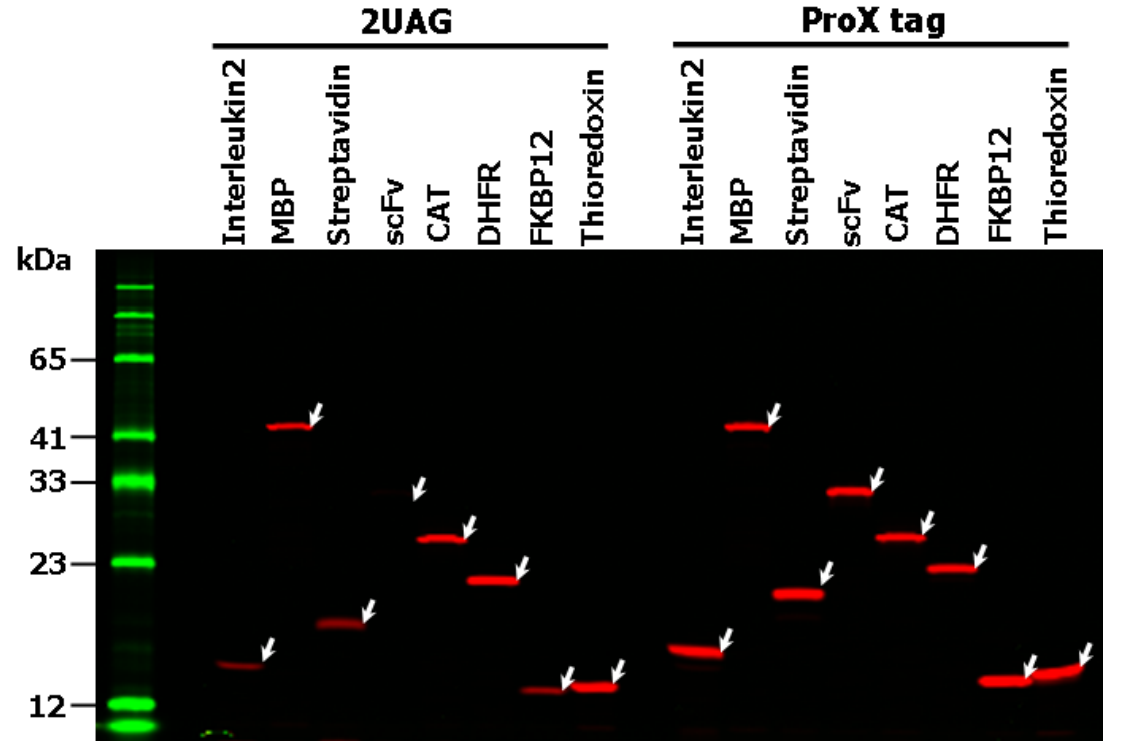
Figure 3 : Expression of site-directly labeled proteins
2UAG : UAG codon is inserted after initiator AUG codon.
ProX tag* : ProX tag is fused to the N-terminus. Applied volume : 0.25 µL of translational reaction mix
Fluorescence image : Excitation at 532 nm and emission at 580 nm.
*ProX tag is original peptide tag developed for incorporation of unnatural amino acids.
ProX tag* : ProX tag is fused to the N-terminus. Applied volume : 0.25 µL of translational reaction mix
Fluorescence image : Excitation at 532 nm and emission at 580 nm.
*ProX tag is original peptide tag developed for incorporation of unnatural amino acids.
●Purification (e.g. His tag)
Reaction mixture includes several proteins derived from cell-free translation system and unnatural amino acid which is not incorporated into protein. Full-length protein containing unnatural amino acid can be isolated by purification for C-terminal tag such as His tag. The following protocol is an example of purification by His SpinTrapTM Column (GE helthcare).
●Additional material and equipment required
• His SpinTrapTM Column (GE Healthcare Science, #28-9321-71)
• Wash buffer
(20 mM Phosphate buffer (pH7.4) / 0.5 M NaCl / 60 mM imidazole / 0.1% Polyoxyethylene(23)Lauryl Ether)
• Elute buffer
(20 mM Phosphate buffer (pH7.4) / 0.5 M NaCl / 0.5 M imidazole / 0.1% Polyoxyethylene(23)Lauryl Ether)
• Wash buffer
(20 mM Phosphate buffer (pH7.4) / 0.5 M NaCl / 60 mM imidazole / 0.1% Polyoxyethylene(23)Lauryl Ether)
• Elute buffer
(20 mM Phosphate buffer (pH7.4) / 0.5 M NaCl / 0.5 M imidazole / 0.1% Polyoxyethylene(23)Lauryl Ether)
●Procedure
(Step1) Twist off the bottom closure of His SpinTrapTM Column, and place the column in a 2 ml microcentrifuge tube.
(Step2) Centrifuge for 1 min at 70 to 100 x g, and Discard flow-through.
(Step3) Add 500 µL of Wash buffer, and centirifuge for 1 min at 70 to 100 x g, and discard flow-through.
(Step4) Add 50 µL of cell-free expression reaction and 350 µL Wash buffer into the column, and mix gently.
(Step5) Incubate the column for 10 min, and centirifuge for 1 min at 70 to 100 x g.
(Step6) Discard flow-through and add 500 µL of Wash buffer into the column, and centirifuge for 1 min at 70 to 100 x g. Repeat this step a total of three times.
(Step7) Place the column in a new 2 ml microcentrifuge tube.
(Step8) Add 200 µL of Elute buffer, and incubate the column for 10 min, and centirifuge for 1 min at 70 to 100 x g.
(Step9) Repeat step 8
(Step10) Collect the elution from step8 and 9.
(Step2) Centrifuge for 1 min at 70 to 100 x g, and Discard flow-through.
(Step3) Add 500 µL of Wash buffer, and centirifuge for 1 min at 70 to 100 x g, and discard flow-through.
(Step4) Add 50 µL of cell-free expression reaction and 350 µL Wash buffer into the column, and mix gently.
(Step5) Incubate the column for 10 min, and centirifuge for 1 min at 70 to 100 x g.
(Step6) Discard flow-through and add 500 µL of Wash buffer into the column, and centirifuge for 1 min at 70 to 100 x g. Repeat this step a total of three times.
(Step7) Place the column in a new 2 ml microcentrifuge tube.
(Step8) Add 200 µL of Elute buffer, and incubate the column for 10 min, and centirifuge for 1 min at 70 to 100 x g.
(Step9) Repeat step 8
(Step10) Collect the elution from step8 and 9.
●Troubleshooting
| Low or no protein production | |
| 1) Expired Kit | Use before expiration date. |
| 2) Inappropriate storage condition | Store this product at appropriate temperature, and avoid multiple freeze-thawing. |
| 3) Nuclease contamination | Nucleases markedly influence on productivity of protein. |
| 4) Cloning error | Check the sequence. |
| 5) Difficult to produce the target protein using E.coli cell-free system | Addition of ProX tag to the protein N-terminus may be effective (See Incorporation site-dependency). |
| Low or no activity of protein | |
| 1) Disulfide bond is essential for the protein activity | Addition of oxidized glutathione may be effective. The adequate concentration of oxidized glutathione is ten millimolar. |
| 2) Post-translational modification is required for the protein activity | In E.coli cell-free system, post-translational modification activity such as glycosylation and phosphorylation is lacked. |
| 3) Protein folding is not correct | Lower reaction temperature may be effective for correct folding. Otherwise, please try to investigate refolding condition. |
| Protein with unnatural amino acid is not pure | |
| 1) Inappropriate purification condition | Check purification condition. (See Page 10) |
| 2) Remain unnatural amino acid which is not incorporated into protein | Try additional purification such as gel- filtration or desalting. |
●References
1) FRET analysis of protein conformational change through position- specific incorporation of fluorescent amino acids
Daisuke Kajihara, Ryoji Abe, Issei Iijima, Chie Komiyama, Masahiko Sisido and Takahiro Hohsaka
Nature Methods., 3, 923-929 (2006).
2) Position-specific incorporation of fluorescent non-natural amino acids into maltose-binding protein for detection of ligand binding by FRET and fluorescence quenching
Issei Iijima and Takahiro Hohsaka
ChemBioChem., 2009, 10, 999-1006.
3) Position-specific incorporation of biotinylated non-natural amino acids into a protein in a cell-free translation system
Takayoshi Watanabe, Norihito Muranaka, Issei Iijima and Takahiro Hohsaka
Biochem. Biophys. Res. Commun., 361, 794-799 (2007)
4) Comprehensive screening of amber suppressor tRNAs suitable for incorporation of non-natural amino acids in a cellfree translation system
Hikaru Taira, Yosuke Matsushita, Kenji Kojima, Kaori Shiraga and Takahiro Hohsaka Biochem. Biophys. Res. Commun., 374, 304-308 (2008).
5) Efficient Incorporation of Nonnatural Amino Acids with Large Aromatic Groups into Streptavidin in In Vitro Protein Synthesizing Systems
Takahiro Hohsaka, Daisuke Kajihara, Yuki Ashizuka, Hiroshi Murakami and Masahiko Sisido
J. Am. Chem. Soc., 121, 34-40 (1999).
6) Incorporation of fluorescent non-natural amino acids into N-terminal tag of proteins in cell-free translation and its dependence on position and neighboring codons
Ryoji Abe, Kaori Shiraga, Shogo Ebisu, Hiroaki Takagi and Takahiro Hohsaka
J. Biosci. Bioeng., 110, 32-38 (2010)