


Citrate Buffer, Sterile [0.1X]
FluxMPS™ Citrate Buffer, Sterile [0.1X]
An MPS-grade, 0.1 M citrate buffer at pH 3.0, manufactured with quadruple-stage filtration for ultra-low particulate, mycoplasma-safe purity. Sterile, ultrapure, and DNase/RNase-tested, it is built for immunohistochemistry, nucleic acid work, and microfluidic channel-safe research applications.
- Quadruple-stage filtration: 0.1 µm membrane filtered twice and 0.04 µm membrane filtered twice for ultra-low particulate purity
- Precise, defined formulation: pH 3.0, 0.1 M citrate buffer (0.1X)
- Sterile and ultrapure — filtered and packaged in a sterile environment
- No detectable DNase or RNase activity after 18-hour incubation at room temperature
- Manufactured with ultrapure Type 1 water (18.2 MΩ·cm)
- Produced under ISO 13485-certified, CE-approved facilities
- Supports IHC antigen retrieval, RNA extraction, DNA FISH, enzymatic reactions, and chromatography
- Custom concentrations, pH, and additive formulations available on request
- pH3.0
- Molarity / Concentration0.1 M
- Dilution Factor0.1X
- AppearanceClear, Colorless Liquid
- Filtration0.1 µm membrane x2, 0.04 µm membrane x2
- SterilitySterile, filtered in a sterile environment
- DNase ActivityNone detected (18 hr, RT)
- RNase ActivityNone detected (18 hr, RT)
- Storage4°C
- Shelf Life18 months
Engineered where standard buffers fail
Conventional 0.22 µm-filtered buffers can carry subvisible particulates, drift in pH, and permit mycoplasma-sized organisms to persist — all of which accumulate in microchannels, elevate assay background, and compromise reproducibility. FluxMPS™ Citrate Buffer is engineered against every one of these failure modes.
Microchannel-safe purity
Quadruple-stage 0.1 µm / 0.04 µm filtration removes fine particulates that a single-pass 0.22 µm filter can miss, protecting delicate microfluidic channels and valves.
Precise, stable pH
Formulated to a defined 0.1 M molarity at pH 3.0, and designed to maintain relatively stable pH across a range of temperatures, suiting protocols with temperature changes.
Ultrapure-grade water
Manufactured with ultrapure Type 1 water (18.2 MΩ·cm), consistent with USP <85> water-quality practice.
Low background for imaging & assays
As a citrate-based antigen retrieval buffer it is known to enhance staining intensity without increasing background signal, improving signal-to-noise in IHC and imaging workflows.
Defined, traceable composition
Tested and confirmed free of detectable DNase and RNase activity after 18-hour incubation, with all packaging, QA, and testing performed at the DiagnoCine R&D and Quality Testing Center.
Customization on demand
Other concentrations, pH values, and additions of chemicals, compounds, proteins, or supplements can be arranged — contact support@diagnocine.com.
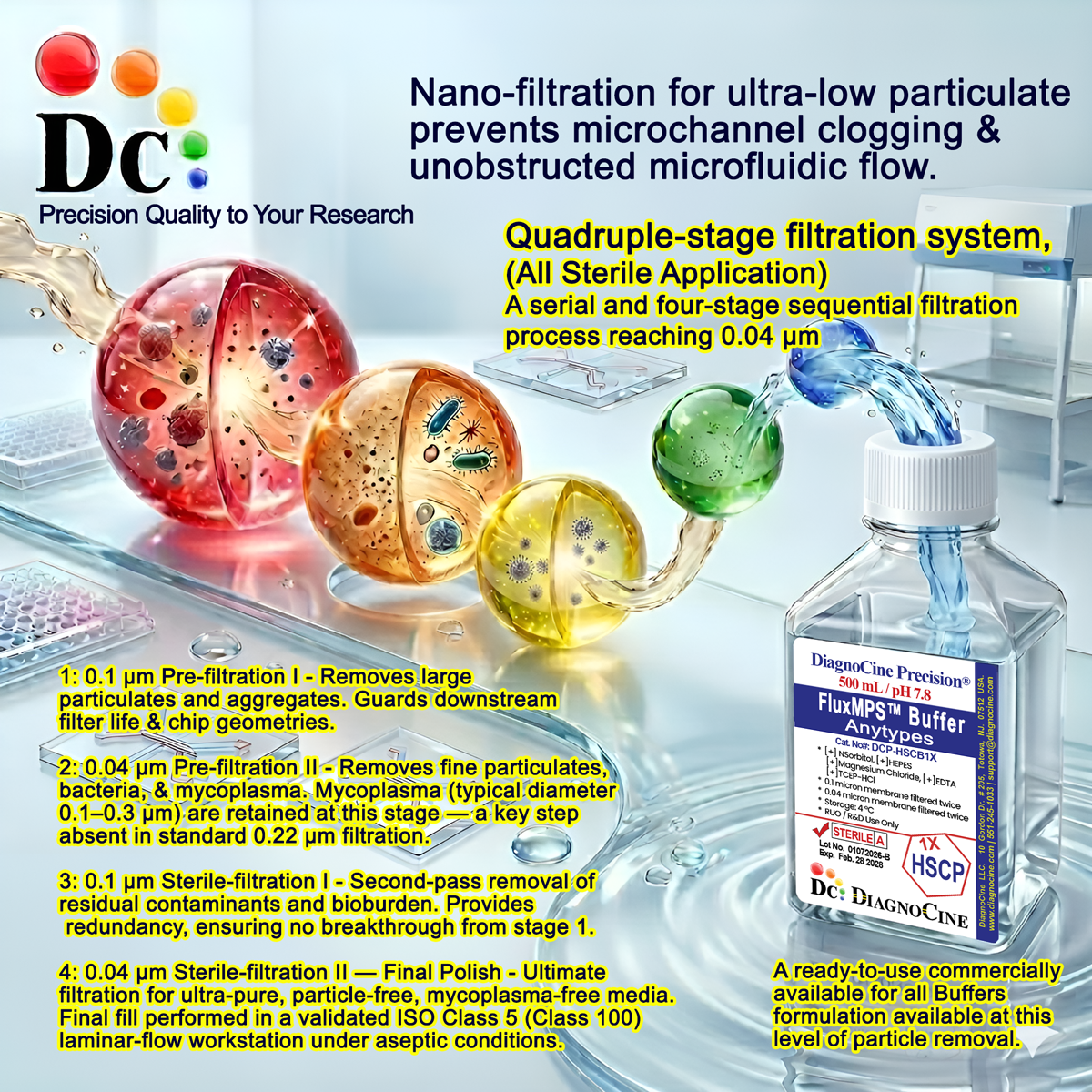
Quadruple-stage filtration system
DCP-CB0.1X is filtered with a 0.1-micron membrane twice and a 0.04-micron membrane twice, all within a sterile filling environment, delivering an ultra-low particulate, mycoplasma-safe buffer for cell and molecular biology work.
-
1
0.1 µm Pre-filtration I
Removes large particulates and aggregates, extending the working life of downstream filtration stages.
-
2
0.04 µm Pre-filtration II
Retains fine particulates and bioburden. The smallest mycoplasma species can be as small as approximately 0.2 micron, so this stage is a key line of defense against mycoplasma contamination.
-
3
0.1 µm Sterile-filtration I
A second 0.1-micron pass adds redundancy ahead of final polishing.
-
4
0.04 µm Sterile-filtration II — Final Polish
A second 0.04-micron pass delivers the final polish, completed in a sterile environment to prevent mycoplasma contamination.
Performance vs. conventional buffer
Sequential 0.1 µm and 0.04 µm filtration, applied twice each, removes finer particulates and mycoplasma-sized contaminants than a single 0.22 µm pass used in conventional buffer solutions.
© Diagnocine® — DCP-CB0.1X
Where DCP-CB0.1X performs
Citrate buffer is a versatile reagent across immunohistochemistry, nucleic acid preparation, molecular cytogenetics, and analytical chemistry, with formulation choices tuned to protect sensitive downstream workflows.
Automated Bioreactors & Robotics
For automated perfusion systems and robotic liquid handlers, an optional 0.01 µm (10 nm) ultra-filtered grade of this buffer can be arranged to further reduce particulate load on valves, sensors, and long-duration perfusion loops.
- Total Particulate Exclusion: Finer filtration reduces the risk of particulate accumulation in automated fluidic pathways.
- Valve & Sensor Protection: Lower particulate load helps protect precision valves and in-line sensors from fouling.
- Extended Perfusion Stability: Cleaner input buffer supports longer unattended perfusion runs.
Inquiry Required: The 0.01 µm ultra-filtered grade is available on request — contact support@diagnocine.com.
Micro Physiological System (MPS) & Chip
MPS-grade purity suited to organ-on-a-chip and lab-on-a-chip workflows where microchannel integrity matters.
Heat-Induced Epitope Retrieval (HIER)
Breaks protein cross-links formed during formalin fixation to unmask antigens and epitopes on FFPE tissue sections, enhancing antibody staining intensity with a very low background.
RNA Extraction Support
Helps prevent base hydrolysis during RNA extraction protocols.
DNA Fluorescent In Situ Hybridization
Used in DNA FISH workflows as part of probe hybridization and detection protocols.
Enzymatic Reactions & Chromatography
Its chelating action on calcium ions and stable low pH support use in enzymatic reaction buffers and chromatography workflows.
Microscopy & Optical Sensing
Low-background performance supports high signal-to-noise imaging and optical detection applications.
Specifications at a glance
Measured and declared values for DCP-CB0.1X, Citrate Buffer, Sterile [0.1X].
| Parameter | Specification |
|---|---|
| Formulation / Composition | Citrate Buffer, 0.1 M (0.1X) |
| Appearance | Clear, Colorless Liquid |
| pH USP <791> | 3.0 |
| Molarity / Concentration | 0.1 M |
| Dilution Factor | 0.1X |
| Parameter | Specification |
|---|---|
| Sterility USP <71> | Filtered 0.1 µm membrane twice and 0.04 µm membrane twice in a sterile environment |
| DNase Activity | None detected after 18-hour incubation with plasmid DNA at room temperature |
| RNase Activity | None detected after 18-hour incubation with ribosomal RNA at room temperature |
| Water Quality | Ultrapure Type 1 water (18.2 MΩ·cm) |
| Parameter | Specification |
|---|---|
| Storage Temperature | 4°C |
| Shelf Life | 18 months |
| pH Stability | Maintains relatively stable pH over a range of temperatures |
| Parameter | Specification |
|---|---|
| Raw Material Grade | Ultrapure |
| Manufacturing QMS ISO 13485 | ISO 13485-certified, CE-approved supplier facilities |
| Traceability | Final packaging, QA, and testing performed at the DiagnoCine R&D and Quality Testing Center |
| Production Method | Customization and assembly at DiagnoCine Precision, Totowa, New Jersey, USA |
| Intended Use | Research Use Only (RUO) |
Full composition
Citrate buffer system formulated to 0.1 M at pH 3.0, prepared and packaged under sterile, quadruple-stage filtered conditions.
| Component | CAS Number | Concentration |
|---|---|---|
| Citrate Buffer (Sodium Citrate / Citric Acid System) | 0.1 M |
Manufacturing & compliance
DCP-CB0.1X is manufactured under a formal quality system, with final packaging, QA, and testing performed at the DiagnoCine R&D and Quality Testing Center.
ISO 13485:2016 QMS
Manufactured under ISO 13485-certified and CE-approved supplier facilities.
Ultrapure Type 1 Water
Formulated with ultrapure Type 1 water (18.2 MΩ·cm).
Sterile Fill & Finish
Filtered and packaged in a sterile environment to prevent mycoplasma contamination.
Micro-Batch Precision
Customization and assembly completed at DiagnoCine Precision, Totowa, New Jersey, USA.
DNase / RNase Testing
No DNase or RNase activity detected after 18-hour incubation with plasmid DNA or ribosomal RNA at room temperature.
Sterility Methodology USP <71>
Filtered 0.1 µm membrane twice and 0.04 µm membrane twice in a sterile environment.
pH Methodology USP <791>
Formulated and controlled to pH 3.0.
Documentation / CoA
A Certificate of Analysis can be requested for this lot.
How DCP-CB0.1X compares
A side-by-side view of DCP-CB0.1X against conventional single-pass filtered citrate buffer.
| Parameter | DCP-CB0.1X (FluxMPS™) | Conventional 0.22 µm buffer | Standard alternative buffer |
|---|---|---|---|
| Defined pH & Molarity (pH 3.0, 0.1 M) | check_circle | cancel | cancel |
| Final filtration pore size | 0.04 µm | 0.22 µm | 0.22 µm |
| Number of filtration stages | 4 | 1 | 1 |
| Sterility methodology USP <71> | check_circle | cancel | cancel |
| DNase / RNase tested absence | check_circle | cancel | cancel |
| Ultrapure Type 1 water base | check_circle | cancel | cancel |
| ISO 13485-certified, CE-approved manufacturing | check_circle | cancel | cancel |
| Microfluidic channel compatibility | check_circle | cancel | cancel |
| Stable pH across temperature range | check_circle | cancel | cancel |
| Custom formulation available | check_circle | cancel | cancel |
Frequently asked questions
Common questions about DCP-CB0.1X, Citrate Buffer, Sterile [0.1X].
Supporting literature
Curated literature relevant to citrate buffer use in antigen retrieval, nucleic acid work, microfluidics, and sterility control.
- Shi SR, Key ME, Kalra KL. Antigen retrieval in formalin-fixed, paraffin-embedded tissues: an enhancement method for immunohistochemical staining. J Histochem Cytochem. doi:10.1177/002215549104100601
- Shi SR, Cote RJ, Taylor CR. Antigen retrieval immunohistochemistry: past, present, and future. J Histochem Cytochem. doi:10.1177/002215549704501001
- Ingber DE. Reverse engineering human pathophysiology with organs-on-chips. Cell. doi:10.1016/j.cell.2016.05.021
- Huh D, Matthews BD, Mammoto A, et al. Reconstituting organ-level lung functions on a chip. Science. doi:10.1126/science.1188302
- Bhatia SN, Ingber DE. Microfluidic organs-on-chips. Nat Biotechnol. doi:10.1038/nbt.2989
- Uphoff CC, Drexler HG. Detection of mycoplasma contamination in cell cultures. Curr Protoc Mol Biol. doi:10.1002/0471142727.mb2404s106
- Levine AJ. Buffers and pH control in molecular biology reactions. Methods Enzymol. doi:10.1016/S0076-6879(09)64001-2
- Speirs V, Ellison DW. Citrate buffer-based antigen retrieval protocols for immunohistochemistry. Methods Mol Biol. doi:10.1007/978-1-60761-950-5_9