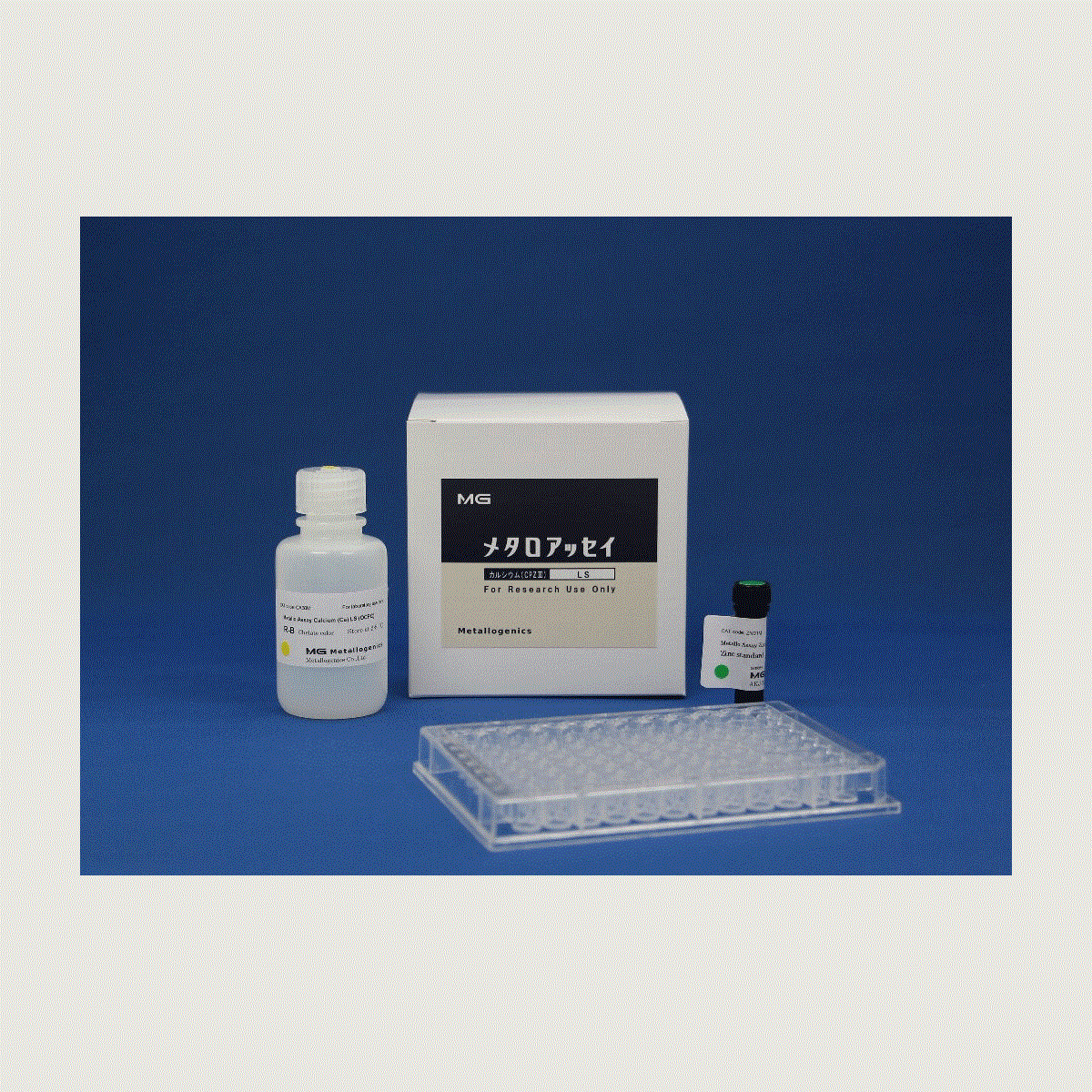
Calcium Assay kit LS - O-Cresolphtalein method, LARGE
Calcium Assay kit LS - O-Cresolphtalein method, LARGE
Cat. No. FNK-CA31ME
Size 500 tests / 1 kit
Store 4 oC
Measuring range 0.2 - 30 mg/dl
Wavelength (maximume wavelength) 560 - 590 nm (570 nm)
Chromogen OCPC
Target Copper Calcium (Ca)
Description
Metallo Assay Calcium Assay kit LS is intended for the quantitative determination of calcium in biological sample by 96-well reader use. Target: calcium(Ca). Measuring range: 0.2-30 mg/dL. Species: all Sample: serum, plasma, urine, saliva, tissue extract, cell lysate, biological fluid, food, beverage etc. Apparatus: UV/Vis 96-well reader or spectrophotometer Wavelength: 690 nm ( 680-700 nm) Procedure: 10 min
Now, the trace metals can be measured easily by microplate reader!
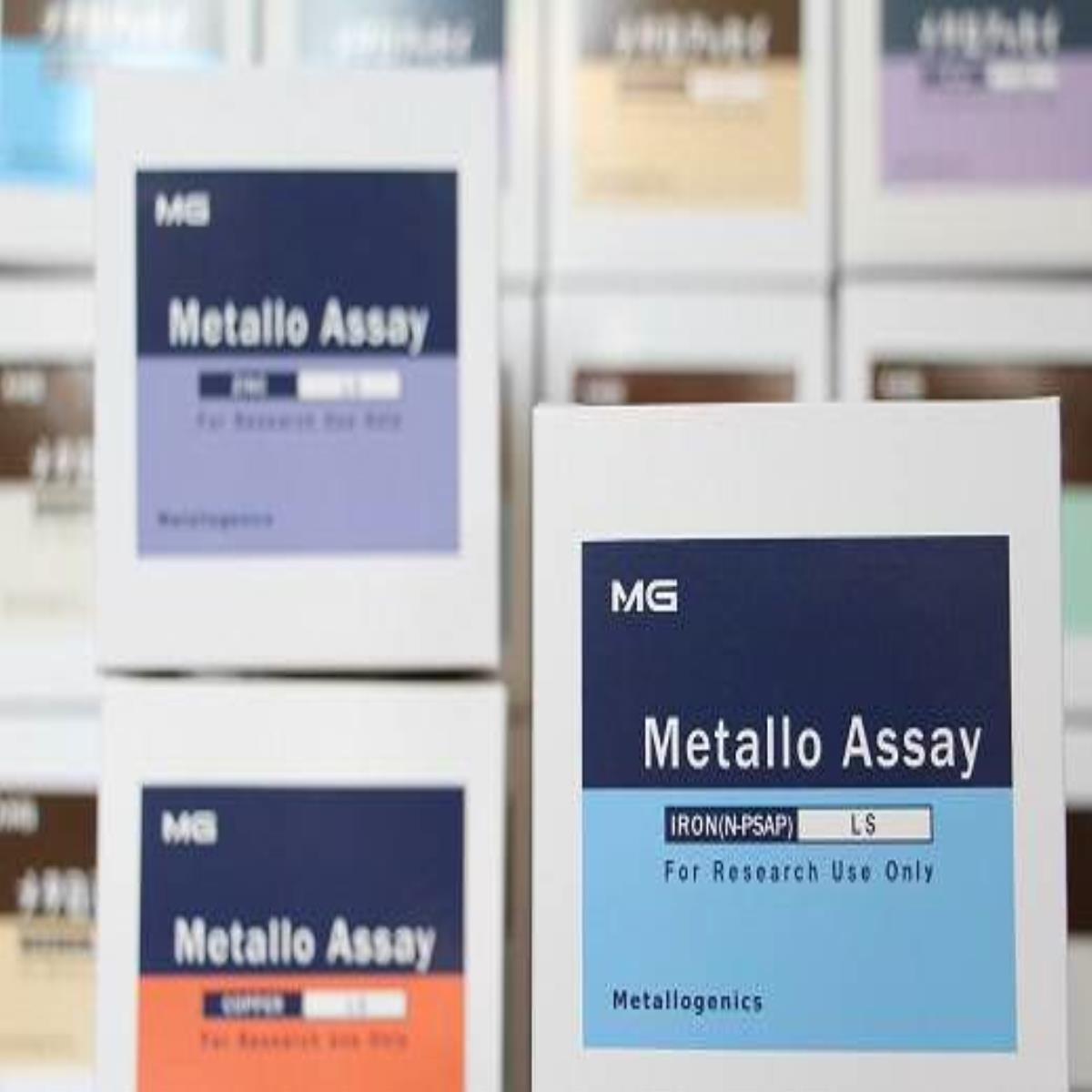
"Metallo Assay LS" Series

Calcium is the most abundant and one of the most important minerals in the human body. Approximately 99% of body calcium is found in bones. The calcium level in the extracellular space is in dynamic equilibrium with the rapidly exchangeable fraction of bone calcium. Calcium ions affect the contractility of heart and skeletal musculature and are essential for the function of the nervous system. Calcium ion play an important role in blood clotting and bone minimization. In plasma, calcium is bound to a considerable extent to proteins, 10 % is in the form of inorganic complexes and 50 % is present as free ion species. The calcium homeostasis regulated by the parathyroid hormone (PTH), calcitriol(CT), and calcitonin. A decrease in albumin level causes a decrease in serum calcium.
Low levels of calcium are found in hypoparathyroidism, pseudohypoparathyroidism, vitamin D deficiency, malnutrition and intestinal malabsortion. Among causes of hypercalcemia are cancers, large intake of vitamin D, enhanced renal retention, osteoporosis, sarcosidosis, thyrotoxicosis, hyperparathyroidism.
This product is a direct colorimetric assay kit without deproteinization of the sample. Calcium with o-cresolphthalein (as chelator) at strong alkaline pH, yields a violet colored complex. The intensity of the color formed is proportional to the calcium concentration in the sample
- Unstableness of incubation temperature may result in unstable results.
- Use disposable test tube and glassware washed with 1M HNO3 or 1M HCl solution and distilled water.
- Accuracy in pipetting volume for samples and reagents may affect the quality of assay. Please note that samples, standards and Working Reagent must be poured accurately µL level.
- Temperature for chromogen reaction may affect optical density. Please try to extend or shorten chromogen reaction time depending on room temperature.
- In the cell lysate or the tissue extract use as specimen, high concentration of proteins or lipid, may affect observed value. Please remove its by ultrafiltration or centrifugation.
Expiration: 1 year from the date of manufacture. After the bottles are opened, the kit should be used in 1 month.
Operation
removed by filtration or centrifugation. EDTA-plasma cannot
be used.
6M HCl/ 1mL of lysate.). Centrifuge at 6,000 rpm for 15 min.
Collect the supernatant and use it for assay.
30 min. Centrifuge at 6,000 rpm for 15 min. Collect the
supernatant and use it for assay.
2. Assay preparation
3. Assay procedure.
(1) Add 2 µL of Distilled water (Blank) / STD (Standard)/ sample into each well.
(2) Add 240 µL of R-R to each well and incubate at room temperature for 10 min.
(3) Read the absorbance at 690 nm (main) and 750 nm (sub).
--> OD
* Select the filter: 680-700 nm at 690nm (main), 740-800 nm at 750 nm (sub).
Assay Result


Example of use
- Metallomics research
- Trace metal research as effector of enzyme / transcription activity
- Quantification of heavy metal accumulated in body
- Quantification of trace metal for drag discovery support research
- Research of relation between plant growth factor and trace metal
- Research for metabolism / kinetics mechanism of trace metal in the cell
- Trace metal research as trigger of reactive oxygen species (ROS)
- Research of relation between trace metal metabolism / dynamic derangement and disease
- Research of trace metal as a cofactor of antioxidant enzyme
- ...and more!
- J. W. Ferguson, J. J. Richard, J. W. O'laughlin and C. V. Banks: Simultaneous Spectrophotometric Determination of Calcium and Magnesium with Chlorophosphonazo-III, Anal. Chem, 36, 796.2 (1962).
- Harold. V, Connerty. MD, Anglis. R, Briggs. BS:Determination of serum calcium by means of orthocresolphthalein complexone.Am J Clin Pathol ,45, p290-296 (1966).
- Fujita. T, Noguchi. K, Terashima. I : Apoplastic mesophyll signals induce rapid stomatal responses to CO2 in Commelina communis, New Phytol, 199(2), p395-406 (2012).
- K. Hisano, O. Fujise, M. Miura, T. Hamachi, E. Matsuzaki andF. Nishimura: Molecular Oral Microbiology, 29(2), p79-89 (2014).