

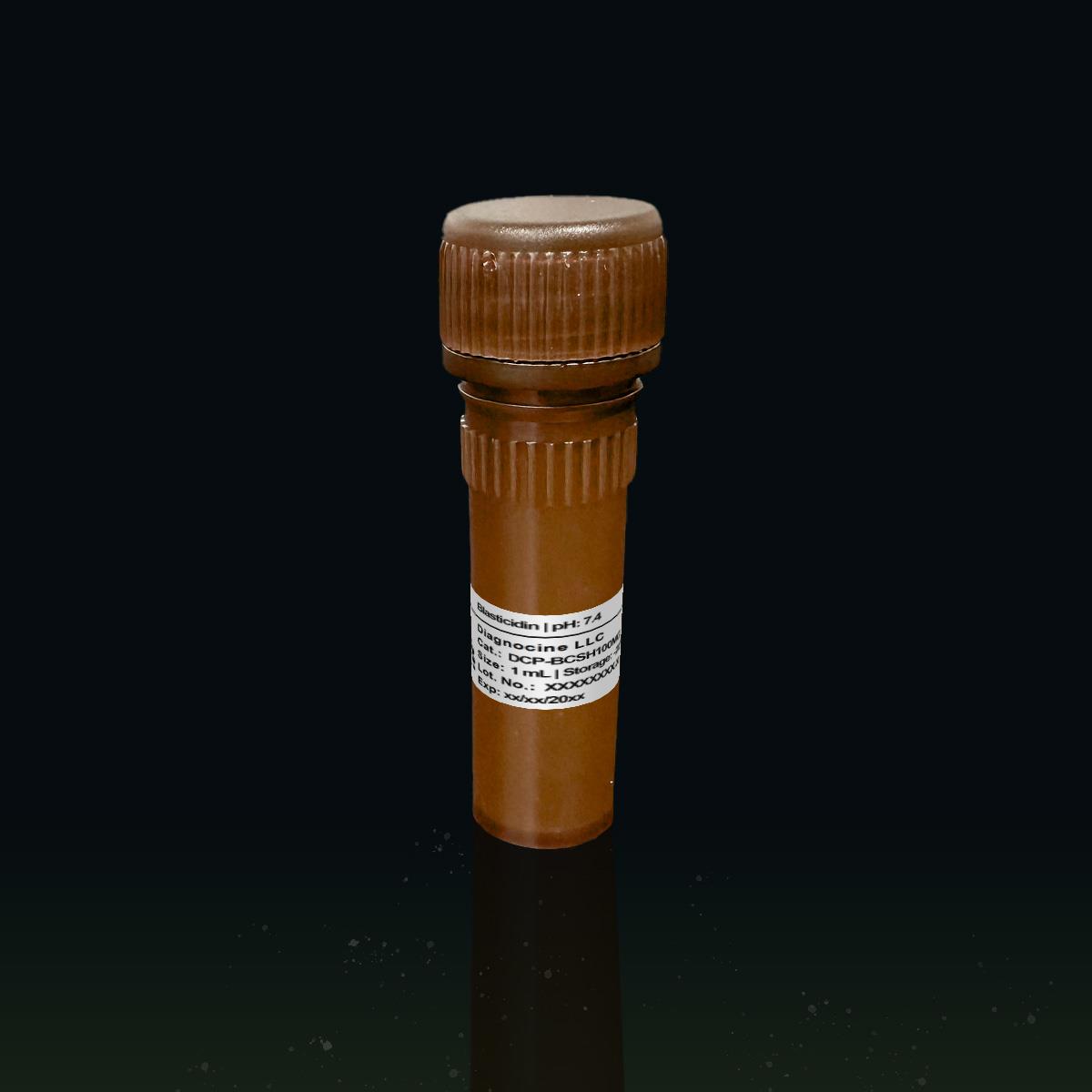
FluxMPS™ Blasticidin (10 mg/mL)
A Microfluidics Suitable, dual-stage ultra-filtered (0.1 µm → 0.04 µm) 10 mg/mL Blasticidin S HCl selection reagent, supplied ready-to-use in 20 mM HEPES buffer at pH 7.4. Formulated for low-particulate, aseptic delivery into microfluidic channels, organ-on-a-chip (OoC) and microphysiological systems (MPS), as well as conventional stable-selection workflows.
- Sterile, HEPES-buffered (20 mM, pH 7.4) blasticidin selection reagent, ready-to-use at 10 mg/mL
- Dual-stage filtration (0.1 µm → 0.04 µm) for low-particulate, microfluidic-safe delivery
- DNase activity: none detected after 18 hr incubation with plasmid DNA at room temperature
- RNase activity: none detected after 18 hr incubation with ribosomal RNA at room temperature
- Rapid-acting selection agent; non-resistant cells are typically eliminated within about 10–14 days
- Manufactured under an ISO 13485:2016 quality management system; final packaging, QC and customization performed at Diagnocine, Totowa, NJ
- Supplied as 10 mL (10 x 1 mL) ready-to-use aliquots; custom concentrations, pH, and additive formulations available on request
- FormulationBlasticidin S HCl, 10 mg/mL in 20 mM HEPES
- AppearanceClear, colorless liquid
- pH (USP <791>)7.4
- BufferHEPES, 20 mM
- Filtration0.1 µm → 0.04 µm (dual-stage)
- Mycoplasma0.1 µm mycoplasma-retentive filtration (not tested per lot)
- DNase ActivityNone detected
- RNase ActivityNone detected
- Storage-80°C
- Shelf Life24 months from date of manufacture, unopened
Engineered where standard antibiotic solutions fall short
Conventional 0.22 µm filtered selection reagents can carry mycoplasma-scale contaminants and sub-micron particulates that accumulate in narrow microfluidic channels, foul sensors, and introduce lot-to-lot variability in selection timing. FluxMPS™ Blasticidin is processed to a tighter cut-off with documented nuclease-negative purity.
Microchannel-safe purity
Dual-stage 0.1 µm → 0.04 µm filtration reduces particulate load relative to single-pass 0.22 µm filtered antibiotic solutions, supporting reliable dosing in microfluidic and chip-based selection workflows.
Rapid, reliable selection
Blasticidin S HCl rapidly inhibits protein synthesis in non-resistant cells, typically achieving elimination of sensitive cells within about 10–14 days under selection pressure.
HEPES-buffered stability
Formulated in 20 mM HEPES at pH 7.4 to support solution stability and convenient dilution directly into culture medium for routine selection.
Nuclease-free validated purity
Each lot is assessed for DNase and RNase activity by 18 hr incubation with plasmid DNA and ribosomal RNA, respectively, with no activity detected—important for genome engineering and RNA-sensitive workflows.
ISO 13485 certified manufacturing
Manufactured under an ISO 13485:2016 quality management system, with final packaging, quality assurance and testing performed at the Diagnocine R&D and Quality Testing Center in Totowa, New Jersey.
Customization on demand
Alternate concentrations, additional chemicals/compounds/proteins/supplements, different pH, and other modifications are available—contact support@diagnocine.com.
Dual-stage filtration system
This product is processed through a validated two-pair filtration train reaching a 0.04 µm final pore size: a 0.1 µm prefilter removes larger particulate and protein aggregates, followed by a 0.04 µm final filter that retains sub-micron particulate finer than the 0.22 µm cut-off used in conventional antibiotic selection reagents.
- 1
0.1 µm Prefiltration
Removes larger particulate, cell debris and protein aggregates; protects the downstream 0.04 µm final filter.
- 2
0.04 µm Final filtration — Polish
Ultimate polishing filter; retains sub-micron particulates and microaggregates that pass a standard 0.22 µm filter, followed by aseptic fill.
Performance vs. conventional media
Diagnocine does not publish a comparative particulate-reduction multiplier for this product; the process facts below are stated directly.
Where Blasticidin (10 mg/mL) is used
Used for stable selection following transfection, transduction, or genome engineering when the expression cassette carries a blasticidin resistance gene (bsd or bsr), and to maintain selective pressure in established stable cell lines.
Automated Bioreactors & Robotics
For automated bioreactors, closed-loop perfusion systems and liquid-handling robotics where valve and sensor fouling is a critical failure mode, Diagnocine also offers an optional 0.01 µm (10 nm) ultra nano-filtered MPS Grade variant of this reagent.
- Total Particulate Exclusion — six-stage cascade down to 0.01 µm
- Valve & Sensor Protection — minimizes fouling in automated fluidic hardware
- Extended Perfusion Stability — reduced particulate accumulation over long perfusion runs
Inquiry Required: The 0.01 µm MPS Grade variant is available on request — contact support@diagnocine.com.
Stable Line Generation in MPS/OoC Systems
Low-particulate selection agent compatible with continuous perfusion in microfluidic and chip-based culture systems.
CRISPR, Lentiviral & Transfection Selection
Selects for cells stably expressing constructs carrying bsd/bsr resistance following CRISPR/Cas9 editing, lentiviral transduction, or transfection.
iPSC/hESC Line Selection & Maintenance
Used to establish and maintain stable iPSC and hESC lines carrying blasticidin resistance markers.
Stable Primary & Endothelial Cell Lines
Supports generation of stable selection in vascular and primary cell models for chip-based and conventional culture.
RNAi & Screening Marker Selection
Selection agent for stable RNAi and screening constructs incorporating blasticidin resistance.
Reporter Line Generation & Imaging
Used to establish stable fluorescent or luminescent reporter lines for downstream confocal and biosensor-based imaging.
Detailed product specifications
Physical, purity, storage, and regulatory parameters for DCP-BCSH100MG.
| Parameter | Specification |
|---|---|
| Formulation | Blasticidin S HCl, 10 mg/mL |
| Appearance | Clear, colorless liquid |
| pH (USP <791>) | 7.4 |
| Buffer | HEPES, 20 mM |
| Parameter | Specification |
|---|---|
| Sterility | Aseptically filtered Dual-stage |
| Mycoplasma control | 0.1 µm mycoplasma-retentive filtration (not tested per lot) |
| DNase activity | None detected (18 hr, RT) |
| RNase activity | None detected (18 hr, RT) |
| Manufacturing standard | ISO 13485:2016 |
| Parameter | Specification |
|---|---|
| Storage temperature | -80°C |
| Shelf life | 24 months from date of manufacture, unopened |
| Pack size | 10 mL (10 x 1 mL) |
| Parameter | Specification |
|---|---|
| Manufacturing QMS | ISO 13485:2016 |
| UNSPSC | 41116155 · Molecular biology and cell culture growth media (UNv260801) |
| Regulatory alignment | ISO 13485:2016 |
| Production method | Aseptic filtration and fill, Totowa, NJ |
| Intended use | Research Use Only (RUO) |
Full composition (mg/L)
This product does not contain a multi-category basal-media formulation; the active antibiotic and its buffering system are listed below.
| Component | CAS Number | mg/L |
|---|---|---|
| No inorganic salt components are included in this formulation. | ||
| Component | CAS Number | mg/L |
|---|---|---|
| No amino acid components are included in this formulation. | ||
| Component | CAS Number | mg/L |
|---|---|---|
| OTHERS | ||
| Blasticidin S HCl | 3055-11-4 | 10000 |
| HEPES | 7365-45-9 | 4766 |
Manufacturing & regulatory compliance
Manufactured by ISO 13485-certified suppliers, with final packaging, quality assurance, and testing performed at the Diagnocine R&D and Quality Testing Center.
ISO 13485:2016 QMS
Manufactured by ISO 13485-certified suppliers under a documented quality management system.
Dual-stage filtration
Processed through a 0.1 µm → 0.04 µm filtration train prior to aseptic fill.
Nuclease-free validated purity
Each lot is assessed for DNase and RNase activity, with none detected after 18 hr incubation.
Finished in Totowa, NJ
All specific customization requests and final assembly are completed at Diagnocine Precision, Totowa, New Jersey, USA.
Sterility
Supplied as an aseptically filtered, sterile solution.
Nuclease Testing
DNase and RNase activity: none detected (18 hr, room temperature).
pH (USP <791>)
7.4
Documentation / CoA
Certificate of Analysis available on request.
How DCP-BCSH100MG compares
A side-by-side view of DCP-BCSH100MG against conventional 0.22 µm filtered blasticidin and standard antibiotic selection reagents.
| Parameter | DCP-BCSH100MG (FluxMPS™) | Conventional Blasticidin (0.22 µm filtered) | Standard Antibiotic Selection Reagent (0.22 µm filtered) |
|---|---|---|---|
| Grade | Microfluidics Suitable | Standard grade | Standard grade |
| Formulation trait | HEPES-buffered, ready-to-use liquid, pH 7.4 | Often unbuffered or lyophilized | Requires reconstitution |
| Final filtration pore size | 0.04 µm | 0.22 µm | 0.22 µm |
| Number of filtration stages | 2 (dual-stage) | 1 | 1 |
| Mycoplasma barrier filtration | check_circle 0.1 µm retentive | cancel Not specified | cancel Not specified |
| Endotoxin (release specification) | FluxMPS™ — Not specified | Corning classical liquid media — < 0.25 EU/mL Sigma-Aldrich DMEM complete medium — ≤ 2 EU/mL Gibco classical DMEM — Not specified (recorded per lot) |
Varies by supplier |
| Nuclease testing (DNase/RNase) | check_circle Tested, none detected | cancel Not specified | cancel Not specified |
| Manufacturing QMS | ISO 13485:2016 | Varies | Varies |
| Microfluidic channel compatibility | check_circle Yes | cancel Not validated | cancel Not validated |
| Custom formulation | check_circle Available on request | cancel Not typically offered | cancel Not typically offered |
Comparison figures from published supplier specifications, accessed 2026-09-02. Suppliers that publish no numeric endotoxin specification are shown as "Not specified".
Frequently asked questions
Common questions about DCP-BCSH100MG Blasticidin (10 mg/mL).
Supporting literature
Curated references on blasticidin selection biology and its use in microfluidic and organ-on-a-chip research.
- Izumi M, Miyazawa H, Kamakura T, Yamaguchi I, Endo T, Hanaoka F. Blasticidin S-resistance gene (bsr): a novel selectable marker for mammalian cells. Exp Cell Res. 1991;197(2):229-233. doi:10.1016/0014-4827(91)90429-8
- Kimura M, Takatsuki A, Yamaguchi I. Blasticidin S deaminase gene from Aspergillus terreus (BSD): a new drug resistance gene for transfection of mammalian cells. Biochim Biophys Acta. 1994;1219(3):653-659. doi:10.1016/0167-4781(94)90223-2
- Yamaguchi I, Shibata M, Seto H, Misato T. Selective inhibition of protein synthesis by blasticidin S. J Antibiot. 1970;23(7):335-338. doi:10.7164/antibiotics.23.335
- Bhatia SN, Ingber DE. Microfluidic organs-on-chips. Nat Biotechnol. 2014;32(8):760-772. doi:10.1038/nbt.2989
- Huh D, Matthews BD, Mammoto A, Montoya-Zavala M, Hsin HY, Ingber DE. Reconstituting organ-level lung functions on a chip. Science. 2010;328(5986):1662-1668. doi:10.1126/science.1188302
- Sackmann EK, Fulton AL, Beebe DJ. The present and future role of microfluidics in biomedical research. Nature. 2014;507(7491):181-189. doi:10.1038/nature13118
- Zhang B, Radisic M. Organ-on-a-chip devices advance to market. Lab Chip. 2017;17(14):2395-2420. doi:10.1039/C6LC01554A
- Good NM, Winget GD, Winter W, Connolly TN, Izawa S, Singh RM. Hydrogen ion buffers for biological research. Biochemistry. 1966;5(2):467-477. doi:10.1021/bi00866a011
- Van Duinen V, Trietsch SJ, Joore J, Vulto P, Hankemeier T. Microfluidic 3D cell culture: from tools to tissue models. Curr Opin Biotechnol. 2015;35:118-126. doi:10.1016/j.copbio.2015.05.002
- Kaji H, Ishibashi T, Nagamine K, Kanzaki M, Nishizawa M. Electrically induced contraction of C2C12 myotubes cultured on a porous membrane-based substrate. Biomaterials. 2010;31(27):6981-6986. doi:10.1016/j.biomaterials.2010.05.070