


Bicarbonate / Carbonate Coating Buffer [1X]
FluxMPS™ Bicarbonate / Carbonate Coating Buffer [1X]
An MPS-grade alkaline carbonate-bicarbonate coating buffer formulated at pH 9.5 for adsorptive immobilization of proteins and antibodies onto polystyrene and other plastic surfaces. Dual-stage 0.1 µm and 0.04 µm membrane filtration delivers ultra-clean, low-particulate liquid built on Ultrapure Type 1 water — supporting ELISA, EIA, RIA, and chip-based capture-assay coating workflows.
- Dual-stage filtration: 0.1 µm membrane filtered once and 0.04 µm membrane filtered once
- Alkaline pH 9.5 formulation promotes adsorptive binding of positively charged proteins and antibodies
- Defined bicarbonate/carbonate molarity: Na2CO3 0.74 M and NaHCO3 0.26 M
- Built on Ultrapure Type 1 water for low-background coating and conjugation chemistry
- No detectable DNase or RNase activity after 18 hr incubation at room temperature
- Non-sterile, research-grade format supplied clear and colorless
- Compatible with microtiter plates, tubes, flasks, dishes, and chromatography media coupling
- Concentration, pH, and additive customization available on request
- pH9.5
- Na2CO3 Concentration0.74 M
- NaHCO3 Concentration0.26 M
- AppearanceClear, Colorless Liquid
- Filtration0.1 µm x1 + 0.04 µm x1
- SterilityNon-sterile, filtered
- DNase ActivityNone Detected
- RNase ActivityNone Detected
- Storage4°C
- Shelf Life1 Year
Engineered where standard coating buffers fall short
Conventional carbonate/bicarbonate coating buffers filtered through a single 0.22 µm pass can carry subvisible particulates and inconsistent pH into sensitive coating, conjugation, and on-chip capture-assay workflows. FluxMPS™ addresses each failure mode directly.
Microchannel-safe purity
Final 0.04 µm membrane pass reduces particulate load relative to a single 0.22 µm filtration, supporting cleaner coating chemistry on plates, tubes, and chip surfaces.
Precise, stable pH
Formulated at pH 9.5 with defined Na2CO3 and NaHCO3 molarity, creating a consistent negatively charged surface for protein and antibody adsorption.
Ultrapure-grade water
Prepared from Ultrapure Type 1 water (18.2 MΩ·cm) per USP <85> water-quality expectations.
Low background for imaging & assays
Clean, low-particulate composition supports low-background ELISA, EIA, RIA, and on-chip biosensor coating applications.
Defined, traceable composition
Every component — Na2CO3 and NaHCO3 — is disclosed with its exact molarity, with no hidden ingredients.
Customization on demand
Alternate concentrations, pH values, and added chemicals, compounds, proteins, or supplements are available on inquiry.
Dual-stage filtration system
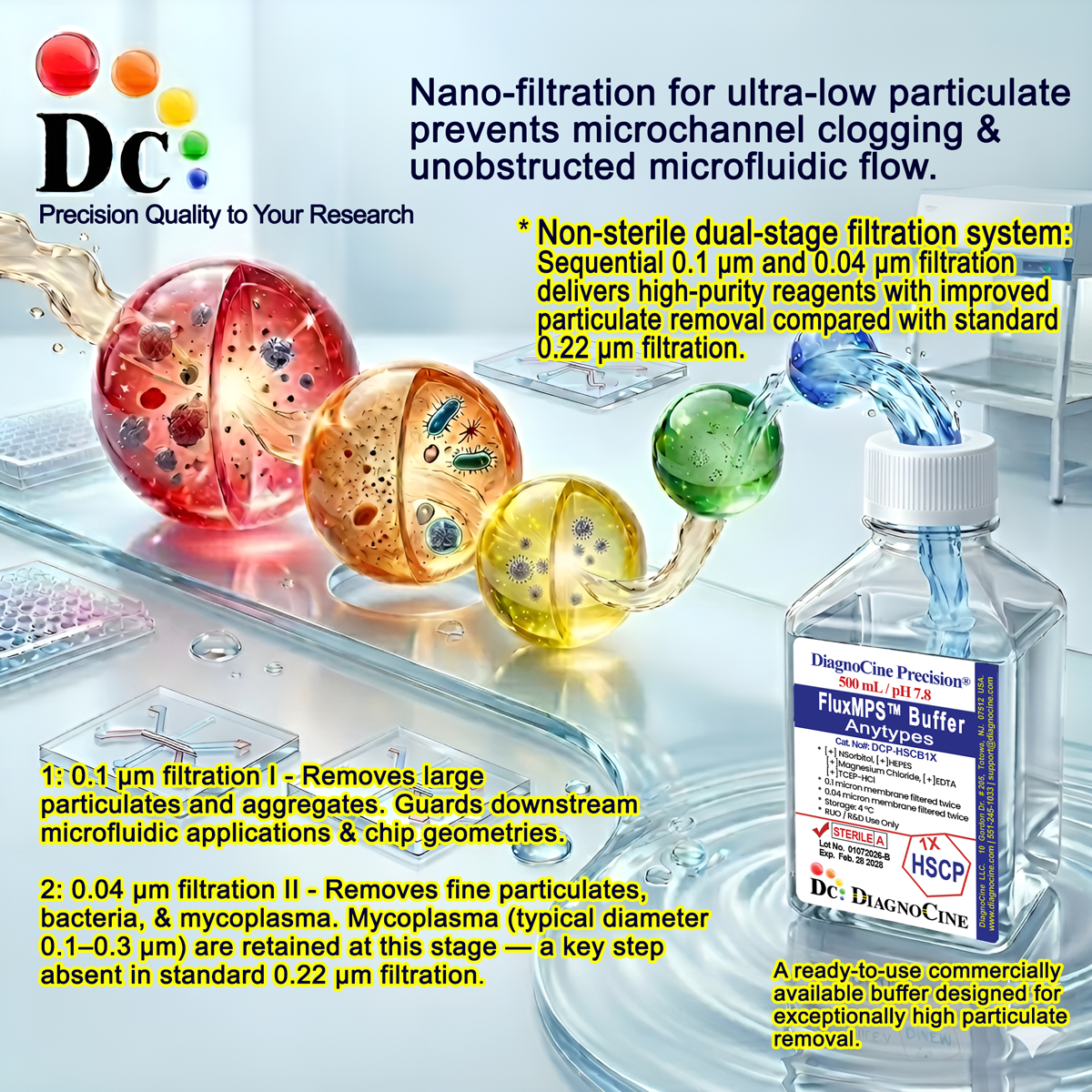
DCP-BCB100X is manufactured non-sterile with a dual-stage membrane filtration pass: 0.1 µm membrane filtered once, followed by 0.04 µm membrane filtered once, reducing particulate load beyond a conventional single 0.22 µm pass.
-
1
0.1 µm Pre-filtration I
Removes larger particulates and aggregates from the carbonate/bicarbonate solution, extending the working life of the downstream membrane.
-
2
0.04 µm Pre-filtration II
Retains finer particulates and bioburden. Mycoplasma organisms, described in DiagnoCine Precision manufacturing notes as being about 0.2 microns at the smallest, fall well above this membrane's retention threshold.
Performance vs. conventional buffer
Sequential 0.1 µm and 0.04 µm membrane filtration removes finer particulates than a single 0.22 µm pass, supporting cleaner protein and antibody coating chemistry and reduced background in downstream immunoassay and chip-based capture applications.
© Diagnocine® — DCP-BCB100X
Where DCP-BCB100X is used
The alkaline carbonate/bicarbonate chemistry creates a negatively charged plastic surface that attracts positively charged proteins and antibodies at high pH, making this buffer a workhorse for adsorptive coating, conjugation, and coupling procedures across immunoassay and microfluidic workflows.
Automated Bioreactors & Robotics
For automated plate-coating robotics and high-throughput liquid handling systems, an optional 0.01 µm (10 nm) ultra-filtered variant is available to further protect fine-bore valves and dispense tips from particulate accumulation.
- Total Particulate Exclusion — minimizes particulate carryover into automated dispensing lines
- Valve & Sensor Protection — reduces particulate stress on fine-bore robotic valves and inline sensors
- Extended Perfusion Stability — supports consistent, low-particulate delivery across long automated coating runs
Inquiry Required: the 0.01 µm (10 nm) ultra-filtered variant is produced to order — contact support@diagnocine.com to request this grade.
Micro Physiological System (MPS) & Chip Coating
Coats microchannel surfaces with capture antibodies or proteins for on-chip immunoassay and biosensor development.
Wash, Dilution & Reconstitution
Used to dilute or reconstitute coating antibodies and proteins prior to plate, tube, or chip surface coating.
iPSC-Derived Model Handling
Coats culture surfaces with capture proteins for binding assays involving iPSC-derived cell models.
Endothelial & Primary Cell Capture Assays
Coats capture antibodies onto perfusion chip and plate surfaces for endothelial and primary cell binding studies.
ELISA, EIA & RIA Plate Coating
The classic bicarbonate/carbonate coating buffer application — adsorptive immobilization of antigens and antibodies onto polystyrene microtiter plates.
Microscopy & Optical Sensing Substrate Coating
Coats imaging substrates and biosensor surfaces with capture proteins to support optical readout assays.
Full specification sheet
Every value below is drawn directly from DCP-BCB100X release documentation.
| Parameter | Specification |
|---|---|
| Formulation / Composition | Bicarbonate/carbonate buffer (Na2CO3 + NaHCO3) |
| Appearance | Clear, Colorless Liquid |
| pH (USP <791>)USP | 9.5 |
| Na2CO3 Molarity | 0.74 M |
| NaHCO3 Molarity | 0.26 M |
| Parameter | Specification |
|---|---|
| Sterility | Non-sterile; filtered 0.1 µm once + 0.04 µm once in a non-sterile environment |
| DNase Activity | None detected after incubation of plasmid DNA and this product for 18 hr at room temperature |
| RNase Activity | No RNase activity detected after incubation of ribosomal RNA and this product for 18 hr at room temperature |
| Water QualityUSP | Ultrapure Type 1 water, 18.2 MΩ·cm |
| Manufacturing StandardISO | ISO 13485-certified, CE-approved facilities |
| Parameter | Specification |
|---|---|
| Storage Temperature | 4°C |
| Shelf Life | 1 year |
| Parameter | Specification |
|---|---|
| Raw Material Grade | Ultrapure reagent grade |
| Traceability | Final packaging, QA, and testing performed at the DiagnoCine R&D and Quality Testing Center |
| Manufacturing QMSISO | ISO 13485-certified facility (Suppliers of DiagnoCine Precision) |
| Regulatory Alignment | CE-approved manufacturing facilities |
| Intended Use | For Research Use Only (RUO) |
Full composition
DCP-BCB100X is a two-component alkaline buffering system providing the negatively charged surface chemistry required for adsorptive protein and antibody coating.
| Component | CAS Number | Concentration |
|---|---|---|
| Na2CO3 | 497-19-8 | 0.74 M |
| NaHCO3 | 144-55-8 | 0.26 M |
Manufacturing & compliance
DCP-BCB100X is produced, packaged, and released under a controlled quality system.
ISO 13485:2016 QMS
Manufactured under ISO 13485-certified and CE-approved facilities (Suppliers of DiagnoCine Precision).
Ultrapure Type 1 Water
Formulated using Ultrapure Type 1 water, 18.2 MΩ·cm, per USP <85> water-quality expectations.
Nuclease-Tested Release
Each lot is tested for DNase and RNase activity following 18 hr incubation with plasmid DNA and ribosomal RNA at room temperature.
Micro-Batch Precision
All specific customization requests and assembly are accomplished at DiagnoCine Precision in Totowa, New Jersey, USA.
DNase ActivityQC
None detected after incubation of plasmid DNA and this product for 18 hr at room temperature.
RNase ActivityQC
No RNase activity detected after incubation of ribosomal RNA and this product for 18 hr at room temperature.
pH ControlUSP <791>
Released at pH 9.5, formulated from defined Na2CO3 and NaHCO3 molarity.
Documentation / CoA
A Certificate of Analysis is available for every lot, documenting appearance, pH, sterility filtration, and nuclease testing results.
How DCP-BCB100X compares
A side-by-side look at how the dual-stage filtered FluxMPS™ coating buffer compares to conventional single-stage filtered alternatives.
| Parameter | DCP-BCB100X (FluxMPS™) | Conventional Buffer (0.22 µm Filtered) | Standard Alternative (0.22 µm Filtered) |
|---|---|---|---|
| Filtration Architecture | 0.1 µm + 0.04 µm dual-stage | 0.22 µm single-stage | 0.22 µm single-stage |
| Number of Filtration Stages | 2 | 1 | 1 |
| Defined pH (9.5) Formulation | check_circle | cancel | cancel |
| DNase / RNase Tested | check_circle | cancel | cancel |
| Manufacturing QMS (ISO 13485) | check_circle | cancel | cancel |
| Ultrapure Type 1 Water Base | check_circle | cancel | cancel |
| Full Composition Disclosure | check_circle | cancel | cancel |
| Custom Formulation Available | check_circle | cancel | cancel |
| Microtiter Plate / Chromatography Coating Compatibility | check_circle | check_circle | check_circle |
Frequently asked questions
Answers to common questions about DCP-BCB100X.
Supporting literature
Curated references relevant to coating buffer chemistry, immunoassay development, and microfluidic / organ-on-a-chip applications.
- Ingber, D.E. Human organs-on-chips for disease modeling, drug development and personalized medicine. Nature Reviews Genetics. doi:10.1038/s41576-022-00466-9
- Bhatia, S.N.; Ingber, D.E. Microfluidic organs-on-chips. Nature Biotechnology. doi:10.1038/nbt.2989
- Butler, J.E. Solid supports in enzyme-linked immunosorbent assay and other solid-phase immunoassays. Methods. doi:10.1006/meth.2000.1009
- Butler, J.E.; et al. The physical and functional behavior of capture antibodies adsorbed on polystyrene. Journal of Immunological Methods. doi:10.1016/0022-1759(92)90271-A
- Good, N.E.; et al. Hydrogen ion buffers for biological research. Biochemistry. doi:10.1021/bi00866a011
- Hermanson, G.T. Bioconjugate Techniques — Coupling of proteins to chromatography supports. Academic Press. doi:10.1016/B978-0-12-382239-0.00001-2
- Lauer, S.A.; Nolan, J.P. Development and characterization of Ni-NTA-bearing microspheres for solid-phase capture assays. Cytometry. doi:10.1002/cyto.10057
- Zhang, B.; et al. Advances in organ-on-a-chip engineering. Nature Reviews Materials. doi:10.1038/s41578-018-0034-7
- Rosen, C.; et al. Mycoplasma contamination control in cell culture and reagent manufacturing. Biologicals. doi:10.1016/j.biologicals.2014.05.007
- Junot, C.; et al. Biosensor surface functionalization strategies for on-chip diagnostics. Biosensors and Bioelectronics. doi:10.1016/j.bios.2018.12.028