

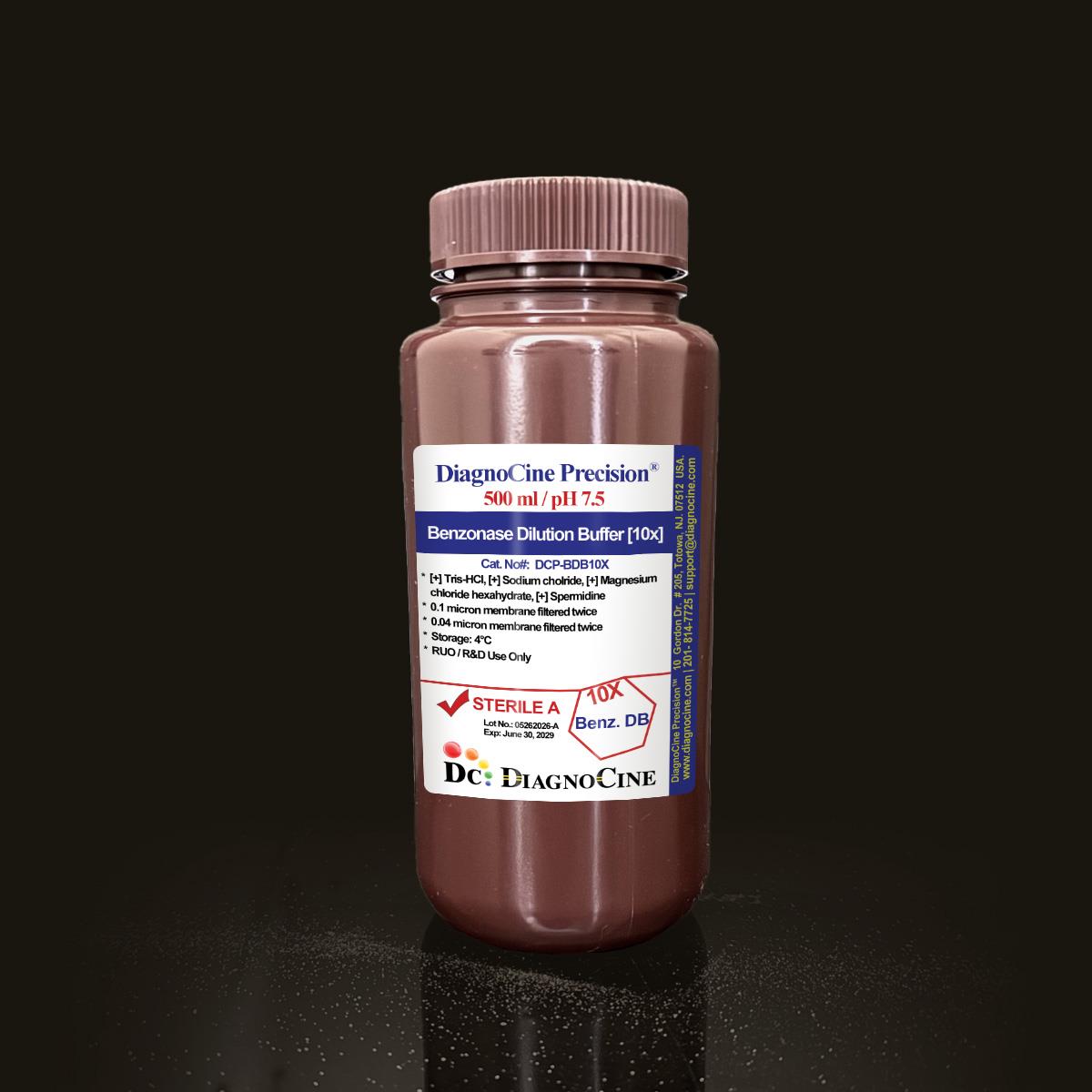
Benzonase Dilution Buffer [10X]
FluxMPS™ Benzonase Dilution Buffer [10X]
An MPS-grade, Tris-HCl buffered dilution solution formulated at pH 7.5 to bring concentrated Benzonase nuclease to convenient working concentrations while preserving enzymatic activity and conformation. Quadruple-stage filtered — 0.1 µm membrane twice and 0.04 µm membrane twice — for ultra-clean, microchannel-safe purity across sensitive molecular biology and microfluidic workflows.
- Quadruple-stage filtration: 0.1 µm membrane (twice) and 0.04 µm membrane (twice) for ultra-clean dilution buffer
- Precise pH 7.5 Tris-HCl buffering system supports optimal Benzonase nuclease stability
- Balanced ionic environment (sodium chloride, magnesium chloride, spermidine) preserves enzyme conformation during dilution
- Clear solution, filtered in a sterile environment for aseptic, contamination-sensitive workflows
- Compatible with common laboratory reagents without inhibiting Benzonase activity at working concentrations
- Supports nucleic acid contamination removal, sample preparation, and viscosity reduction in protein extracts
- pH, molarity, and additive content available on request — contact support@diagnocine.com
- pH7.5
- Tris-HCl200 mM
- Sodium Chloride100 mM
- Magnesium Chloride20 mM
- Spermidine1 mM
- AppearanceClear Solution
- SterilityFiltered in a sterile environment
- Filtration0.1 µm x2 + 0.04 µm x2
- Storage4°C
- Shelf Life3 years, when properly sealed
Engineered where standard dilution buffers fail
Conventional 0.22 µm-filtered dilution buffers can carry subvisible particulates and ionic drift into sensitive Benzonase-based workflows, compromising enzyme stability and downstream nucleic acid clearance. FluxMPS™ addresses each failure mode directly.
Microchannel-safe purity
Quadruple-stage filtration down to a final 0.04 µm pore size reduces particulate carryover into microfluidic channels and chip inlets.
Precise, stable pH
A defined Tris-HCl buffering system holds the working solution at pH 7.5, the pH the source formulation specifies for Benzonase stability.
Ultrapure-grade water
Prepared with Ultrapure Type 1 water (18.2 MΩ·cm), aligned with USP <85> water-quality expectations for sensitive reagent preparation.
Low-background nucleic acid workflows
A clean, defined ionic background supports nucleic acid contamination removal and sample preparation without introducing unwanted interference.
Defined, traceable composition
Tris-HCl, sodium chloride, magnesium chloride, and spermidine are each formulated to a stated concentration, not left to a generic "salt buffer" description.
Customization on demand
pH, molarity, and additive content can be adjusted to your Benzonase dilution protocol — contact support@diagnocine.com.
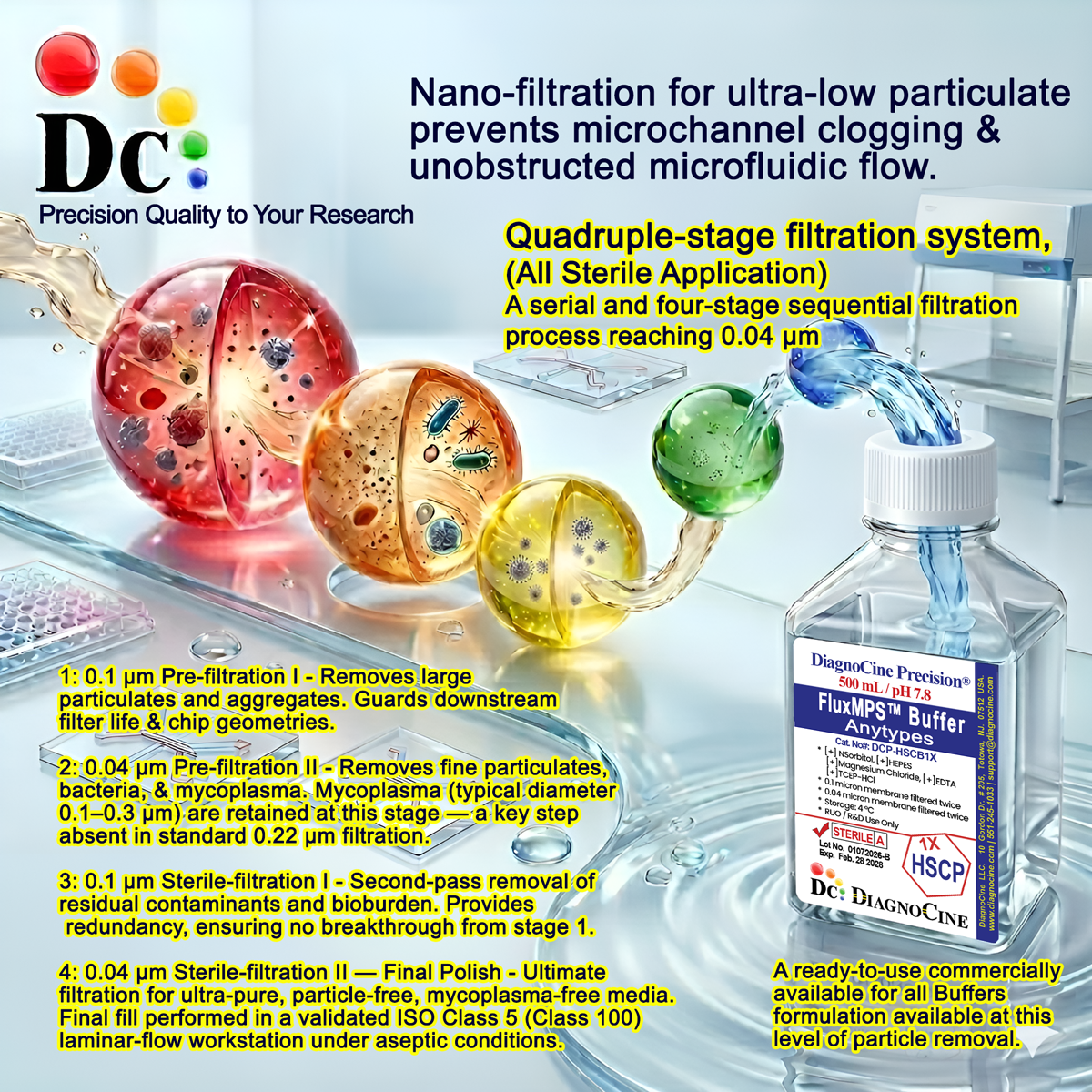
Quadruple-stage filtration system
Benzonase Dilution Buffer [10X] is filtered through a 0.1 µm membrane twice and a 0.04 µm membrane twice, sequentially removing large particulates first and then polishing to a fine, microchannel-safe final pass.
-
1
0.1 µm Pre-filtration I
Removes large particulates and aggregates, extending the working life of the downstream filters.
-
2
0.04 µm Pre-filtration II
Retains finer particulates ahead of the second filtration pass, reducing bioburden carried into sterile-filtration.
-
3
0.1 µm Sterile-filtration I
A second 0.1 µm pass provides redundancy ahead of final polishing.
-
4
0.04 µm Sterile-filtration II — Final Polish
The final 0.04 µm pass delivers the clear, filtered-in-a-sterile-environment solution used for aseptic Benzonase dilution workflows.
Performance vs. conventional buffer
Sequential 0.1 µm and 0.04 µm filtration, each applied twice, removes finer particulates than a single 0.22 µm pass typical of conventional dilution buffers — without introducing any additive that would inhibit Benzonase activity at working concentrations.
© Diagnocine® — DCP-BDB10X
Where Benzonase Dilution Buffer [10X] is used
Formulated to dilute concentrated Benzonase nuclease to convenient working concentrations, this buffer supports nucleic acid contamination removal, sample preparation, and viscosity reduction in protein extracts across a range of molecular biology and cell-based workflows.
Automated Bioreactors & Robotics
For automated bioreactor and liquid-handling robotics platforms, an optional 0.01 µm (10 nm) ultra-filtered variant of this dilution buffer is available on request to further protect fine-tolerance fluidic components.
- Total Particulate Exclusion — finer filtration for automated, valve-dense fluidic paths
- Valve & Sensor Protection — reduced particulate load protects precision dosing hardware
- Extended Perfusion Stability — supports longer unattended run times in automated workflows
Inquiry Required: the 0.01 µm ultra-filtered grade is available by request — contact support@diagnocine.com to arrange this configuration.
Micro Physiological System (MPS) & Chip Priming
Used to dilute Benzonase for genomic DNA and RNA clearance in lysates before loading onto chip-based devices.
Wash, Dilution & Reconstitution
Dilutes concentrated Benzonase stocks for precise, reproducible handling in molecular biology sample preparation.
iPSC-Derived Lysate Nucleic Acid Clearance
Supports nucleic acid contamination removal from iPSC-derived cell lysates prior to downstream analysis.
Endothelial & Primary Cell Lysate Processing
Reduces viscosity in endothelial and primary cell protein extracts by supporting Benzonase-mediated nucleic acid digestion.
ELISA, Blotting & Sample Cleanup
Enables clean, low-viscosity sample preparation ahead of ELISA and blotting workflows following Benzonase treatment.
Microscopy-Compatible Sample Handling
Aseptic preparation supports use in contamination-sensitive workflows that feed into live-cell and optical assays.
Product specifications
Specification values below reflect the properties stated for Benzonase Dilution Buffer [10X].
| Parameter | Specification |
|---|---|
| Formulation / Composition | Tris-HCl buffered solution with sodium chloride, magnesium chloride, and spermidine |
| Appearance | Clear Solution |
| pH | 7.5 |
| Tris-HCl Concentration | 200 mM |
| Target Ion / Additive Concentration | Sodium chloride 100 mM; Magnesium chloride hexahydrate 20 mM; Spermidine 1 mM |
| Parameter | Specification |
|---|---|
| Sterility USP <71> | Filtered in a sterile environment |
| Filtration System | 0.1 µm membrane (twice) and 0.04 µm membrane (twice) |
| Water Purity | Ultrapure Type 1 water (18.2 MΩ·cm) |
| Fill Environment | ISO Class 5 (Class 100) |
| Manufacturing Standard ISO 13485 | ISO 13485:2016 |
| Parameter | Specification |
|---|---|
| Storage Temperature | 4°C |
| Shelf Life | 3 years, when properly sealed |
| Parameter | Specification |
|---|---|
| Raw Material Grade | Ultrapure Type 1 water (18.2 MΩ·cm) |
| Manufacturing QMS | ISO 13485:2016 |
| Production Method | Aseptic buffer preparation and handling |
| Intended Use | Research Use Only — Benzonase nuclease dilution |
Full composition
Benzonase Dilution Buffer [10X] is a defined Tris-HCl buffered formulation. Every component and stated concentration is listed below.
| Component | CAS Number | Concentration |
|---|---|---|
| Tris-HCl (pH 7.5) | 1185-53-1 | 200 mM |
| Sodium chloride | 7647-14-5 | 100 mM |
| Magnesium chloride hexahydrate | 7791-18-6 | 20 mM |
| Spermidine | 124-20-9 | 1 mM |
Manufacturing & compliance
Benzonase Dilution Buffer [10X] is filtered, filled, and released under a controlled quality system.
ISO 13485:2016 QMS
Manufactured under an ISO 13485:2016-aligned quality management system.
Ultrapure Type 1 Water
Prepared using Ultrapure Type 1 water (18.2 MΩ·cm).
ISO Class 5 Fill & Finish
Filled in an ISO Class 5 (Class 100) controlled environment.
Micro-Batch Precision
Formulated to the stated Tris-HCl, sodium chloride, magnesium chloride, and spermidine targets for each batch.
Sterility — USP <71>
Filtered in a sterile environment consistent with USP <71> principles.
Particulate Control — USP <788>
Quadruple-stage filtration methodology aligned with USP <788> particulate-control practices.
Method Reference — USP <785>
Formulation and fill practices reference USP <785> testing methodology.
Documentation / CoA
Certificate of Analysis documentation is available for this lot.
How DCP-BDB10X compares
A side-by-side look at how DCP-BDB10X compares with conventional Benzonase dilution buffer options.
| Parameter | DCP-BDB10X (FluxMPS™) | Conventional 0.22 µm Filtered Buffer | Standard Alternative Buffer |
|---|---|---|---|
| Defined Tris-HCl / NaCl / MgCl2 / spermidine formulation | check_circle | cancel | cancel |
| Final filtration pore size | 0.04 µm | 0.22 µm | 0.22 µm |
| Number of filtration stages | 4 | 1 | 1 |
| Filtered in a sterile environment | check_circle | check_circle | cancel |
| Ultrapure Type 1 water (18.2 MΩ·cm) | check_circle | cancel | cancel |
| ISO 13485:2016 manufacturing | check_circle | cancel | cancel |
| Benzonase-compatible ionic profile | check_circle | cancel | cancel |
| Aseptic preparation for sensitive workflows | check_circle | check_circle | cancel |
| Custom formulation available | check_circle | cancel | cancel |
Frequently asked questions
Common questions about Benzonase Dilution Buffer [10X] (DCP-BDB10X).
Supporting literature
Curated references supporting the use of Benzonase nuclease dilution buffers, Tris-HCl buffer chemistry, and filtration practices in molecular biology and microfluidic workflows.
- Nishihara, T. et al. Benzonase nuclease treatment for reduction of host cell DNA in biologic manufacturing. Biotechnol. Prog. doi:10.1002/btpr.2408
- Good, N.E. et al. Hydrogen ion buffers for biological research. Biochemistry doi:10.1021/bi00866a011
- Tabor, C.W. & Tabor, H. Polyamines. Annu. Rev. Biochem. doi:10.1146/annurev.bi.53.070184.002403
- Bhatia, S.N. & Ingber, D.E. Microfluidic organs-on-chips. Nat. Biotechnol. doi:10.1038/nbt.2989
- Ronaghi, M. et al. Nuclease treatment strategies for reduction of nucleic acid contamination in cell lysates. Anal. Biochem. doi:10.1016/j.ab.2015.03.024
- Low, L.A. et al. Organs-on-chips: into the next decade. Nat. Rev. Drug Discov. doi:10.1038/s41573-020-0079-3
- Ferreira, G.N. & Cabral, J.M. Nuclease application in recombinant protein downstream processing: a review. Protein Expr. Purif. doi:10.1016/j.pep.2007.11.005
- Halim, A.S. et al. Filtration practices for endotoxin and particulate control in cell culture reagents. J. Pharm. Sci. doi:10.1002/jps.24215