

Anti-SQSTM1 Rabbit Polyclonal Antibody
Product#: SB-GB11239-1
$560.00
Availability:
Ships in 1-2 Weeks
Anti-SQSTM1 Rabbit Polyclonal Antibody
General information
| Cat. No. | :SB-GB11239-1 |
| Size | :100 uL |
| Protein full name | :Sequestosome-1 |
| Synonym | :SQSTM1, A170, OSIL, PDB3, ZIP3, p60, p62, p62B, FTDALS3, Sequestosome 1, NADGP, DMRV |
| Immunogen | :Recombinant protein corresponding to Mouse P62 |
| Isotype | :IgG |
| Predicted MW. | :48 kDa |
| Observed MW. | :62 kDa |
| Purity | :Affinity purification |
| Subcellular location | :Late endosome, Nucleus, PML body, Lysosome, Endoplasmic reticulum, Cytosol, Autophagosome, Sarcomere |
| Uniprot ID | :Q13501, O08623, Q64337 |
| Storage | :Store at -20 ℃ for one year. Avoid repeated freeze/thaw cycles. |
| Storage Buffer | :PBS with 0.02% sodium azide,100 μg/ml BSA and 50% glycerol. |
Application
| Applications | Species | Dilution | Positive Tissue |
| WB | Human, Mouse, Rat | 1: 500-1: 1500 | liver, muscle |
| IF | Mouse | 1: 1000-1: 2000 | NIH3T3 |
Description
Autophagy receptor that interacts directly with both the cargo to become degraded and an autophagy modifier of the MAP1 LC3 family . Along with WDFY3, involved in the formation and autophagic degradation of cytoplasmic ubiquitin-containing inclusions (p62 bodies, ALIS/aggresome-like induced structures). Along with SQSTM1, required to recruit ubiquitinated proteins to PML bodies in the nucleus. May regulate the activation of NFKB1 by TNF-alpha, nerve growth factor (NGF) and interleukin-1. May play a role in titin/TTN downstream signaling in muscle cells. May regulate signaling cascades through ubiquitination. Adapter that mediates the interaction between TRAF6 and CYLD.
 |
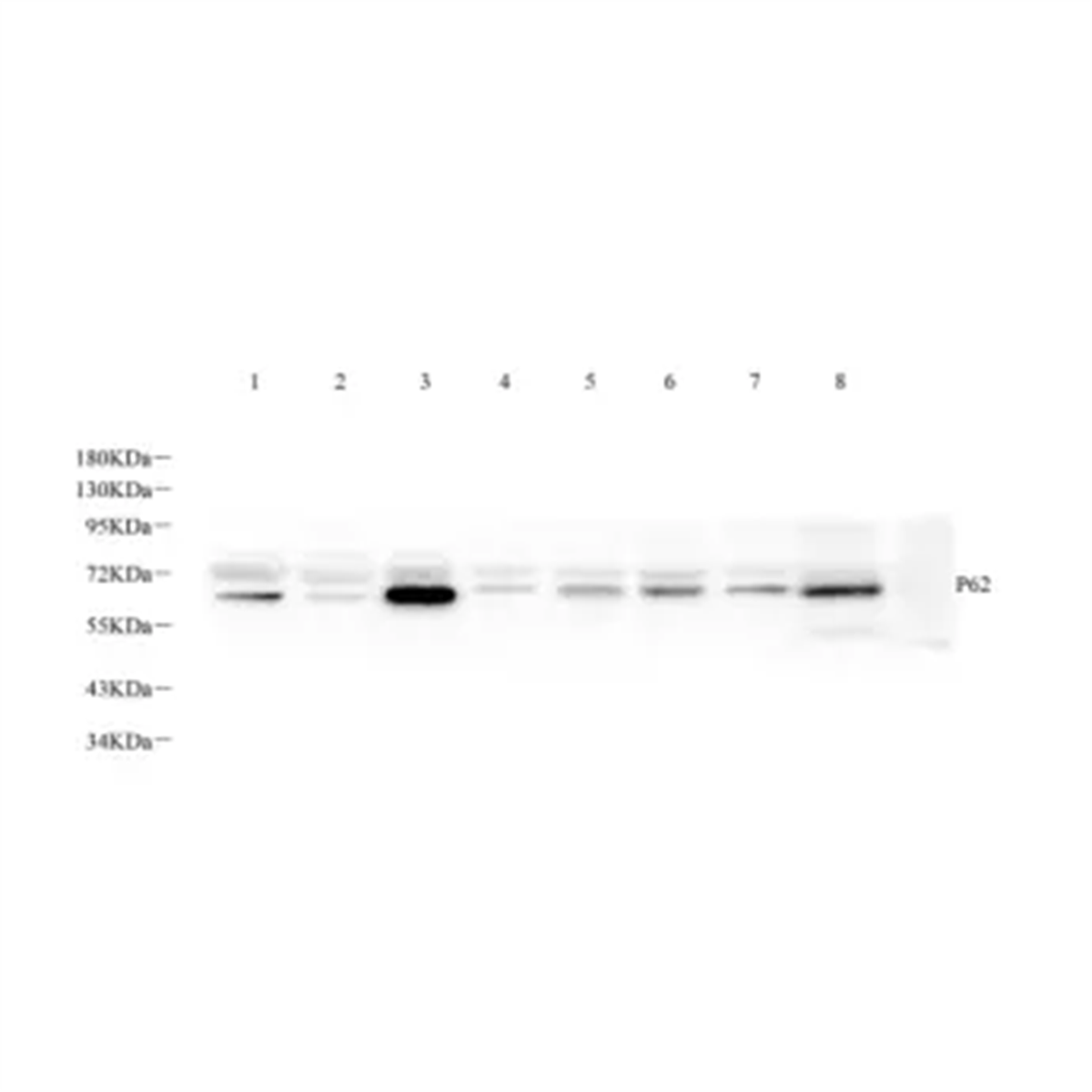
Western blot analysis of P62 (GB11239-1) at dilution of 1: 1000. Lane 1: MCF-7 cell lysate Lane 2: 293T cell lysate Lane 3: A549 cell lysate Lane 4: Mouse muscle tissue lysate Lane 5: Mouse liver tissue lysate Lane 6: Mouse heart tissue lysate Lane 7: Rat muscle tissue lysate Lane 8: Rat liver tissue lysate |
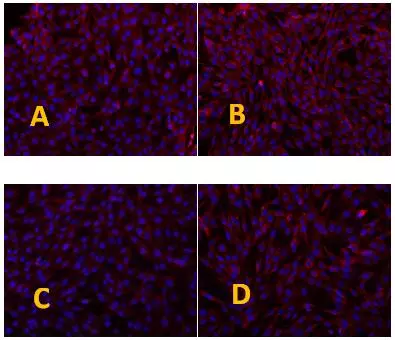 |
Immunofluorescent analysis of 4% paraformaldehyde-fixed NIH3T3 cell using P62 (GB11239-1) at dilution of 1: 1000 A: negative control B: treated with 50 μ mol/L Chloroquine overnight C: treated with 1 μ mol/L Rapamycin for 48 hours D: treated with 1 μ mol/L Rapamycin overnight and Chloroquine overnight |
References
- Zhang, Y. et al.The Role of Astragaloside IV against Cerebral Ischemia/Reperfusion Injury: Suppression of Apoptosis via Promotion of P62-LC3-Autophagy.Molecules24,1838(2019).PMID 31086091Application: WBIF 4.411
Aliases for SQSTM1 Gene
- GeneCards Symbol: SQSTM1 2
- Sequestosome 1 2 3 5
- P60 2 3 4 5
- P62B 2 3 5
- A170 2 3 5
- OSIL 3 4 5
- P62 2 3 5
- Phosphotyrosine-Independent Ligand For The Lck SH2 Domain Of 62 KDa 3 4
- EBI3-Associated Protein Of 60 KDa 3 4
- Oxidative Stress Induced Like 2 3
- Ubiquitin-Binding Protein P62 3 4
- Autophagy Receptor P62 2 3
- Sequestosome-1 3 4
- EBIAP 3 4
- PDB3 3 5
- Phosphotyrosine Independent Ligand For The Lck SH2 Domain P62 3
- EBI3-Associated Protein P60 3
- Paget Disease Of Bone 3 2
- FTDALS3 3
- NADGP 3
- DMRV 3
- ZIP3 3
- ORCA 4