


Anti-MUC1, Mouse-Mono (014E) (Anti-Mucin1), 100 uL
Anti-MUC1, Mouse-Mono (014E) (Anti-Mucin1), 100 uL
DiagnoCine offers excellent MUC1 I MUCIN-1 | Mouse-Mono(014E) Antibodies used for studying Tumorigenesis, Immunotherapy, Pathophysiology, Steotohepatisis, Homeostasis, Cell Transplantation, Myalgi Encelphalomyelitis, Hypertension, & Cancer Metastasis.
Human diseases include Cardiovascular disease, Tumor, Prostate cancer, Lung Tumor, Pancreatic Cancer, Head&Neck Cancer, Liver Disease, Ovarian cancer, Chronic Fatigue Syndrome, Glomerular disease, & Multicentric Castleman disease.
Anti-MUC1 I Mouse-Mono(014E) Antibodies has excellent quality and this highly pure antibody can be adapted for Immunohistochemistry, Western blotting & other methods with optimization.
Description
| Cat. No. | :FNK-FDV-0012B |
| Size | :100ul |
| Clone | :014E |
| Formulation | :Mouse Ascites (Contain 50% Glycerol, Not contain any preservative) |
| Host Species and Clonality | :Mouse monoclonal |
| Isotype and Subclass | :IgG1, kappa |
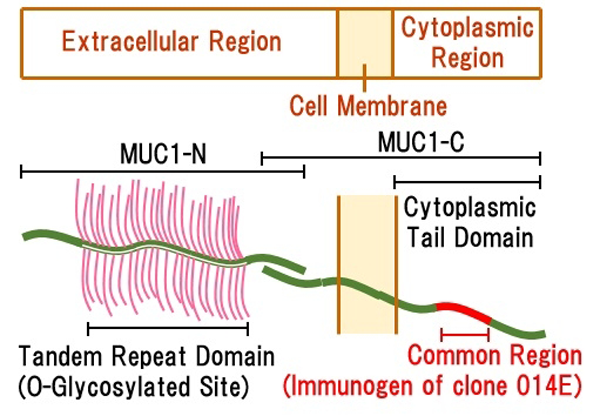
| Immunogen | :Synthetic Peptide, corresponding to Common Region in Cytoplasmic Tail Domain (CTD) of Human MUC1 (CRYVPPSSTDRSPYEKVSAG) |
| Lot Number | :see vial label |
| Species Reactivity | :Human; other species not tested yet. |
| Specificity | :Human Mucin1 / MUC1 |
| Application | :IHC (paraffin, 1:2,500 - 1:5,000), WB (1:2,500 - 1:5,000) (Optimal working dilutions should be determined experimentally by each laboratory for each application.) |
| Long Term Storage | : -20°C or below |
| Shipping Condition | :Dry Ice |
Product Background
MUC1 (Mucin-1; also PEM, PEMT and Episialin), a mucintype glycoprotein, has been associated with cancer progression and metastasis. Initially polypeptide chain of MUC1 is cleaved into two pieces, MUC1-N and MUC1-C. MUC1-N includes cleavage sites and a tandem repeat (TR) domain which has the potential for extensive O-glycosylation. On the other hand, MUC1-C has a lot of splicing variants. The most of the commercially available MUC1 antibodies fail in the detection of the MUC1 variants. Clone 014E antibody is raised against common region of MUC1 splicing variants. Clone 014E antibody recognizes most variant forms of MUC1. Recent studies show that clone 014E antibody succeeded in detecting scirrhous gastric cancer and pancreatic cancer.
Application Data
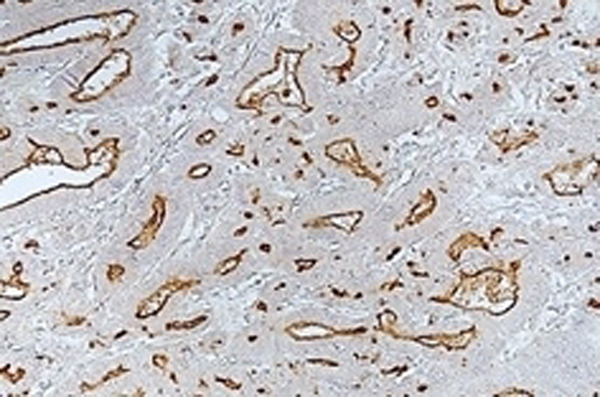
Fig.1 Immunohistochemistry Staining
Retrieval Method ; Heat-induced epotope removal; HIER (ph6.0 / 30 min)
Dilution : 1 : 2,500
Detection Reagent : ImmPRESS Reagent, Anti-Mouse Ig (Vector Laboratories, #MP-7402-15)
Chromogen : ImmPACT DAB Peroxidase Substrate (Vector Laboratories, #SK-4105)
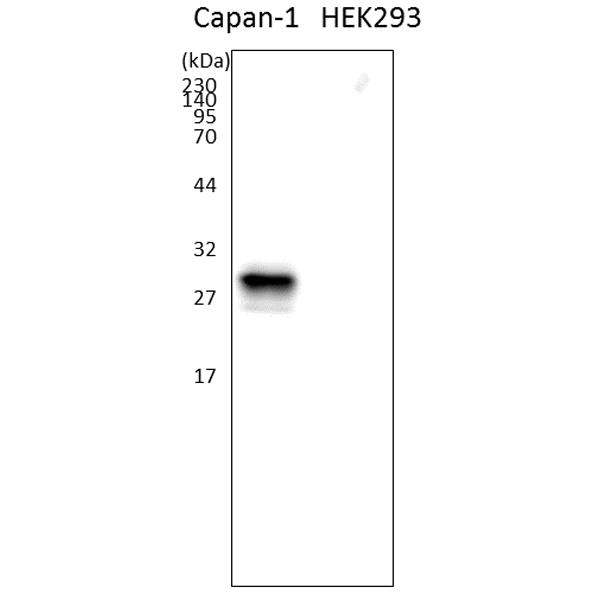
Fig.2 Western Blotting
Dilutiuon : 1 : 2,500
Secondary Antibody : Anti-Mouse IgG, Goat-Poly, HRP (Kirkegaard & Perry Laboratories, #074-1516)
Chemiluminescence Substrate : SuperSignal West Pico (Pierce)
Detection : 1 minute exposure
Antigen Characterization
- Type: Primary
- Application: Immunohistochemistry (IHC), Flow Cytometry, ELISA, Western Blotting
- Species: Human, Mouse, Rat
- Recombinant: Yes
Human Diseases
- Breast Cancer: MUC1 is overexpressed and is used as a tumor marker (CA15-3) for monitoring disease status.
- Colorectal Cancer: Aberrant glycosylation of MUC1 is implicated in tumor progression and metastasis.
- Pancreatic Cancer: MUC1 expression correlates with aggressive disease and poor prognosis.
- Ovarian Cancer: Altered expression patterns are associated with malignancy.
Cellular Signaling Pathways
- Signal Transduction: MUC1-C interacts with various signaling pathways, including those involving β-catenin and NF-κB, promoting tumor cell survival and proliferation.
- Inflammation Pathways: MUC1 is involved in chronic inflammation mechanisms that contribute to tumor development.
- Immune Evasion: MUC1 can inhibit T cell responses, facilitating tumor immune escape.
Aliases for MUC1 Gene
- Mucin 1, Cell Surface Associated 2 3 5
- PEM 2 3 4
- Tumor-Associated Epithelial Membrane Antigen 3 4
- Breast Carcinoma-Associated Antigen DF3 3 4
- Peanut-Reactive Urinary Mucin 3 4
- Polymorphic Epithelial Mucin 3 4
- Carcinoma-Associated Mucin 3 4
- Mucin 1, Transmembrane 2 3
- Krebs Von Den Lungen-6 3 4
- Cancer Antigen 15-3 3 4
- Episialin 3 4
- ADMCKD1 2 3
- CA 15-3 3 4
- Mucin-1 3 4
- ADMCKD 2 3
- CD227 2 3
- H23AG 3 4
- MUC-1 3 4
- KL-6 3 4
- MCKD 2 3
- PEMT 3 4
- EMA 3 4
- MCD 2 3
- PUM 3 4
- Medullary Cystic Kidney Disease 1 (Autosomal Dominant) 2
- Tumor Associated Epithelial Mucin 3
- Tumor-Associated Mucin 4
- CD227 Antigen 4
- H23 Antigen 3
- MUC-1/SEC 3
- MUC-1/X 3
- MUC1/ZD 3
- MCKD1 3
- MAM6 3
- MUC1 5
References
- Yonezawa, S., et al., Gastric Cancer, 15, 370-381 (2012).
- Yokoyama, S., et al., BMC Cancer, 12, 67 (2012).
- Kitamoto, S., et al., Oncogene, 32, 4614 (2013).
- Yokoyama, S., et al., PLoS ONE, 9 (4) :e93760 (2014).
- Asano, Y., et al., J Mol Med (Berl), 97(2):257-268 (2019).
- Anti-MUC1 Antibody.” Abcam, www.abcam.com/en-us/products/primary-antibodies/muc1-antibody-ab15481.
- Bose, Mukulika, and Pinku Mukherjee. “Potential of Anti-MUC1 Antibodies as a Targeted Therapy for Gastrointestinal Cancers.” Vaccines, U.S. National Library of Medicine, 5 Nov. 2020, www.ncbi.nlm.nih.gov/pmc/articles/PMC7712407/.
- J, Liu, et al. “MUC1 Promotes Cancer Stemness and Predicts Poor Prognosis in Osteosarcoma.” (23614-1-AP), www.thermofisher.com/antibody/product/MUC1-CA15-3-Antibody-Polyclonal/23614-1-AP. Accessed 19 Sept. 2024.
- MUC1 Antibody (RBT-MUC1).” Bio SB, 21 June 2023, www.biosb.com/biosb-products/muc1-antibody-rmab-rbt-muc1/.
- Clinical Trials of Muc1-Specific Monoclonal Antibodies ..., www.researchgate.net/figure/Clinical-trials-of-MUC1-specific-monoclonal-antibodies_tbl2_325497445.
