
Anti-DLVPR (G196) epitope-tag, Mouse-Mono
Product#: FNK-R-G-001
$465.67
Availability:
Ships in 1-2 Weeks
Anti-DLVPR (G196) epitope-tag monoclonal antibody
Shipping Condition: Cold pack, ica pack, 4C ( Do not use Dry-ice )
| Category | tag antibody |
| Catalog No. | FNK-R-G-001 |
| Applications | WB, IP, ChIP, IF |
Product information
| Source | Mouse |
| Clone No. | G196 |
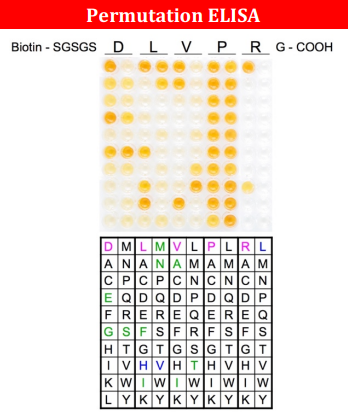
| Epitope | Five amino acid sequence Asp-Leu-Val-Pro-Arg (DLVPR) |
| Isotype | IgG1 |
| Purification method | DEAE ion-exchange purification |
| Lot No. | 001 |
| Concentration | 1.0 mg/mL |
| Buffer | 50% glycerol/PBS, pH7.4, with 0.05% ProClin 300 |
| Storage | Store at -20°C. |
Recommended dilutions
| WB | 1:2000 – 1:10000 |
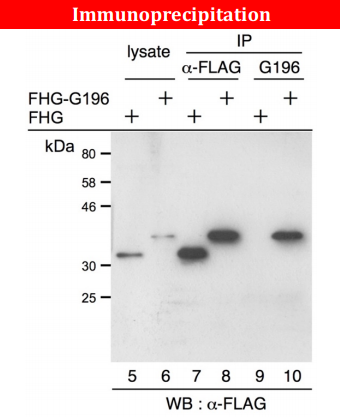
| IP | 1:200 – 1:500 |
| ChIP | 1:200 – 1:500 |
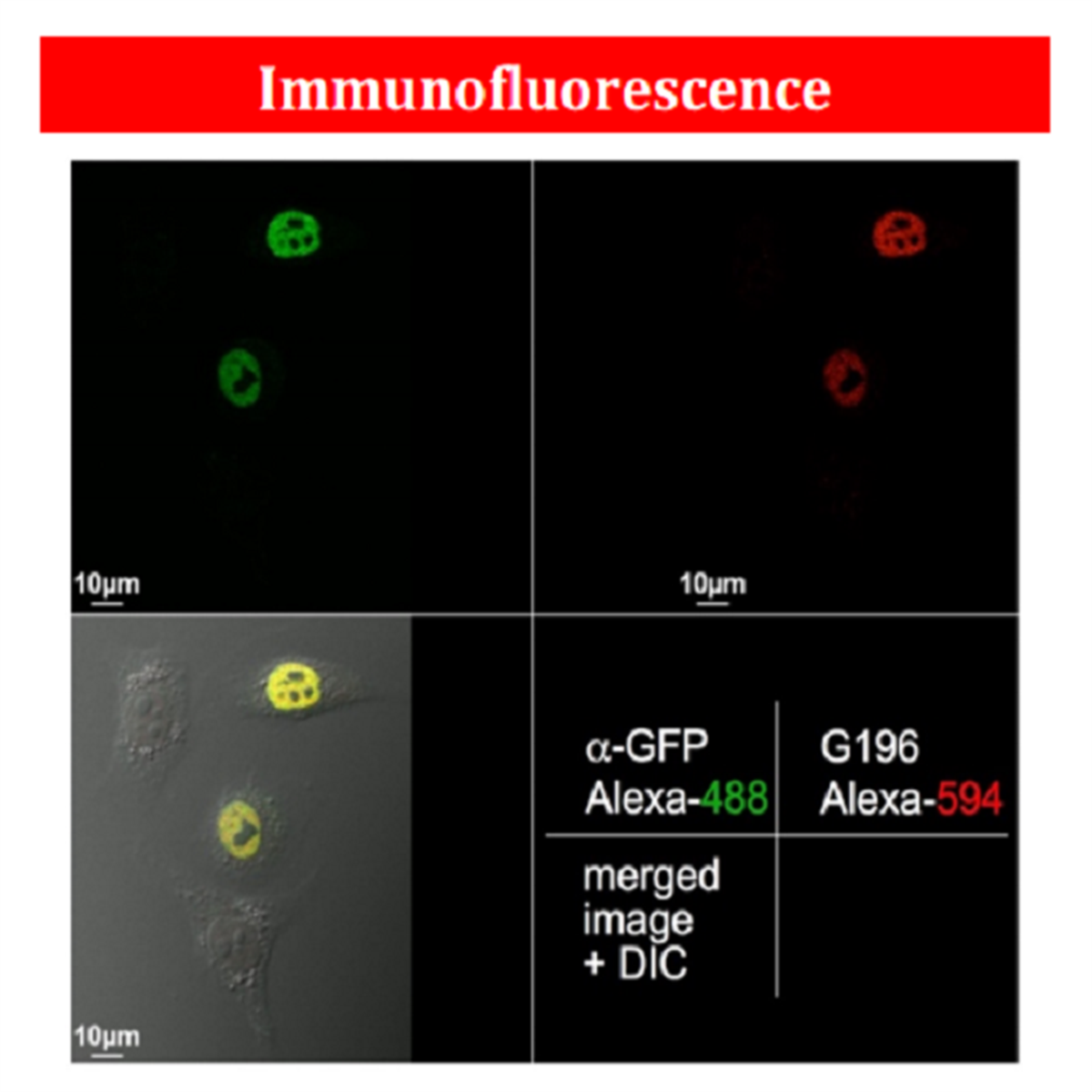
| IF | 1:200 – 1:500 |
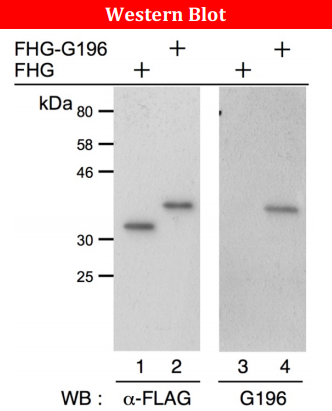
Western blot analysis of FLAG-HA-GFP (FHG) tagged with C-terminal G196-tag in HeLa cells using mAb G196 (Catalog # R-G-001).
HeLa cells were transfected with FHG/pcDNA3 or FHGG196/pcDNA3. The cells were lysed and subjected to Western blotting (WB) with anti-FLAG (M2) or G196 mAbs.
 |
 |
 |
Background
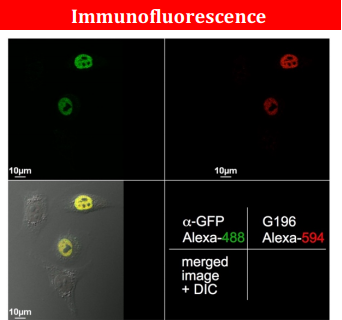
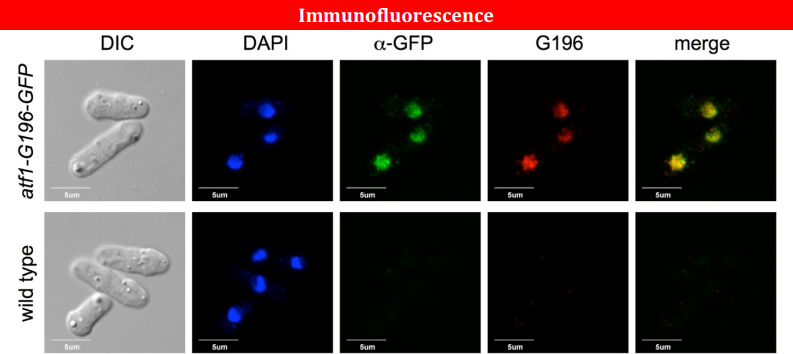
mAb G196/G196-epitope peptide (five amino acid sequence Asp-Leu-Val-Pro-Arg, DLVPR) is a new peptide tagging system for cell biology and biochemistry research. The recognition specificity of monoclonal antibodies (mAbs) has made mAbs among the most frequently used tools in both basic science research and in clinical diagnosis and therapies. Precise determination of the epitope allows the development of epitope tag systems to be used with recombinant proteins for various purposes. A new family of tag was derived from the epitope recognized by a highly specific mAb G196. The minimal epitope was the five amino acid sequence Asp-Leu-Val-Pro-Arg. Isothermal titration calorimetry revealed the high affinity (Kd = 1.25 nM) of the mAb G196/G196-epitope peptide interaction, and G196- tag was used to detect several recombinant cytosolic and nuclear proteins in human and yeast cells.
References for G196 monoclonal antibody (R-G-001)
| PMID: | 28266535 | Journal: | Scientific Reports |
| Application: | WB, IF, IP, ChIP | IF (2017): | 4.122 |
| Title: | G196 epitope tag system: a novel monoclonal antibody, G196, recognizes the small, soluble peptide DLVPR with high affinity. | ||
| PMID: | 24794433 | Journal: | Cell Reports |
| Application: | IF | IF (2017): | 8.032 |
| Title: | TRIM27/MRTF-B-dependent integrin β1 expression defines leading cells in cancer cell collectives. | ||
| PMID: | 27647735 | Journal: | Gens to Cells |
| Application: | WB | IF (2017): | 2.048 |
| Title: | Four domains of Ada1 form a heterochromatin boundary through different mechanisms. | ||
| PMID: | 24307402 | Journal: | The Journal of Biochemistry |
| Application: | WB | IF (2017): | 2.350 |
| Title: | The N-terminus and Tudor domains of Sgf29 are important for its heterochromatin boundary formation function. | ||
| PMID: | 23819448 | Journal: | Gens to Cells |
| Application: | WB | IF (2017): | 2.048 |
| Title: | C-terminus of the Sgf73 subunit of SAGA and SLIK is important for retention in the larger complex and for heterochromatin boundary function. | ||