

Anti-Carbonic Anhydrase 2/CA2 Rabbit Polyclonal Antibody
Product#: SB-GB112426
$560.00
Availability:
Ships in 1-2 Weeks
Anti-Carbonic Anhydrase 2/CA2 Rabbit Polyclonal Antibody
General information
| Cat. No. | :SB-GB112426 |
| Size | :100 uL |
| Protein full name | :Carbonic anhydrase 2 |
| Synonym | :Carbonate dehydratase II, Carbonic anhydrase II, CA-II, Ca2, Car2, HEL-76, CAC |
| Immunogen | :Recombinant protein corresponding to Mouse Carbonic anhydrase 2/CA2 |
| Isotype | :IgG |
| Purity | :Affinity purification |
| Predicted MW. | :29 kDa |
| Observed MW. | :29 kDa |
| Uniprot ID | :P00920, P27139 |
| Storage | :Store at -20 ℃ or below for one year. Avoid repeated freeze/thaw cycles. |
| Shipping Condition | :Dry Ice |
| Storage Buffer | :PBS with 0.02% sodium azide,100 μg/ml BSA and 50% glycerol. |
Application
| Applications | Species | Dilution | Positive Tissue |
| WB | Human, Mouse, Rat | 1: 3000-1: 5000 |
liver, kidney, brain, colon |
Description
CA2(carbonic anhydrase II ) is also named as Car2, CA-II, CAII and belongs to the alpha-carbonic anhydrase family. It reversibly hydrates CO2 in cellular ion transport and homeostasis. CA2 is essential for bone resorption and osteoclast differentiation. It regulates SLC9A1 activity via a phosphorylation-regulated CAII binding site in SLC9A1 tail. It also may be involved in the development of brain.
 |
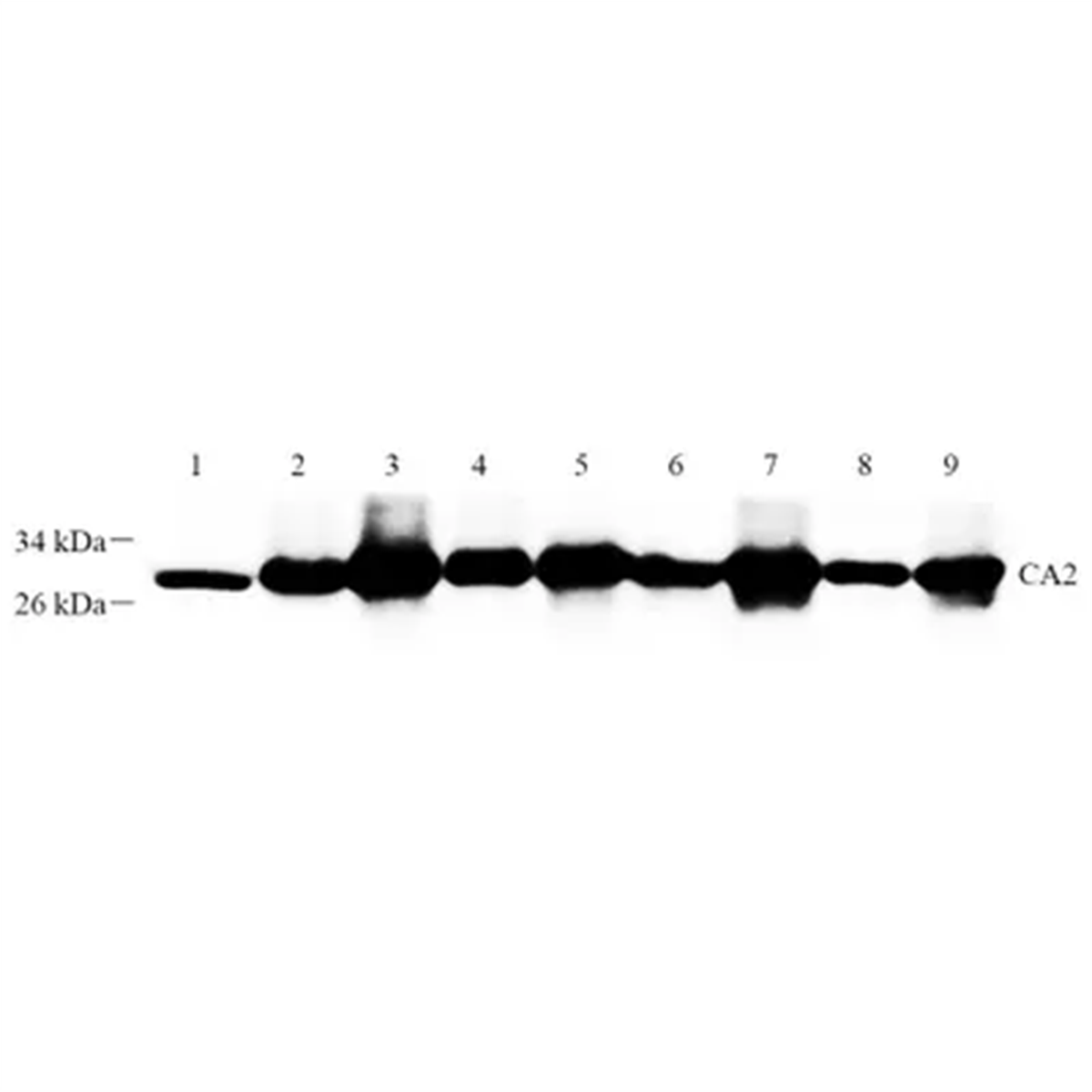
Western blot analysis of CA2 (GB112426) at dilution of 1: 5000 Lane 1: THP-1 cell lysate Lane 2: Mouse liver tissue lysate Lane 3: Mouse kidney tissue lysate Lane 4: Mouse brain tissue lysate Lane 5: Mouse colon tissue lysate Lane 6: Rat liver tissue lysate Lane 7: Rat kidney tissue lysate Lane 8: Rat brain tissue lysate Lane 9: Rat colon tissue lysate |
Human Diseases
- Glaucoma: Overexpression of CA II leads to increased secretion of aqueous humor, raising intraocular pressure.
- Osteopetrosis: Mutations in the CA II gene can cause this condition characterized by excessive bone density.
- Renal Tubular Acidosis: Deficiency in CA II activity affects bicarbonate reabsorption in the kidneys.
- Cerebral Calcification: Impaired carbonic anhydrase function can lead to abnormal calcium deposits in the brain.
Cellular Signaling Pathways
- pH Regulation Pathway: CA II catalyzes the conversion of CO2 and water to bicarbonate and protons, crucial for maintaining acid-base balance.
- Respiratory Control Pathway: Facilitates CO2 transport and excretion, influencing respiratory rate.
- Signal Transduction Pathways: Involved in various metabolic processes, including ion exchange and bicarbonate transport, impacting cellular signaling related to homeostasis.
Aliases for CA2 Gene
- GeneCards Symbol: CA2 2
- Carbonic Anhydrase 2 2 3 4 5
- CA-II 2 3 4 5
- Carbonic Anhydrase II 2 3 4
- Car2 2 3 5
- CAII 2 3 5
- Carbonate Dehydratase II 3 4
- Carbonic Anhydrase C 3 4
- EC 4.2.1.1 4 49
- CAC 3 4
- Epididymis Secretory Protein Li 282 3
- Epididymis Luminal Protein 76 3
- Carbonic Anhydrase B 3
- Carbonic Dehydratase 3
- HEL-S-282 3
- HEL-76 3
References
- Boone, Christopher D., et al. “Carbonic Anhydrases and Their Biotechnological Applications.” MDPI, Multidisciplinary Digital Publishing Institute, 19 Aug. 2013, www.mdpi.com/2218-273X/3/3/553.
- Kida, Elizabeth, et al. “Carbonic Anhydrase II in the Developing and Adult Human Brain.” OUP Academic, Oxford University Press, 1 July 2006, academic.oup.com/jnen/article/65/7/664/2646723.
- O’Herin, Conor B, et al. “Development of Human Carbonic Anhydrase II Heterobifunctional Degraders.” Journal of Medicinal Chemistry, U.S. National Library of Medicine, 23 Feb. 2023, www.ncbi.nlm.nih.gov/pmc/articles/PMC9969396/.
- Wambo, Thierry O, et al. “Molecular Dynamics Study of Human Carbonic Anhydrase II in Complex with Zn(2+) and Acetazolamide on the Basis of All-Atom Force Field Simulations.” Biophysical Chemistry, U.S. National Library of Medicine, 2016, www.ncbi.nlm.nih.gov/pmc/articles/PMC4901522/.