Anti-CLIC4 Rabbit Polyclonal Antibody
Product#: SB-GB112388
$560.00
Availability:
Ships in 1-2 Weeks
Anti-CLIC4 Rabbit Polyclonal Antibody
General information
| Cat. No. | :SB-GB112388 |
| Size | :100 uL |
| Protein full name | :Chloride intracellular channel protein 4 |
| Synonym | :mc3s5/mtCLIC, Clic4, Intracellular chloride ion channel protein p64H1, mtCLIC, p64H1 |
| Immunogen | :KLH conjugated Synthetic peptide corresponding to Mouse CLIC4 |
| Isotype | :IgG |
| Predicted MW. | :29 kDa |
| Observed MW. | :29 kDa |
| Purity | :Affinity purification |
| Uniprot ID | :Q9Y696, Q9Z0W7 |
| Storage | :Store at -20 ℃ for one year. Avoid repeated freeze/thaw cycles. |
| Shipping Condition | :Dry Ice |
| Storage Buffer | :PBS with 0.02% sodium azide,100 μg/ml BSA and 50% glycerol. |
Application
| Applications | Species | Dilution | Positive Tissue |
| WB | Human, Rat | 1: 400-1: 800 | kidney, ovary |
Description
Can insert into membranes and form poorly selective ion channels that may also transport chloride ions. Channel activity depends on the pH. Membrane insertion seems to be redox-regulated and may occur only under oxydizing conditions. Promotes cell-surface expression of HRH3. Has alternate cellular functions like a potential role in angiogenesis or in maintaining apical-basolateral membrane polarity during mitosis and cytokinesis. Could also promote endothelial cell proliferation and regulate endothelial morphogenesis. Tissue specificity: Detected in epithelial cells from colon, esophagus and kidney (at protein level). Expression is prominent in heart, kidney, placenta and skeletal muscle.
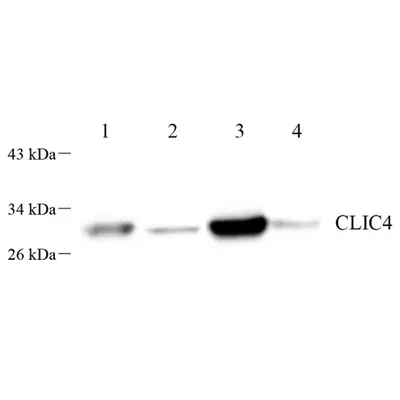 |
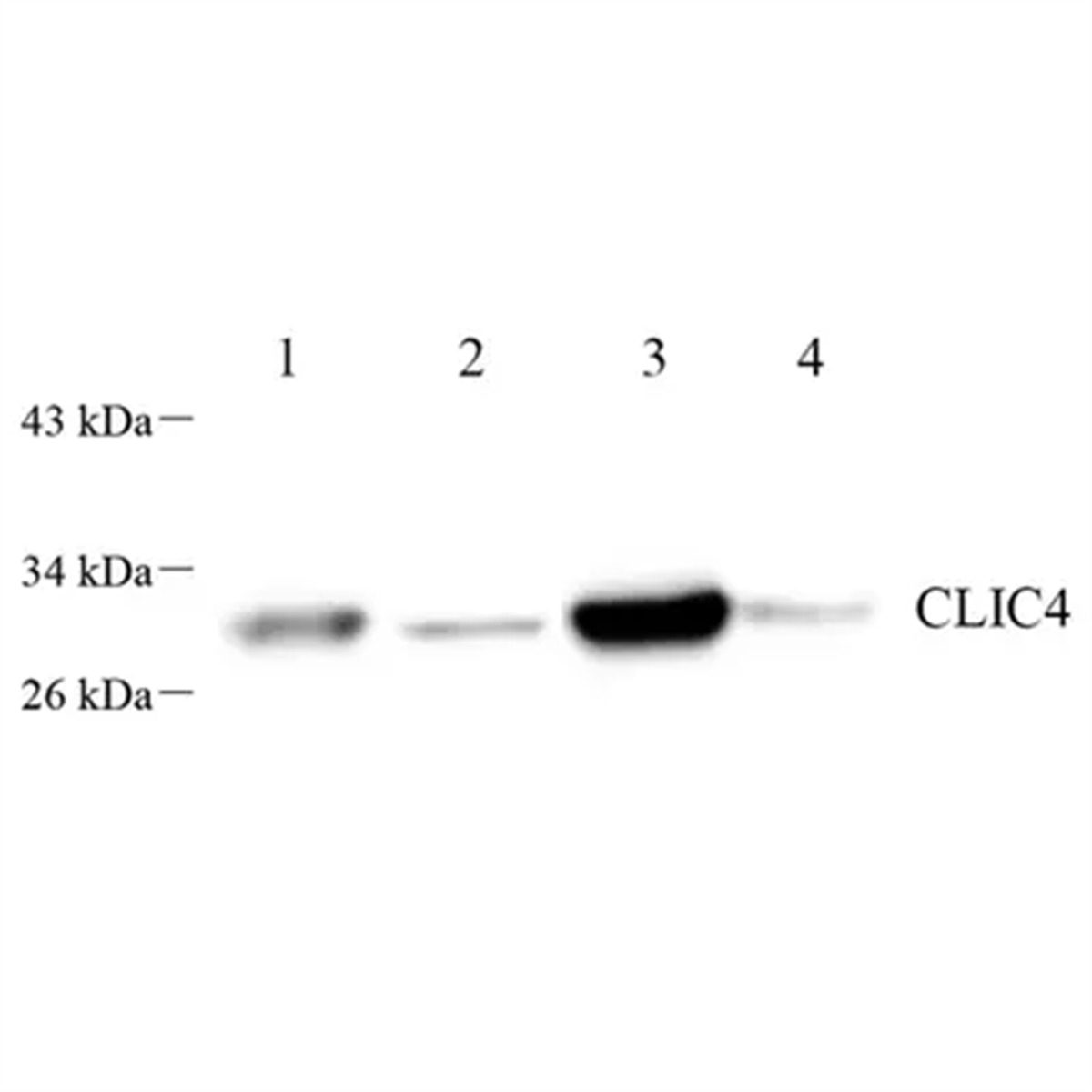
Western blot analysis of CLIC4 (GB112388) at dilution of 1: 800 Lane 1: Mouse kidney tissue lysate Lane 2: Mouse ovary tissue lysate Lane 3: Rat kidney tissue lysate Lane 4: Rat ovary tissue lysate |
Aliases for CLIC4 Gene
- GeneCards Symbol: CLIC4 2
- Chloride Intracellular Channel 4 2 3 5
- P64H1 2 2 3 5
- CLIC4L 2 3 5
- HuH1 2 3 5
- H1 2 3 5
- Intracellular Chloride Ion Channel Protein P64H1 3 4
- Chloride Intracellular Channel Protein 4 3 4
- DKFZP566G223 2 5
- Epididymis Secretory Sperm Binding Protein 3
- Chloride Intracellular Channel 4 Like 3
- MTCLIC 3
References
- Bogenpohl JW;Weston RM;Foreman TN;Kitchen KE;Miles MF; “Chloride Intracellular Channel 4 (CLIC4) Expression Profile in the Mouse Medial Prefrontal Cortex and Its Regulation by Ethanol.” Alcoholism, Clinical and Experimental Research, U.S. National Library of Medicine, pubmed.ncbi.nlm.nih.gov/34839533/.
- Chou, Szu-Yi, et al. “CLIC4 Regulates Apical Exocytosis and Renal Tube Luminogenesis through Retromer- and Actin-Mediated Endocytic Trafficking.” Nature News, Nature Publishing Group, 20 Jan. 2016, www.nature.com/articles/ncomms10412.
- Account - Genecards Suite, www.genecards.org/cgi-bin/carddisp.pl?gene=CLIC4.
- Bogenpohl, James W, et al. “Chloride Intracellular Channel 4 (CLIC4) Expression Profile in the Mouse Medial Prefrontal Cortex and Its Regulation by Ethanol.” Alcoholism, Clinical and Experimental Research, U.S. National Library of Medicine, Jan. 2022, www.ncbi.nlm.nih.gov/pmc/articles/PMC8799520/.