Anti-CIITA Rabbit Polyclonal Antibody
Anti-CIITA Rabbit Polyclonal Antibody
General information
| Cat. No. | :SB-GB112521 |
| Size | :100 uL |
| Protein full name | :MHC class II transactivator |
| Synonym | :CIITA, C2ta, Mhc2ta, Class II transactivator, NLR family acid domain containing |
| Immunogen | :KLH conjugated Synthetic peptide corresponding to Mouse CIITA |
| Isotype | :IgG |
| Purity | :Affinity purification |
| Subcellular location | :Nucleus |
| Uniprot ID | :P79621 |
| Storage | :Store at -20 ℃ or below for one year. Avoid repeated freeze/thaw cycles. |
| Storage Buffer | :PBS with 0.02% sodium azide,100 μg/ml BSA and 50% glycerol. |
| Shipping Condition | :Dry Ice |
Application
| Applications | Species | Dilution | Positive Tissue |
| IHC | Mouse | 1: 1000-1: 2000 |
spleen, thymus |
Description
This gene encodes a protein with an acidic transcriptional activation domain, 4 LRRs (leucine-rich repeats) and a GTP binding domain. The protein is located in the nucleus and acts as a positive regulator of class II major histocompatibility complex gene transcription, and is referred to as the "master control factor" for the expression of these genes. The protein also binds GTP and uses GTP binding to facilitate its own transport into the nucleus. Once in the nucleus it does not bind DNA but rather uses an intrinsic acetyltransferase (AT) activity to act in a coactivator-like fashion.
 |
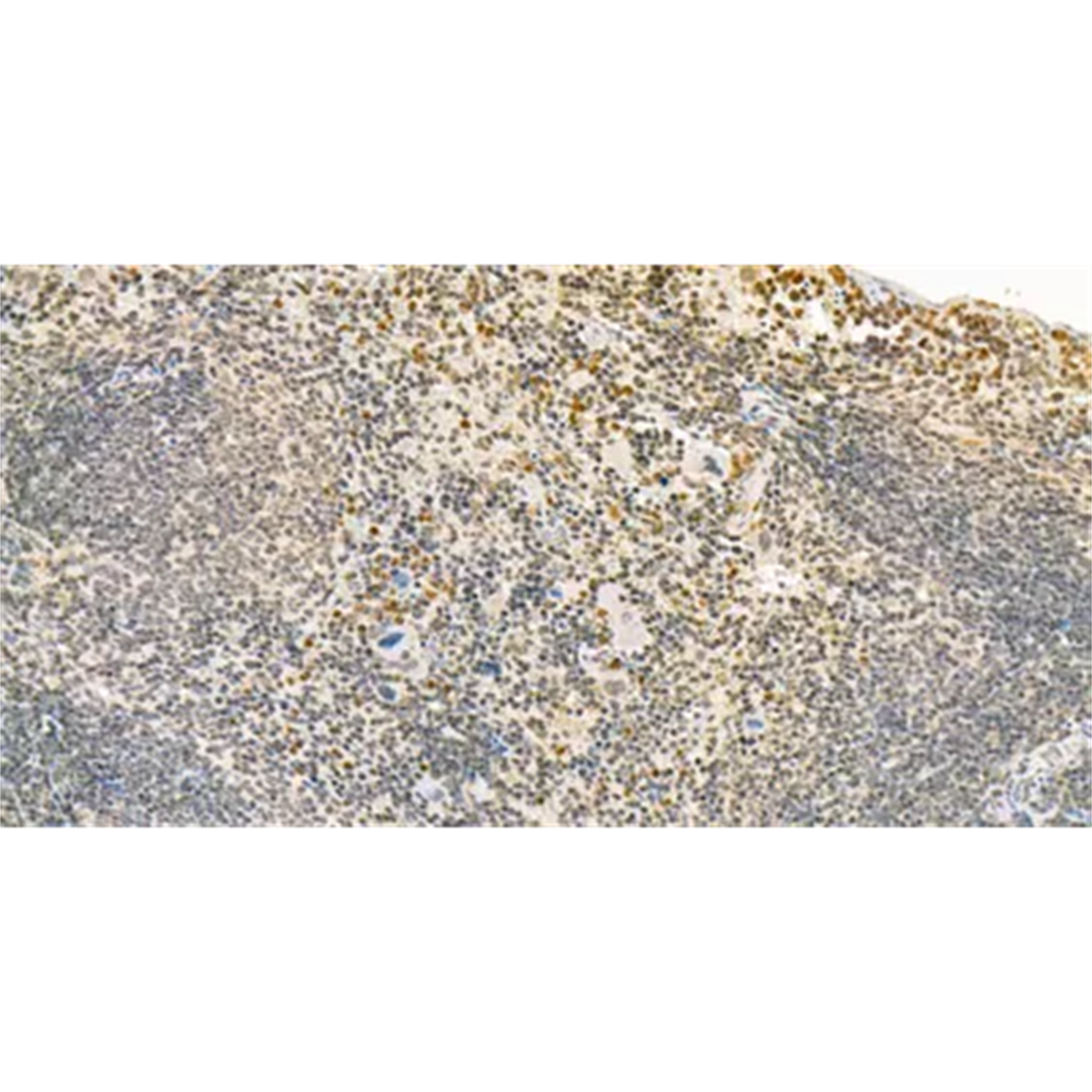
Immunohistochemistry analysis of paraffin-embedded mouse spleen using CIITA (GB112521) at dilution of 1: 2000 |
 |
Immunohistochemistry analysis of paraffin-embedded mouse thymus using CIITA (GB112521) at dilution of 1: 2000 |
Human Diseases
- Type II Bare Lymphocyte Syndrome: CIITA deficiency leads to a lack of MHC class II expression, resulting in severe immunodeficiency.
- Autoimmune Diseases: Aberrant CIITA expression has been linked to conditions like systemic lupus erythematosus (SLE).
- Cancer: Dysregulation of CIITA is associated with various cancers, affecting tumor immunogenicity and immune evasion.
- Viral Infections: CIITA plays a role in the immune response to viral infections, including HIV and Ebola.
Cellular Signaling Pathways
- MHC Class II Transcription Regulation: CIITA acts as a transcriptional coactivator for MHC class II genes, recruiting other transcription factors like RFX and NF-Y to form an enhanceosome.
- Interferon-Gamma Signaling: Induces CIITA expression, enhancing MHC class II gene transcription and antigen presentation in response to infections.
- Regulation of Cytokine Genes: CIITA also influences the transcription of various cytokines, including IL-4 and IL-10, impacting immune responses.
- Interaction with TFIID Complex: CIITA interacts with components of the TFIID complex to facilitate RNA polymerase II recruitment for MHC gene transcription.
Aliases for CIITA Gene
- GeneCards Symbol: CIITA 2
- Class II Major Histocompatibility Complex Transactivator 2 3 5
- MHC Class II Transactivator 2 3 4
- MHC2TA 3 4 5
- C2TA 2 3 5
- NLRA 2 3 5
- Nucleotide-Binding Oligomerization Domain, Leucine Rich Repeat And Acid Domain Containing 2 3
- NLR Family, Acid Domain Containing 2 3
- Class II, Major Histocompatibility Complex, Transactivator 2
- MHC Class II Transactivator Type III 3
- MHC Class II Transactivator Type I 3
- EC 2.7.11.1 4
- EC 2.3.1.- 4
- CIITAIV 3
References
- Accolla, Roberto S., et al. “CIITA-Driven MHC Class II Expressing Tumor Cells as Antigen Presenting Cell Performers: Toward the Construction of an Optimal Anti-Tumor Vaccine.” Frontiers, Frontiers, 17 July 2019, www.frontiersin.org/journals/immunology/articles/10.3389/fimmu.2019.01806/full.
- Singer, Dinah S., and Ballachanda N. Devaiah. “Ciita and Its Dual Roles in MHC Gene Transcription.” Frontiers, Frontiers, 7 Dec. 2013, www.frontiersin.org/journals/immunology/articles/10.3389/fimmu.2013.00476/full.
- Wong, Daniel, et al. “Genomic Mapping of the MHC Transactivator CIITA Using an Integrated Chip-Seq and Genetical Genomics Approach - Genome Biology.” BioMed Central, BioMed Central, 31 Oct. 2014, genomebiology.biomedcentral.com/articles/10.1186/s13059-014-0494-z.
- León Machado, Jorge Alfonso, and Viktor Steimle. “The MHC Class II Transactivator Ciita: Not (Quite) the Odd-One-out Anymore among NLR Proteins.” MDPI, Multidisciplinary Digital Publishing Institute, 22 Jan. 2021, www.mdpi.com/1422-0067/22/3/1074.