

- Home
- Antibody
- Antigen A
- Anti-Asymmetric Dimethylarginine of TLS/FUS (R216, R218), Human, Mouse-mono (100 ug)
Anti-Asymmetric Dimethylarginine of TLS/FUS (R216, R218), Human, Mouse-mono (100 ug)
Anti-Asymmetric Dimethylarginine of TLS/FUS (R216, R218), Human, Mouse-mono
General information
| Cat. No. | :FNK-FDV-0007 (100 ug) |
| Size | :100 ug or 20 ug (FDV-0006) |
| Antigen Species | :Human |
| Host Species | :Mouse |
| Clone No. | :2B12 |
| Specificity | :This antibody recognizes asymmetric dimethylarginine (R216, R218) of TLS/FUS. This antibody does not cross-reacts against symmetric dimethylarginine of TLS/FUS, and non-methylated TLS/FUS. |
| Immunogen | :Synthetic CGGRme2aGRme2aGGSG |
| Subclass | :IgG |
| Application | :WB(1:500 – 1:2000), IP |
| Purification | :Protein G Purified |
| Concentration | :0.5 mg/ml |
| Cross Reactivity | :Human, Mouse, Hamster (CHO cell) – Not yet tested in other species. |
| Lot Number | :See vial label |
| TLS | :Translocated in LipoSarcoma |
| FUS | :Fused in Sarcoma |
| Storage Buffer | :Phosphate buffered saline, pH7.2, no preservative added |
| Storage | :Store below -20℃. Avoid repeated freeze-thaw cycles. |
| Intended Use | :For Research Use Only. Not for diagnostic or other use. |
Antigen Characterization
| Type | :RNA-binding protein |
| Application | :Western Blot, Immunoprecipitation, Immunofluorescence, Flow Cytometry, RNA Immunoprecipitation, Immunohistochemistry, Co-Immunoprecipitation, Chromatin Immunoprecipitation, ELISA |
| Species | :Human, Mouse, Hamster |
| Recombinant | :Not Specified |
TLS/FUS (R216, R218) in the Cell
- Is a specific post-translational modification of TLS/FUS protein
- Involves asymmetric dimethylation of arginine residues at positions 216 and 218
- Carried out by protein arginine methyltransferases (PRMTs), particularly PRMT1
- Exact function not fully understood, but believed to:
- Regulate TLS/FUS protein interactions
- Influence protein localization
- Affect involvement in RNA metabolism processes (transcription, pre-mRNA splicing, mRNA transport)
- Potentially modify the protein's ability to bind RNA
- Possibly impact participation in various cellular complexes
TLS/FUS (R216, R218) in the Human Body
- Of particular interest in the context of neurodegenerative diseases, especially ALS
- TLS/FUS is a known causative gene for familial ALS
- Alterations in methylation patterns may contribute to ALS pathogenesis
- Specific role in healthy individuals still under research
- Likely involved in:
- Normal functioning of neurons
- Processes in other cells where TLS/FUS is expressed
- Understanding this modification could provide insights into:
- Normal cellular processes
- Mechanisms underlying neurodegenerative disorders
Aliases for TLS/FUS (R216, R218) Gene
- Fused in Sarcoma
- Translocated in Sarcoma
- 75 kDa DNA pairing protein
Description
This antibody recognizes asymmetric dimethylarginine (R216, R218) of TLS/FUS. It does not cross-reacts against symmetric dimethylarginine of TLS/FUS, and non -methylated TLS /FUS.
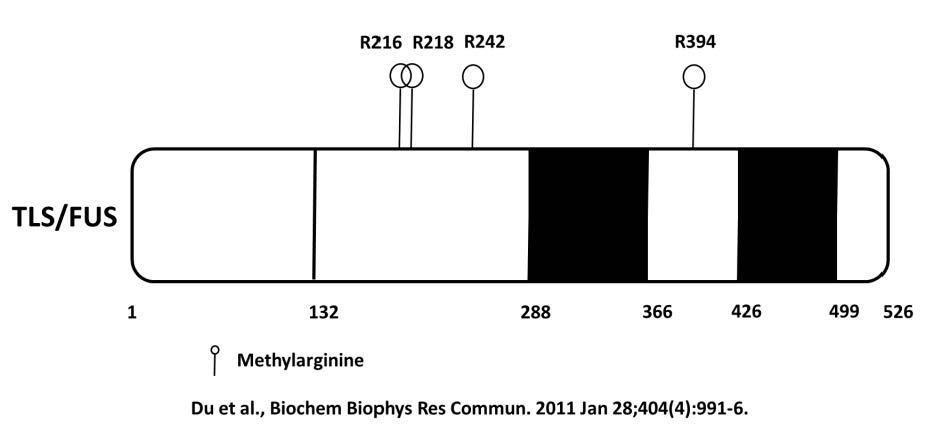
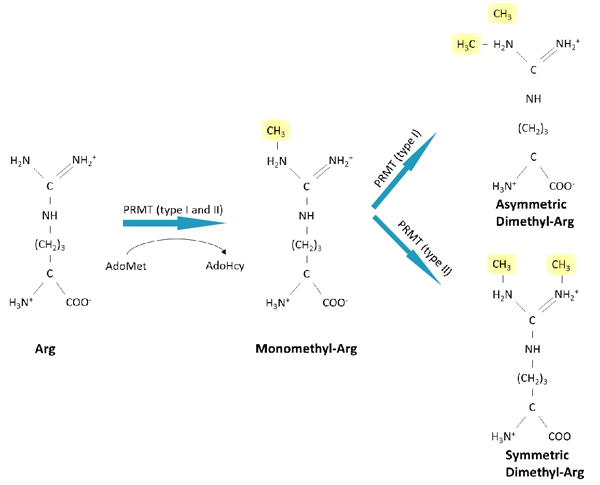
Arginine methylation is one posttranslational modification. Arginine can be methylated once (monomethylated arginine) or twice (dimethylated arginine). Dimethylation can be further categorized as symmetric (me2s) or asymmetric (me2a). TLS/FUS (Translocated in LipoSarcoma/Fused in Sarcoma) is known as one of the causative genes for familial amyotrophic lateral sclerosis. Specifically, it is reported that four arginine residues in TLS/FUS (R216, R218, R242, and R394) are constitutively dimethylated by protein arginine methyltransferases. However, the function of methylated TLS/FUS is still unclear.
Application
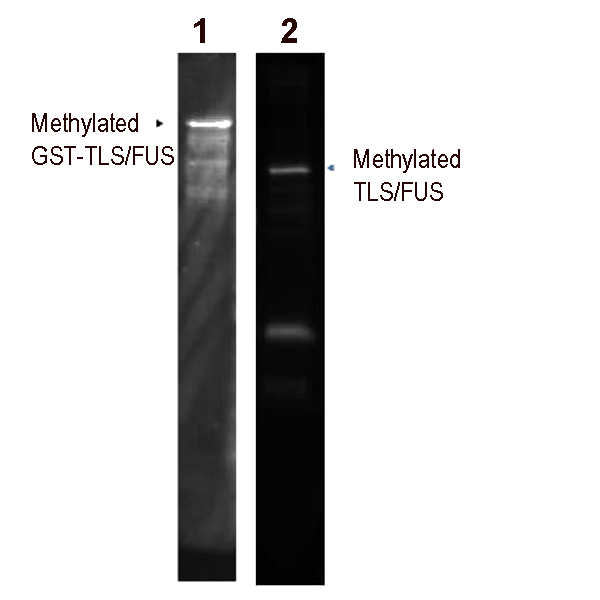 |
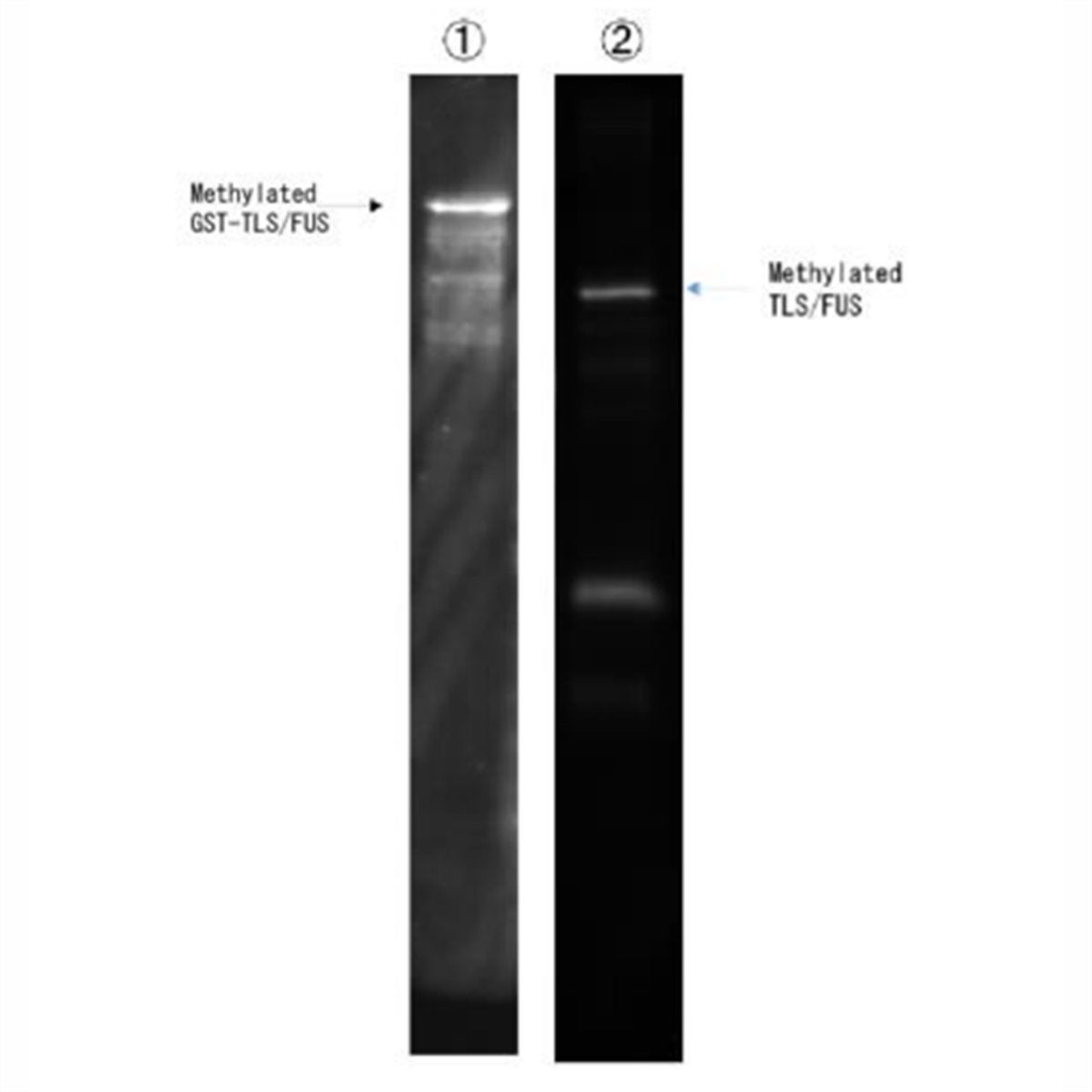
Lane1 Recombinant GST-TLS/FUS methylated using PRMT1 in the presence of SAM (20 µM) in vitro. Lane2 Cell extract from CHO cells immunoprecipitated with rabbit polyclonal anti-TLS/FUS antibody (Bethyl Laboratories, #A300-302A). ※It is hard to detect the specific band for methylated TLS/FUS with crude lysate sample. We recommend to do immunoprecipitation using polyclonal anti-TLS/FUS antibody prior to WB. |
Arginine methylation of TLS/FUS
Type of arginine methylation
Reference
- Jun M, et al. Sequestration of PRMT1 and Nd1-L mRNA into ALS-linked FUS mutant R521C-positive aggregates contributes to neurite degeneration upon oxidative stress. Sci Rep. (2017) 7: 40474.
- Xiong, Dian et al. “Elevated FUS/TLS expression is negatively associated with E-cadherin expression and prognosis of patients with non-small cell lung cancer.” Oncology letters vol. 16,2 (2018): 1791-1800. doi:10.3892/ol.2018.8816
- Kino, Y., Washizu, C., Kurosawa, M. et al. FUS/TLS acts as an aggregation-dependent modifier of polyglutamine disease model mice. Sci Rep 6, 35236 (2016). https://doi.org/10.1038/srep35236
- Tan, Adelene Y, and James L Manley. “TLS/FUS: a protein in cancer and ALS.” Cell cycle (Georgetown, Tex.) vol. 11,18 (2012): 3349-50. doi:10.4161/cc.21875
- Kino, Y., Washizu, C., Kurosawa, M. et al. FUS/TLS deficiency causes behavioral and pathological abnormalities distinct from amyotrophic lateral sclerosis. acta neuropathol commun 3, 24 (2015). https://doi.org/10.1186/s40478-015-0202-6
- Ward, C., Boggio, K., Johnson, B. et al. A loss of FUS/TLS function leads to impaired cellular proliferation. Cell Death Dis 5, e1572 (2014). https://doi.org/10.1038/cddis.2014.508
- “FUS.” FUS - an Overview | ScienceDirect Topics, www.sciencedirect.com/topics/agricultural-and-biological-sciences/fus.
