

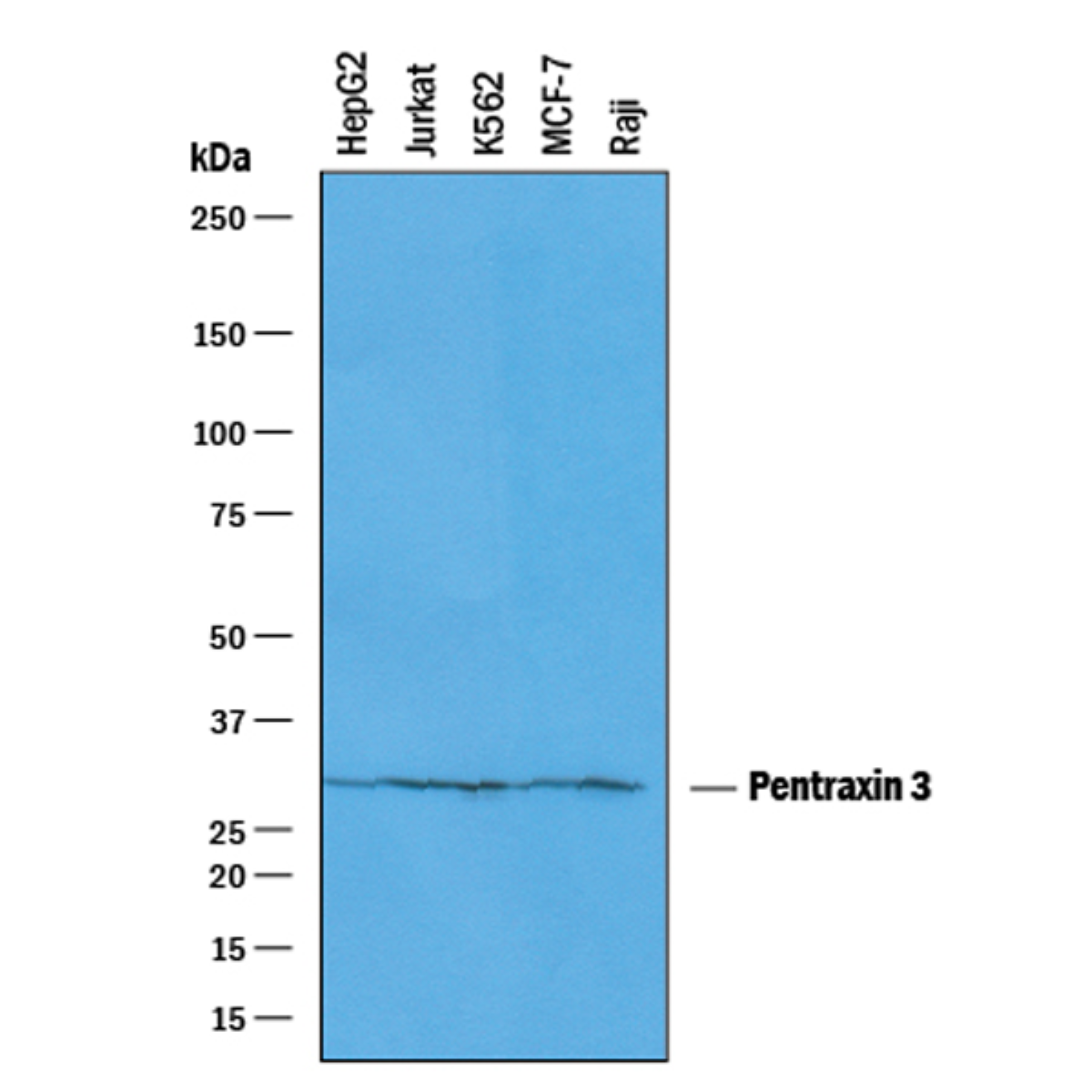
Anti Human PTX3 mouse monoclonal antibody (PPJ0069)
Anti Human PTX3 mouse monoclonal antibody (PPJ0069)
DiagnoCine offers excellent TSG-14 | PTX3 | Pentaxin3 antibody for researchers studying inflammatory cytokines in response to inflammatory stimuli in several mesenchymal and epithelial cells, endothelial cells, and mononuclear phagocytes; fibrocyte differentiation and is involved in regulating inflammation and complement activation; regulation of innate resistance to pathogens, inflammatory reactions, and clearance of self-components and female fertility; association with virion binding and (1->3)-beta-D-glucan binding.
Human diseases include Infectious Myocarditis, Takayasu Arteritis, Innate Immune System, and Lung fibrosis.
TSG-14 | PTX3 | Pentaxin3 antibody has excellent quality and this highly pure antibody can be adapted for Western Blots, ELISA, Immunohistochemistry, Immunofluorescence research with optimization.
General information
| Cat. No. | :FNK-PP-PPJ0069-00 |
| Size | :100 ul |
| Antigen Species | :Human |
| Host Species | :Mouse |
| Cross Reactivity | :Human |
| Purification | :Ammonium sulfate fractionation |
| Clone No | :PPJ0069 |
| Concentration | :1 mg/mL |
| Ig Class | :G2a |
| Application | :ELISA (0.3 ug/mL), Western Blot (1 ug/mL) |
| Specificity |
:This antibody specifically recognizes human PTX3. Not yet tested in other species.
|
| Storage | :Store at 2 - 8 ºC up to one month. For long-term storage, the solution may be frozen in working aliquots. Repeated freezing and thawing is not recommended. Storage in a frost-free freezer is not recommended. |
| Form | :Physiological saline with 0.1% NaN3 as a preservative |
| Genbank | :BC039733 |
Origin
Produced in BALB/c mouse ascites after inoculation with hybridoma of mouse myeloma cells (NS-1) and spleen cells derived from a mouse immunized with recombinant human PTX3 (18-381 aa).
Pentraxins are a superfamily of conserved proteins characterized by the pentraxin domain. CRP and SAP are recognized as classical short pentraxins, whereas Pentraxin3(PTX3) belongs to the long pentraxins. CRP and SAP are induced in the liver in response to IL-6. In contrast, PTX3 is produced by a variety of tissues and cells, such as vascular endothelial cells, macrophages, and neutrophils, predominantly in response to proinflammatory signals (bacterial products, IL-1, and TNF).
Aliases for PTX3 Gene
- Pentraxin 3 2 3 5
- TSG-14 2 3 4
- Tumor Necrosis Factor-Inducible Gene 14 Protein 3 4
- Tumor Necrosis Factor Alpha-Induced Protein 5 3 4
- Pentraxin-Related Protein PTX3 3 4
- TNF Alpha-Induced Protein 5 3 4
- Long Pentraxin 3 2 3
- TNFAIP5 3 4
- Pentraxin-Related Gene, Rapidly Induced By IL-1 Beta 2
- Pentaxin-Related Gene, Rapidly Induced By IL-1 Beta 2
- Tumor Necrosis Factor, Alpha-Induced Protein 5 2
- Tumor Necrosis Factor-Inducible Protein TSG-14 3
- Pentaxin-Related Protein PTX3 4
- Pentraxin 3, Long 2
- TSG14 4
- PTX3 5
