


2% Paraformaldehyde with 2% Glutaraldehyde
FluxMPS™ 2% Paraformaldehyde with 2% Glutaraldehyde
An MPS-grade dual-aldehyde fixative combining 2% paraformaldehyde and 2% glutaraldehyde in 0.1 M phosphate buffer at pH 7.4, formulated for superior ultrastructural preservation in electron microscopy, immunohistochemistry, and organ-on-a-chip specimen workflows. Quadruple-stage 0.1 µm and 0.04 µm membrane filtration delivers mycoplasma-safe, ultra-clean fixation for the most demanding cell and molecular biology experiments.
- Quadruple-stage filtration: 0.1-micron membrane twice and 0.04-micron membrane twice for mycoplasma-safe, ultra-clean fixation
- Dual-aldehyde formulation: 2% paraformaldehyde and 2% glutaraldehyde in 0.1 M phosphate buffer, pH 7.4
- Ultrapure Type 1 water (18.2 MΩ·cm) base formulation
- Sterile, filter-processed via sequential 0.1 µm and 0.04 µm membranes
- Manufactured under ISO 13485-certified, CE-approved facilities
- No detectable DNase or RNase activity after 18-hour incubation at room temperature
- Microchannel-safe purity suited for electron microscopy, IHC, and organ-on-chip specimen fixation
- Custom concentrations, pH, and additive formulations available on request
- pH7.4
- Formulation2% PFA / 2% Glutaraldehyde
- Buffer System0.1 M Phosphate Buffer
- Filtration0.1 µm x2, 0.04 µm x2
- SterilityFilter-sterilized, quadruple-stage
- DNase ActivityNone detected
- RNase ActivityNone detected
- Storage4°C, protected from light
- Shelf Life12 months
- ShippingTypically within 48 hours
Engineered where standard fixatives fail
Conventional 0.22 µm-filtered fixatives can carry subvisible particulates, uneven aldehyde cross-linking, and mycoplasma-scale bioburden into sensitive electron microscopy and organ-on-a-chip workflows. FluxMPS™ dual-aldehyde fixative is engineered to eliminate these failure modes with a controlled, quadruple-stage filtration process and a precisely buffered pH 7.4 formulation.
Microchannel-safe purity
Sequential 0.1 µm and 0.04 µm membrane passes minimize particulate carry-over for microfluidic and electron microscopy applications.
Precise, stable pH
Buffered at pH 7.4 in 0.1 M phosphate buffer for consistent, reproducible fixation across experiments.
Ultrapure-grade water
Formulated with Ultrapure Type 1 water (18.2 MΩ·cm) as the base for consistent reagent performance.
Preserves antigenic sites
Rapid paraformaldehyde penetration combined with glutaraldehyde cross-linking preserves both ultrastructure and antigenicity for imaging and IHC.
Defined, traceable composition
Fixed 2% paraformaldehyde / 2% glutaraldehyde ratio in 0.1 M phosphate buffer, verified by lot-level quality control.
Customization on demand
Alternate concentrations, pH, or added chemicals/compounds/proteins/supplements available on inquiry.
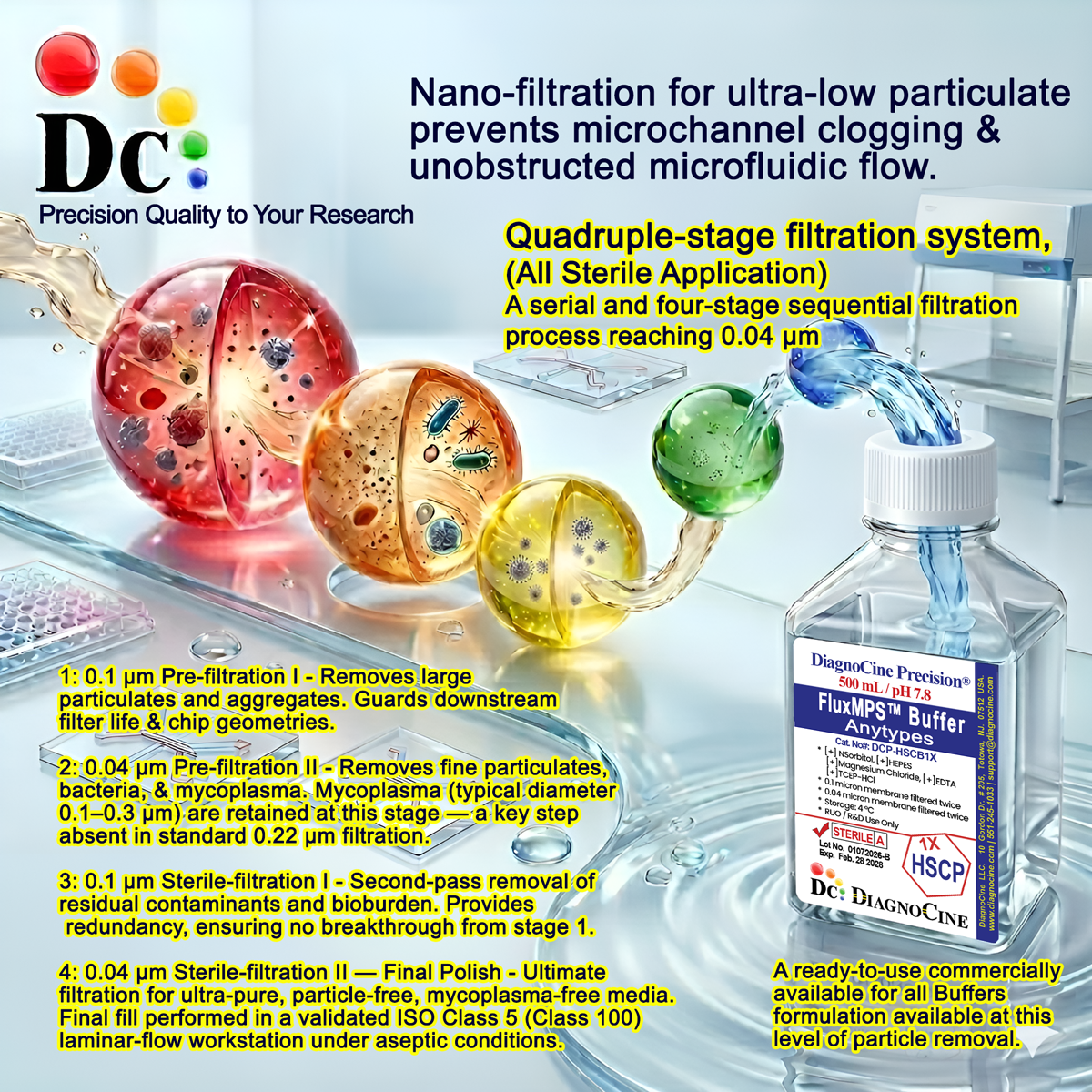
Quadruple-stage filtration system
This fixative is sterile-filtered through a 0.1-micron membrane twice and a 0.04-micron membrane twice, a quadruple-stage process designed to minimize particulate load and prevent mycoplasma contamination before final fill.
-
1
0.1 µm Pre-filtration I
Removes large particulates and aggregates from the fixative solution, extending the life of downstream filters.
-
2
0.04 µm Pre-filtration II
Retains fine particulates and bioburden, including organisms in the mycoplasma size range (as small as approximately 0.2 micron).
-
3
0.1 µm Sterile-filtration I
Second-pass redundancy through the 0.1-micron membrane for additional assurance of clarity and sterility.
-
4
0.04 µm Sterile-filtration II — Final Polish
Final 0.04-micron pass delivers the ultimate polish prior to fill, preventing mycoplasma contamination.
Performance vs. conventional fixative
Sequential dual-pass 0.1 µm and dual-pass 0.04 µm membrane filtration removes finer particulates than a single conventional 0.22 µm pass, supporting mycoplasma-safe processing for sensitive microscopy and cell-based applications.
© Diagnocine® — DCP-PFAGA2X
Where dual-aldehyde fixation performs
This dual-aldehyde fixative combines rapid paraformaldehyde penetration with durable glutaraldehyde cross-linking, supporting electron microscopy, immunohistochemistry, and perfusion or immersion fixation across a broad range of specimens.
Automated Bioreactors & Robotics
For automated perfusion and robotic liquid-handling platforms, an optional 0.01 µm (10 nm) ultra-filtered variant of this fixative can be requested to further reduce particulate load in valves and sensors.
- Total Particulate Exclusion for automated dispensing lines
- Valve & Sensor Protection in closed perfusion systems
- Extended Perfusion Stability for long-duration fixation protocols
Inquiry Required: the 0.01 µm ultra-filtered grade is available upon request — contact support@diagnocine.com.
Organ-on-a-Chip & MPS Specimen Fixation
Preserves fine ultrastructural detail suitable for downstream electron microscopy of organ-on-a-chip and microphysiological system specimens.
Electron Microscopy Specimen Preparation
Suitable for both perfusion and immersion fixation; specimens for immersion fixation should be no larger than 1 mm3 to ensure complete penetration.
iPSC-Derived Model Ultrastructure Preservation
Dual-aldehyde cross-linking preserves subcellular structure with minimal extraction, suited to iPSC-derived model handling.
Endothelial & Primary Cell Perfusion Fixation
Supports perfusion fixation of endothelial and primary cell cultures, delivering thorough cross-linking with minimal extraction.
Immunohistochemistry & Antigen Preservation
Preserves antigenic sites while maintaining structural integrity for immunohistochemistry studies requiring structural preservation.
Microorganism, Plant & Mammalian Specimen Stabilization
Stabilizes bacteria and other microorganisms, plant material, mammalian cells and tissues, and delicate tissue structures requiring optimal preservation.
Measured & declared parameters
Specification values below are as measured or declared for this lot-released dual-aldehyde fixative.
| Parameter | Specification |
|---|---|
| Formulation / Composition | 2% Paraformaldehyde, 2% Glutaraldehyde in 0.1 M Phosphate Buffer |
| Appearance | Clear solution |
| pH (USP <791>) | 7.4 |
| Buffer Molarity | 0.1 M Phosphate Buffer |
| Parameter | Specification |
|---|---|
| Sterility USP <71> | Filtered 0.1-micron membrane twice and 0.04-micron membrane twice |
| DNase Activity | None detected after 18-hour incubation with plasmid DNA at room temperature |
| RNase Activity | None detected after 18-hour incubation with ribosomal RNA at room temperature |
| Manufacturing Standard ISO 13485 | ISO 13485-certified, CE-approved facilities |
| Parameter | Specification |
|---|---|
| Storage Temperature | 4°C, away from bright light (amber) |
| Shelf Life | 12 months |
| Shipping Condition | Typically ships within 48 hours; may take up to 1 week during unforeseen events |
| Post-Fixation Storage | Fixed specimens may be stored at 4°C for up to one week before subsequent processing |
| Parameter | Specification |
|---|---|
| Manufacturing QMS | ISO 13485-certified facilities |
| Regulatory Alignment | CE-approved facilities |
| Production & QA Location | Final packaging, quality assurance, and testing performed at the DiagnoCine R&D and Quality Testing Center; customization completed at DiagnoCine Precision, Totowa, New Jersey, USA |
| Intended Use | For Research Use Only (RUO) |
Full composition
Dual-aldehyde composition buffered in phosphate buffer, released per lot.
| Component | CAS Number | Concentration |
|---|---|---|
| Paraformaldehyde (PFA) | 30525-89-4 | 2% |
| Glutaraldehyde | 111-30-8 | 2% |
| Phosphate Buffer | 0.1 M |
Manufacturing & compliance
Manufactured, packaged, and tested under a controlled quality system with full customization traceability.
ISO 13485:2016 QMS
Manufactured under ISO 13485-certified, CE-approved supplier facilities.
Ultrapure Type 1 Water
Formulated with Ultrapure Type 1 water (18.2 MΩ·cm).
Quadruple-Stage Filtration
Filter-sterilized with 0.1-micron filtration twice and 0.04-micron filtration twice to prevent mycoplasma contamination.
Micro-Batch Precision
Final packaging, QA, and testing performed at the DiagnoCine R&D and Quality Testing Center; customization at Totowa, New Jersey, USA.
DNase Activity
None detected after 18-hour incubation of plasmid DNA at room temperature.
RNase Activity
No RNase activity detected after 18-hour incubation of ribosomal RNA at room temperature.
Sterility
Filtered 0.1-micron membrane twice and 0.04-micron membrane twice.
Documentation / CoA
Certificate of Analysis available for this lot upon request.
How DCP-PFAGA2X compares
A qualitative comparison of the dual-aldehyde FluxMPS™ fixative against conventional single-pass filtered fixatives.
| Parameter | DCP-PFAGA2X (FluxMPS™) | Conventional fixative (0.22 µm filtered) | Standard alternative (0.22 µm filtered) |
|---|---|---|---|
| Dual-aldehyde formulation (2% PFA + 2% GA) | check_circle | cancel | cancel |
| Final filtration pore size | 0.04 µm | 0.22 µm | 0.22 µm |
| Number of filtration stages | 4 | 1 | 1 |
| Mycoplasma-safe filtration | check_circle | cancel | cancel |
| DNase / RNase tested | check_circle | cancel | cancel |
| ISO 13485-certified manufacturing | check_circle | check_circle | cancel |
| Microfluidic / OoC compatibility | check_circle | cancel | cancel |
| Custom formulation available | check_circle | cancel | cancel |
Frequently asked questions
Common questions about DCP-PFAGA2X dual-aldehyde fixative.
Supporting literature
Curated literature relevant to dual-aldehyde fixation, ultrastructural preservation, and microfluidic/organ-on-a-chip specimen handling.
- Karnovsky MJ. A formaldehyde-glutaraldehyde fixative of high osmolality for use in electron microscopy. J Cell Biol. 1965. doi:10.1083/jcb.27.2.137a
- Hopwood D. Fixatives and fixation: a review. Histochem J. 1969. doi:10.1007/BF01003278
- Kiernan JA. Formaldehyde, formalin, paraformaldehyde and glutaraldehyde: what they are and what they do. Microsc Today. 2000. doi:10.1017/S1551929500057060
- Bahnson AB. Wieder ED. Aldehyde fixation of tissues for electron microscopy: mechanisms and applications. Methods Cell Biol. 1998.
- Huh D. Torisawa YS. Hamilton GA. Kim HJ. Ingber DE. Microengineered physiological biomimicry: organs-on-chips. Lab Chip. 2012. doi:10.1039/C2LC40089H
- Bhatia SN, Ingber DE. Microfluidic organs-on-chips. Nat Biotechnol. 2014. doi:10.1038/nbt.2989
- Fried J, Perez AG, Klein BB. Fixation and organ-on-chip preservation methods for ultrastructural analysis. Front Bioeng Biotechnol. 2020. doi:10.3389/fbioe.2020.00500
- Rasmussen KE, Albrechtsen J. Glutaraldehyde: the influence of pH, temperature, and buffering on the polymerization rate. Histochemistry. 1974. doi:10.1007/BF00494564
- Razin S, Yogev D, Naot Y. Molecular biology and pathogenicity of mycoplasmas. Microbiol Mol Biol Rev. 1998. doi:10.1128/MMBR.62.4.1094-1156.1998
- Melan MA. Overview of cell fixatives and cell membrane permeants used for immunohistochemistry. Methods Mol Biol. 1999. doi:10.1385/0-89603-576-9:55